
blog

How CLEAR, CMS, and Industry Leaders are Building a Connected, Identity-First Healthcare System

December 16, 2025

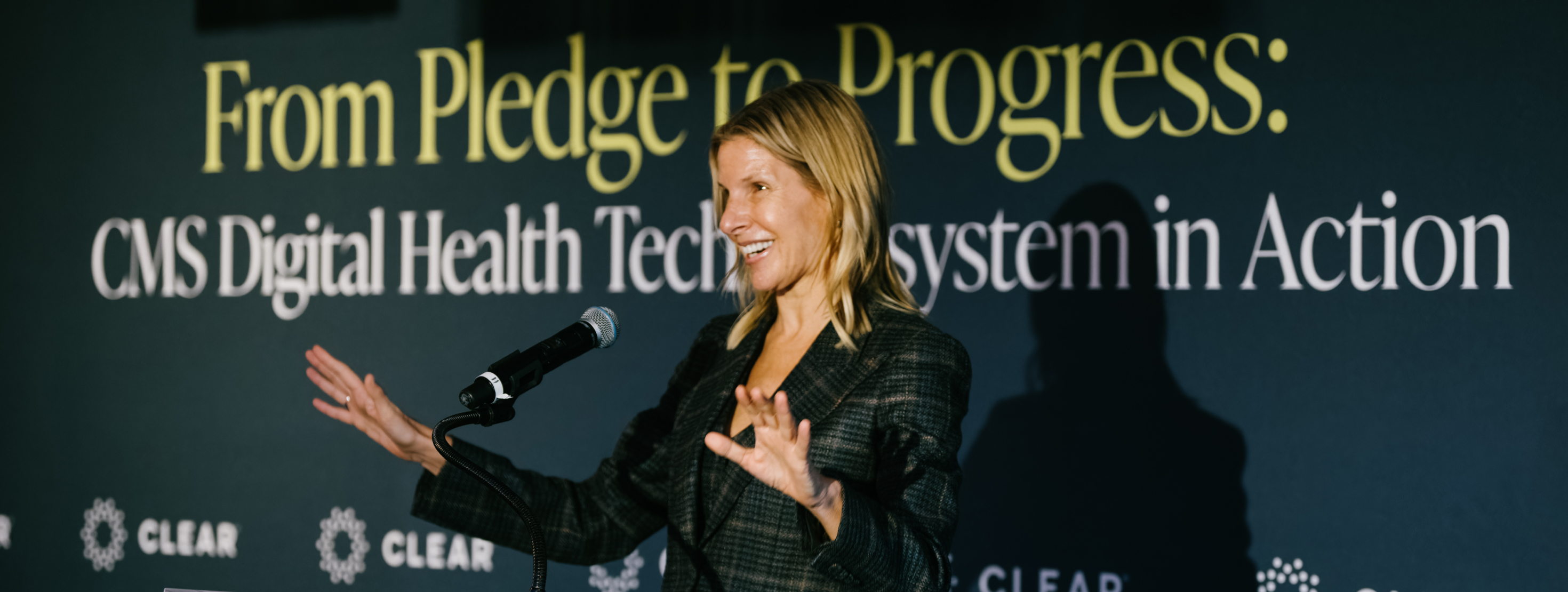
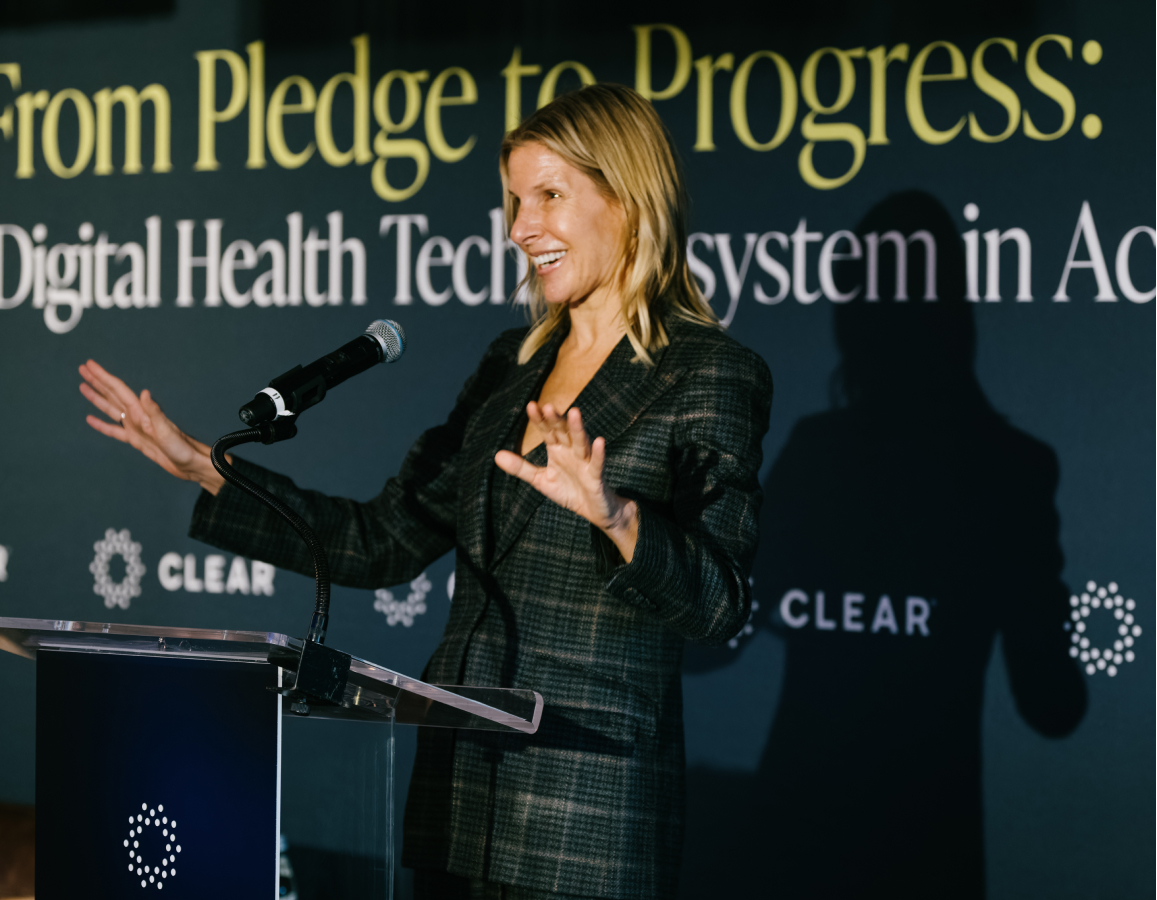
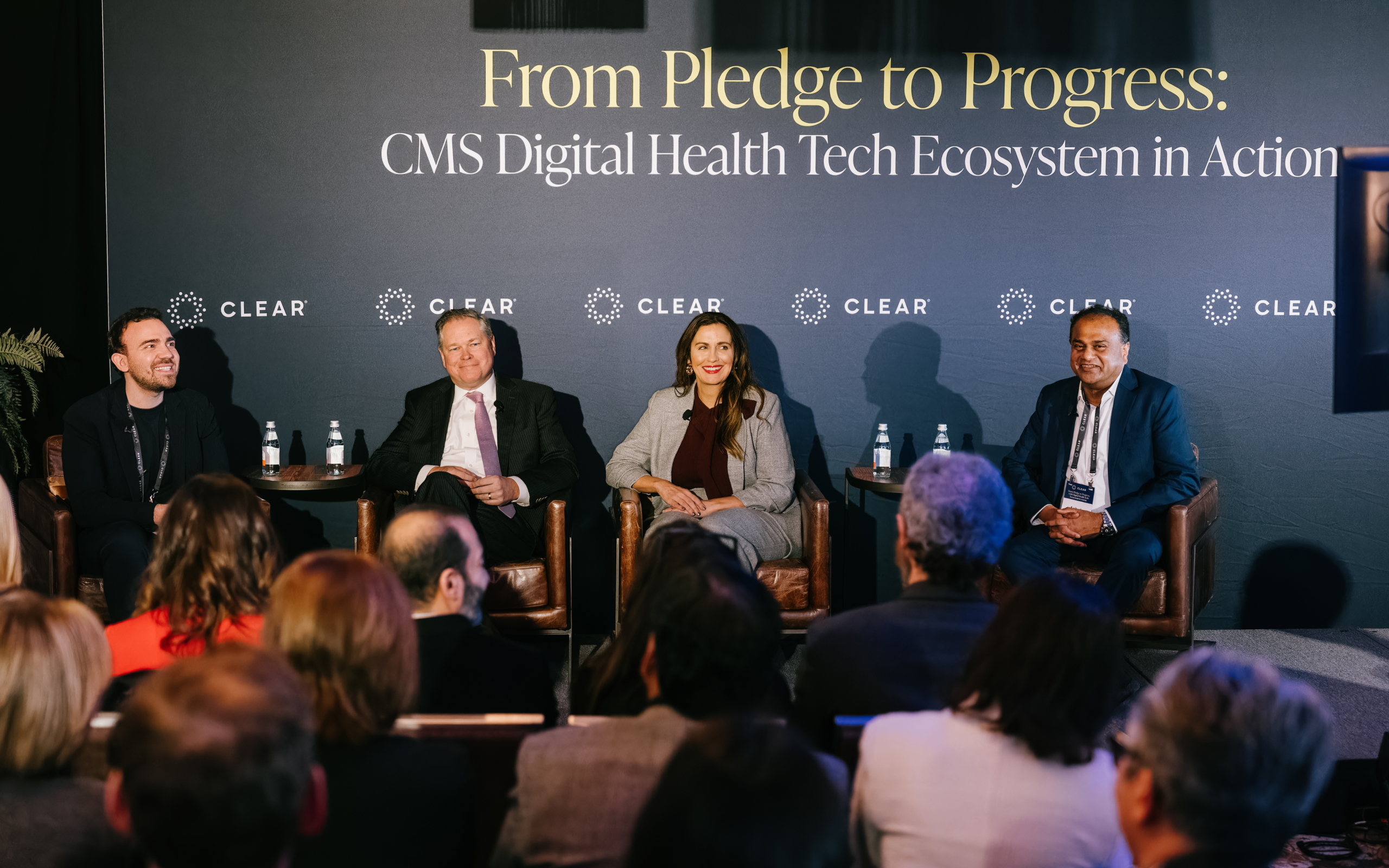
On December 9th in Washington, D.C., CLEAR hosted an event that was more than just a healthcare gathering: it was a day of genuine collaboration. Leaders from every corner of the ecosystem—health systems, payers, government, technology companies, innovators, and even direct competitors amongst them all—came together in the same room to advance a shared vision. What united the group was a simple, yet proud belief that the path to better care begins with trusted identity.


Back in July, more than 60 organizations voluntarily aligned with CMS around a shared mission to make patient data flow easily and safely across the healthcare ecosystem. And last week, at From Pledge to Progress: CMS Digital Health Tech Ecosystem in Action, that pledge came fully to life with leaders bringing forward proof points, prototypes, statewide activations, personal stories, policy clarity, and aligned implementation plans. 

The Human Cost of Friction

To open the day, Former U.S. CTO Aneesh Chopra reminded us why this moment matters so much. For too long, “interoperability” has lived as a buzzword—something discussed, but not necessarily delivered. The CMS Health Tech Ecosystem is changing that by aligning government and industry behind shared standards and shared infrastructure, as well as a clear call to action. 

In her opening remarks, CLEAR CEO Caryn Seidman Becker grounded that urgency in the sentiment that transforming healthcare isn’t just a technical problem to solve—it gets at something deeply human. Caryn shared moments from navigating her late husband Marc’s care, which required her to pick up CD-ROMs of medical images, manually digitize them to send across the country and internationally, and log into multiple portals during moments that were already filled with fear and urgency. 

“It’s hard enough to navigate illness,” she said. “It shouldn’t be this hard to navigate the healthcare system too.”

Throughout the event, this sentiment—that friction is not just an inconvenience, but a barrier to care—echoed. And at the center of this friction is identity. Patients verify themselves over and over, filling out the same forms and re-entering information that should already be accessible. Providers face their own hurdles, often locked out of systems or forced through cumbersome processes to access essential clinical information. Until we get identity right, data won’t move the way patients, clinicians, and innovators need it to. 

CLEAR and CMS: The National Path Forward 

That’s why CMS’s announcement that it contracted with CLEAR to modernize identity verification on Medicare.gov resonated so strongly across the room. This integration represents a concrete national step toward a trusted, reusable identity for both patients and providers—one that can reduce friction, strengthen trust, and enable secure, seamless access to care.

As Amy Gleason, Administrator at the U.S. Digital Operations & Government Experience (DOGE) Service and Strategic Advisor to CMS, put it: “We have to kill the clipboard and build a system that honors people’s time, dignity, and safety.” CLEAR is proud to work alongside CMS to help bring that future to life.
Innovation and Transformation in Rural Health (Session 1)

The first session of the day, moderated by CLEAR’s GM & Head of Healthcare, David Bardan, spotlighted what progress looks like when states, health systems, and technology partners work in lockstep.

With $50 billion in federal support through CMS’s Rural Health Transformation (RHT) program, states have a historic opportunity to modernize their digital infrastructure. Louisiana has already shown what that future can look like: a few months ago, it became the first state in the nation to launch MyChart Central statewide, giving 2.5 million patients one secure login and one unified record across every Epic-connected system in the state.

Representatives from Epic, Ochsner, and Elevance Health described what it took to make this a reality:

  • “At the end of the day, it’s about what’s best for patients. When someone goes to another facility, the experience shouldn’t depend on who owns the building.” - Amy Trainor, SVP & Chief Information Officer, Ochsner Health
  • “Identity, matching, and consent are the backbone of this work.” - Ladd Wiley, Head of Public Policy, Epic
  • “A connected care ecosystem works only when every player participates. Shared accountability is what excites me.” - Ashok Chennuru, Chief Data & Digital Transformation Officer, Elevance

Louisiana now stands as a blueprint for what we’re capable of at a federal level, showcasing how identity-first interoperability can improve access, care continuity, and operational efficiency. 

Connecting Patients Through a Trusted Digital App Ecosystem (Session 2)

The next conversation, led by Ryan Howells of Leavitt Partners, shifted the focus from statewide infrastructure to the expanding universe of patient-facing digital health tools. Executives from Oracle, HHS, Sharecare, and Intermountain all agreed that a digital app ecosystem cannot scale unless the ecosystem converges.

To unlock a truly connected experience for patients, the industry must either adopt common identity and data standards so any app can reliably plug into the ecosystem, or converge around trusted applications that consistently deliver seamless, secure, identity-first interactions. In either model, the foundation is the same: trusted identity. None of this works unless we can verify, with confidence, that the right person is accessing the right information at the right time.

CMS Aligned Network Workgroup Demos (Session 3)

The demos brought the ecosystem described in the previous session to life. Leaders from across the CMS Health Tech Ecosystem showcased real examples of how aligned networks can reduce friction, “kill the clipboard,” and create a smoother care journey for patients and providers alike. Organizations including b.well, Welldoc, Sharecare, Docusign, and HealthEx demonstrated how their solutions are helping to enable a more connected, patient-centered experience. Taken together, these demos offered a tangible reflection of how the CMS Digital Health Tech Ecosystem is already moving from policy to practice.

Putting the Consumer at the Center (Session 4)

The afternoon panel, moderated by Aneesh Chopra, featured leaders from Wellstar, Hackensack Meridian Health, and Mount Sinai—three organizations that are either actively using CLEAR1 today or preparing to roll it out across their systems. Their conversation gave real-world examples of how everything begins to flow when patient identity becomes trusted, reusable, and embedded across touchpoints. 

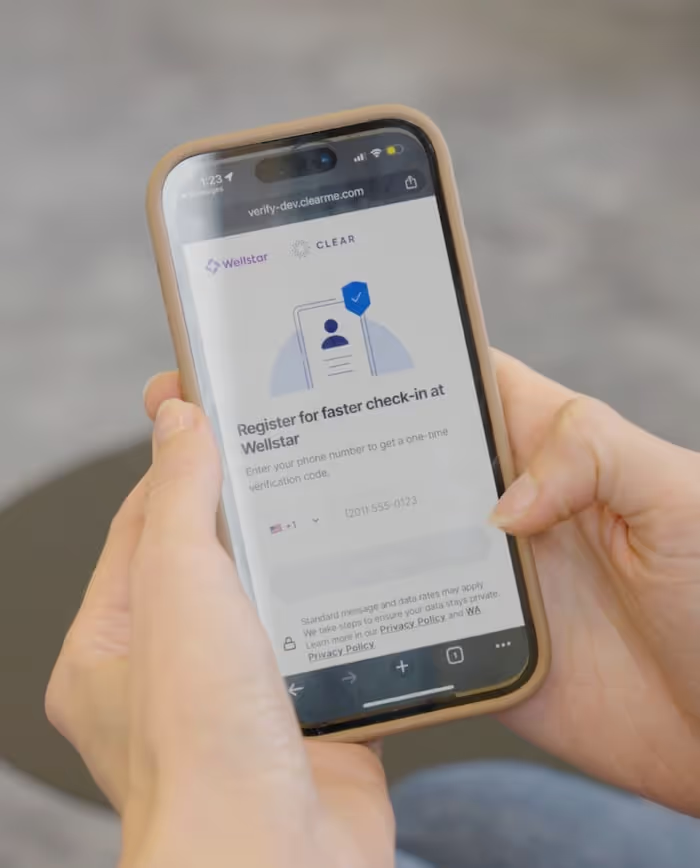
  • At Wellstar, CLEAR1 is already transforming the check-in experience across multiple care sites—enabling patients to verify their identity with a quick selfie, reducing manual lookups, improving match rates, and redirecting thousands of staff hours toward higher-value care. 
  • Hackensack Meridian Health is now also starting to implement CLEAR1 to streamline MyChart account creation and recovery, as well as to power appointment check-in –– removing friction from the first moments of a patient’s digital journey ensuring trust is established from the start.
  • Mount Sinai Health System plans on implementing CLEAR1 across both their workforce and patient population to strengthen cybersecurity and simplify provider access, while laying the foundation for seamless digital experiences for millions of New Yorkers.

Fireside Chat: Caryn Seidman Becker & Dr. Mehmet Oz

The day culminated in a conversation between CLEAR CEO Caryn Seidman Becker and CMS Administrator Dr. Mehmet Oz.

Caryn returned to the emotional core of the day: that the healthcare system must not add hardship to moments already heavy with uncertainty and vulnerability; and Dr. Oz continued to thread the needle on why identity modernization is central to CMS’s strategy by: 

  • Enabling telehealth, AI diagnostics, and modern digital workflows
  • Protecting against fraud
  • Lightening the administrative burden on providers
  • Giving patients control over their information

Together, Caryn and Dr. Oz painted a future where trusted identity unlocks the deeper promise of interoperability for better preventative care, more personalized insights, smarter routing, faster answers, fewer barriers, and ultimately, more time for what matters.  

From Pledge to Progress—and now to Practice

As CMS moves toward a more connected, patient-centered future, CLEAR is proud to support this work with the trusted, reusable identity infrastructure it has spent more than 15 years building through public–private partnerships in highly regulated environments. CLEAR1’s multi-layered approach meets the realities of today’s identity threats and simplifies access for both patients and providers—and its upcoming integration with Medicare.gov will help advance CMS’s goal of “killing the clipboard” and strengthening a nationwide identity layer. 

December 9th made clear that this connected ecosystem is no longer aspirational; it is operational, collaborative, and moving with purpose. CLEAR is honored to stand alongside CMS, health systems, technology partners, payers, and policymakers as we work together to build a healthcare experience designed for people, not paperwork.

Learn more about CLEAR1 in healthcare: identity.clearme.com/healthcare 

On December 9th in Washington, D.C., CLEAR hosted an event that was more than just a healthcare gathering: it was a day of genuine collaboration. Leaders from every corner of the ecosystem—health systems, payers, government, technology companies, innovators, and even direct competitors amongst them all—came together in the same room to advance a shared vision. What united the group was a simple, yet proud belief that the path to better care begins with trusted identity.


Back in July, more than 60 organizations voluntarily aligned with CMS around a shared mission to make patient data flow easily and safely across the healthcare ecosystem. And last week, at From Pledge to Progress: CMS Digital Health Tech Ecosystem in Action, that pledge came fully to life with leaders bringing forward proof points, prototypes, statewide activations, personal stories, policy clarity, and aligned implementation plans. 

The Human Cost of Friction

To open the day, Former U.S. CTO Aneesh Chopra reminded us why this moment matters so much. For too long, “interoperability” has lived as a buzzword—something discussed, but not necessarily delivered. The CMS Health Tech Ecosystem is changing that by aligning government and industry behind shared standards and shared infrastructure, as well as a clear call to action. 

In her opening remarks, CLEAR CEO Caryn Seidman Becker grounded that urgency in the sentiment that transforming healthcare isn’t just a technical problem to solve—it gets at something deeply human. Caryn shared moments from navigating her late husband Marc’s care, which required her to pick up CD-ROMs of medical images, manually digitize them to send across the country and internationally, and log into multiple portals during moments that were already filled with fear and urgency. 

“It’s hard enough to navigate illness,” she said. “It shouldn’t be this hard to navigate the healthcare system too.”

Throughout the event, this sentiment—that friction is not just an inconvenience, but a barrier to care—echoed. And at the center of this friction is identity. Patients verify themselves over and over, filling out the same forms and re-entering information that should already be accessible. Providers face their own hurdles, often locked out of systems or forced through cumbersome processes to access essential clinical information. Until we get identity right, data won’t move the way patients, clinicians, and innovators need it to. 

CLEAR and CMS: The National Path Forward 

That’s why CMS’s announcement that it contracted with CLEAR to modernize identity verification on Medicare.gov resonated so strongly across the room. This integration represents a concrete national step toward a trusted, reusable identity for both patients and providers—one that can reduce friction, strengthen trust, and enable secure, seamless access to care.

As Amy Gleason, Administrator at the U.S. Digital Operations & Government Experience (DOGE) Service and Strategic Advisor to CMS, put it: “We have to kill the clipboard and build a system that honors people’s time, dignity, and safety.” CLEAR is proud to work alongside CMS to help bring that future to life.

Innovation and Transformation in Rural Health (Session 1)

The first session of the day, moderated by CLEAR’s GM & Head of Healthcare, David Bardan, spotlighted what progress looks like when states, health systems, and technology partners work in lockstep.

With $50 billion in federal support through CMS’s Rural Health Transformation (RHT) program, states have a historic opportunity to modernize their digital infrastructure. Louisiana has already shown what that future can look like: a few months ago, it became the first state in the nation to launch MyChart Central statewide, giving 2.5 million patients one secure login and one unified record across every Epic-connected system in the state.

Representatives from Epic, Ochsner, and Elevance Health described what it took to make this a reality:

  • “At the end of the day, it’s about what’s best for patients. When someone goes to another facility, the experience shouldn’t depend on who owns the building.” - Amy Trainor, SVP & Chief Information Officer, Ochsner Health
  • “Identity, matching, and consent are the backbone of this work.” - Ladd Wiley, Head of Public Policy, Epic
  • “A connected care ecosystem works only when every player participates. Shared accountability is what excites me.” - Ashok Chennuru, Chief Data & Digital Transformation Officer, Elevance

Louisiana now stands as a blueprint for what we’re capable of at a federal level, showcasing how identity-first interoperability can improve access, care continuity, and operational efficiency. 

Connecting Patients Through a Trusted Digital App Ecosystem (Session 2)

The next conversation, led by Ryan Howells of Leavitt Partners, shifted the focus from statewide infrastructure to the expanding universe of patient-facing digital health tools. Executives from Oracle, HHS, Sharecare, and Intermountain all agreed that a digital app ecosystem cannot scale unless the ecosystem converges.

To unlock a truly connected experience for patients, the industry must either adopt common identity and data standards so any app can reliably plug into the ecosystem, or converge around trusted applications that consistently deliver seamless, secure, identity-first interactions. In either model, the foundation is the same: trusted identity. None of this works unless we can verify, with confidence, that the right person is accessing the right information at the right time.

CMS Aligned Network Workgroup Demos (Session 3)

The demos brought the ecosystem described in the previous session to life. Leaders from across the CMS Health Tech Ecosystem showcased real examples of how aligned networks can reduce friction, “kill the clipboard,” and create a smoother care journey for patients and providers alike. Organizations including b.well, Welldoc, Sharecare, Docusign, and HealthEx demonstrated how their solutions are helping to enable a more connected, patient-centered experience. Taken together, these demos offered a tangible reflection of how the CMS Digital Health Tech Ecosystem is already moving from policy to practice.

Putting the Consumer at the Center (Session 4)

The afternoon panel, moderated by Aneesh Chopra, featured leaders from Wellstar, Hackensack Meridian Health, and Mount Sinai—three organizations that are either actively using CLEAR1 today or preparing to roll it out across their systems. Their conversation gave real-world examples of how everything begins to flow when patient identity becomes trusted, reusable, and embedded across touchpoints. 

  • At Wellstar, CLEAR1 is already transforming the check-in experience across multiple care sites—enabling patients to verify their identity with a quick selfie, reducing manual lookups, improving match rates, and redirecting thousands of staff hours toward higher-value care. 
  • Hackensack Meridian Health is now also starting to implement CLEAR1 to streamline MyChart account creation and recovery, as well as to power appointment check-in –– removing friction from the first moments of a patient’s digital journey ensuring trust is established from the start.
  • Mount Sinai Health System plans on implementing CLEAR1 across both their workforce and patient population to strengthen cybersecurity and simplify provider access, while laying the foundation for seamless digital experiences for millions of New Yorkers.

Fireside Chat: Caryn Seidman Becker & Dr. Mehmet Oz

The day culminated in a conversation between CLEAR CEO Caryn Seidman Becker and CMS Administrator Dr. Mehmet Oz.

Caryn returned to the emotional core of the day: that the healthcare system must not add hardship to moments already heavy with uncertainty and vulnerability; and Dr. Oz continued to thread the needle on why identity modernization is central to CMS’s strategy by: 

  • Enabling telehealth, AI diagnostics, and modern digital workflows
  • Protecting against fraud
  • Lightening the administrative burden on providers
  • Giving patients control over their information

Together, Caryn and Dr. Oz painted a future where trusted identity unlocks the deeper promise of interoperability for better preventative care, more personalized insights, smarter routing, faster answers, fewer barriers, and ultimately, more time for what matters.  

From Pledge to Progress—and now to Practice

As CMS moves toward a more connected, patient-centered future, CLEAR is proud to support this work with the trusted, reusable identity infrastructure it has spent more than 15 years building through public–private partnerships in highly regulated environments. CLEAR1’s multi-layered approach meets the realities of today’s identity threats and simplifies access for both patients and providers—and its upcoming integration with Medicare.gov will help advance CMS’s goal of “killing the clipboard” and strengthening a nationwide identity layer. 

December 9th made clear that this connected ecosystem is no longer aspirational; it is operational, collaborative, and moving with purpose. CLEAR is honored to stand alongside CMS, health systems, technology partners, payers, and policymakers as we work together to build a healthcare experience designed for people, not paperwork.

Learn more about CLEAR1 in healthcare: identity.clearme.com/healthcare 

Maximize security, minimize friction with CLEAR

Reach out to uncover what problems you can solve when you solve for identity.

By submitting my personal data, I consent to CLEAR collecting, processing, and storing my information in accordance with the CLEAR Privacy Notice.
blog

How CLEAR, CMS, and Industry Leaders are Building a Connected, Identity-First Healthcare System

December 16, 2025

On December 9th in Washington, D.C., CLEAR hosted an event that was more than just a healthcare gathering: it was a day of genuine collaboration. Leaders from every corner of the ecosystem—health systems, payers, government, technology companies, innovators, and even direct competitors amongst them all—came together in the same room to advance a shared vision. What united the group was a simple, yet proud belief that the path to better care begins with trusted identity.


Back in July, more than 60 organizations voluntarily aligned with CMS around a shared mission to make patient data flow easily and safely across the healthcare ecosystem. And last week, at From Pledge to Progress: CMS Digital Health Tech Ecosystem in Action, that pledge came fully to life with leaders bringing forward proof points, prototypes, statewide activations, personal stories, policy clarity, and aligned implementation plans. 

The Human Cost of Friction

To open the day, Former U.S. CTO Aneesh Chopra reminded us why this moment matters so much. For too long, “interoperability” has lived as a buzzword—something discussed, but not necessarily delivered. The CMS Health Tech Ecosystem is changing that by aligning government and industry behind shared standards and shared infrastructure, as well as a clear call to action. 

In her opening remarks, CLEAR CEO Caryn Seidman Becker grounded that urgency in the sentiment that transforming healthcare isn’t just a technical problem to solve—it gets at something deeply human. Caryn shared moments from navigating her late husband Marc’s care, which required her to pick up CD-ROMs of medical images, manually digitize them to send across the country and internationally, and log into multiple portals during moments that were already filled with fear and urgency. 

“It’s hard enough to navigate illness,” she said. “It shouldn’t be this hard to navigate the healthcare system too.”

Throughout the event, this sentiment—that friction is not just an inconvenience, but a barrier to care—echoed. And at the center of this friction is identity. Patients verify themselves over and over, filling out the same forms and re-entering information that should already be accessible. Providers face their own hurdles, often locked out of systems or forced through cumbersome processes to access essential clinical information. Until we get identity right, data won’t move the way patients, clinicians, and innovators need it to. 

CLEAR and CMS: The National Path Forward 

That’s why CMS’s announcement that it contracted with CLEAR to modernize identity verification on Medicare.gov resonated so strongly across the room. This integration represents a concrete national step toward a trusted, reusable identity for both patients and providers—one that can reduce friction, strengthen trust, and enable secure, seamless access to care.

As Amy Gleason, Administrator at the U.S. Digital Operations & Government Experience (DOGE) Service and Strategic Advisor to CMS, put it: “We have to kill the clipboard and build a system that honors people’s time, dignity, and safety.” CLEAR is proud to work alongside CMS to help bring that future to life.

Innovation and Transformation in Rural Health (Session 1)

The first session of the day, moderated by CLEAR’s GM & Head of Healthcare, David Bardan, spotlighted what progress looks like when states, health systems, and technology partners work in lockstep.

With $50 billion in federal support through CMS’s Rural Health Transformation (RHT) program, states have a historic opportunity to modernize their digital infrastructure. Louisiana has already shown what that future can look like: a few months ago, it became the first state in the nation to launch MyChart Central statewide, giving 2.5 million patients one secure login and one unified record across every Epic-connected system in the state.

Representatives from Epic, Ochsner, and Elevance Health described what it took to make this a reality:

  • “At the end of the day, it’s about what’s best for patients. When someone goes to another facility, the experience shouldn’t depend on who owns the building.” - Amy Trainor, SVP & Chief Information Officer, Ochsner Health
  • “Identity, matching, and consent are the backbone of this work.” - Ladd Wiley, Head of Public Policy, Epic
  • “A connected care ecosystem works only when every player participates. Shared accountability is what excites me.” - Ashok Chennuru, Chief Data & Digital Transformation Officer, Elevance

Louisiana now stands as a blueprint for what we’re capable of at a federal level, showcasing how identity-first interoperability can improve access, care continuity, and operational efficiency. 

Connecting Patients Through a Trusted Digital App Ecosystem (Session 2)

The next conversation, led by Ryan Howells of Leavitt Partners, shifted the focus from statewide infrastructure to the expanding universe of patient-facing digital health tools. Executives from Oracle, HHS, Sharecare, and Intermountain all agreed that a digital app ecosystem cannot scale unless the ecosystem converges.

To unlock a truly connected experience for patients, the industry must either adopt common identity and data standards so any app can reliably plug into the ecosystem, or converge around trusted applications that consistently deliver seamless, secure, identity-first interactions. In either model, the foundation is the same: trusted identity. None of this works unless we can verify, with confidence, that the right person is accessing the right information at the right time.

CMS Aligned Network Workgroup Demos (Session 3)

The demos brought the ecosystem described in the previous session to life. Leaders from across the CMS Health Tech Ecosystem showcased real examples of how aligned networks can reduce friction, “kill the clipboard,” and create a smoother care journey for patients and providers alike. Organizations including b.well, Welldoc, Sharecare, Docusign, and HealthEx demonstrated how their solutions are helping to enable a more connected, patient-centered experience. Taken together, these demos offered a tangible reflection of how the CMS Digital Health Tech Ecosystem is already moving from policy to practice.

Putting the Consumer at the Center (Session 4)

The afternoon panel, moderated by Aneesh Chopra, featured leaders from Wellstar, Hackensack Meridian Health, and Mount Sinai—three organizations that are either actively using CLEAR1 today or preparing to roll it out across their systems. Their conversation gave real-world examples of how everything begins to flow when patient identity becomes trusted, reusable, and embedded across touchpoints. 

  • At Wellstar, CLEAR1 is already transforming the check-in experience across multiple care sites—enabling patients to verify their identity with a quick selfie, reducing manual lookups, improving match rates, and redirecting thousands of staff hours toward higher-value care. 
  • Hackensack Meridian Health is now also starting to implement CLEAR1 to streamline MyChart account creation and recovery, as well as to power appointment check-in –– removing friction from the first moments of a patient’s digital journey ensuring trust is established from the start.
  • Mount Sinai Health System plans on implementing CLEAR1 across both their workforce and patient population to strengthen cybersecurity and simplify provider access, while laying the foundation for seamless digital experiences for millions of New Yorkers.

Fireside Chat: Caryn Seidman Becker & Dr. Mehmet Oz

The day culminated in a conversation between CLEAR CEO Caryn Seidman Becker and CMS Administrator Dr. Mehmet Oz.

Caryn returned to the emotional core of the day: that the healthcare system must not add hardship to moments already heavy with uncertainty and vulnerability; and Dr. Oz continued to thread the needle on why identity modernization is central to CMS’s strategy by: 

  • Enabling telehealth, AI diagnostics, and modern digital workflows
  • Protecting against fraud
  • Lightening the administrative burden on providers
  • Giving patients control over their information

Together, Caryn and Dr. Oz painted a future where trusted identity unlocks the deeper promise of interoperability for better preventative care, more personalized insights, smarter routing, faster answers, fewer barriers, and ultimately, more time for what matters.  

From Pledge to Progress—and now to Practice

As CMS moves toward a more connected, patient-centered future, CLEAR is proud to support this work with the trusted, reusable identity infrastructure it has spent more than 15 years building through public–private partnerships in highly regulated environments. CLEAR1’s multi-layered approach meets the realities of today’s identity threats and simplifies access for both patients and providers—and its upcoming integration with Medicare.gov will help advance CMS’s goal of “killing the clipboard” and strengthening a nationwide identity layer. 

December 9th made clear that this connected ecosystem is no longer aspirational; it is operational, collaborative, and moving with purpose. CLEAR is honored to stand alongside CMS, health systems, technology partners, payers, and policymakers as we work together to build a healthcare experience designed for people, not paperwork.

Learn more about CLEAR1 in healthcare: identity.clearme.com/healthcare 

On December 9th in Washington, D.C., CLEAR hosted an event that was more than just a healthcare gathering: it was a day of genuine collaboration. Leaders from every corner of the ecosystem—health systems, payers, government, technology companies, innovators, and even direct competitors amongst them all—came together in the same room to advance a shared vision. What united the group was a simple, yet proud belief that the path to better care begins with trusted identity.


Back in July, more than 60 organizations voluntarily aligned with CMS around a shared mission to make patient data flow easily and safely across the healthcare ecosystem. And last week, at From Pledge to Progress: CMS Digital Health Tech Ecosystem in Action, that pledge came fully to life with leaders bringing forward proof points, prototypes, statewide activations, personal stories, policy clarity, and aligned implementation plans. 

The Human Cost of Friction

To open the day, Former U.S. CTO Aneesh Chopra reminded us why this moment matters so much. For too long, “interoperability” has lived as a buzzword—something discussed, but not necessarily delivered. The CMS Health Tech Ecosystem is changing that by aligning government and industry behind shared standards and shared infrastructure, as well as a clear call to action. 

In her opening remarks, CLEAR CEO Caryn Seidman Becker grounded that urgency in the sentiment that transforming healthcare isn’t just a technical problem to solve—it gets at something deeply human. Caryn shared moments from navigating her late husband Marc’s care, which required her to pick up CD-ROMs of medical images, manually digitize them to send across the country and internationally, and log into multiple portals during moments that were already filled with fear and urgency. 

“It’s hard enough to navigate illness,” she said. “It shouldn’t be this hard to navigate the healthcare system too.”

Throughout the event, this sentiment—that friction is not just an inconvenience, but a barrier to care—echoed. And at the center of this friction is identity. Patients verify themselves over and over, filling out the same forms and re-entering information that should already be accessible. Providers face their own hurdles, often locked out of systems or forced through cumbersome processes to access essential clinical information. Until we get identity right, data won’t move the way patients, clinicians, and innovators need it to. 

CLEAR and CMS: The National Path Forward 

That’s why CMS’s announcement that it contracted with CLEAR to modernize identity verification on Medicare.gov resonated so strongly across the room. This integration represents a concrete national step toward a trusted, reusable identity for both patients and providers—one that can reduce friction, strengthen trust, and enable secure, seamless access to care.

As Amy Gleason, Administrator at the U.S. Digital Operations & Government Experience (DOGE) Service and Strategic Advisor to CMS, put it: “We have to kill the clipboard and build a system that honors people’s time, dignity, and safety.” CLEAR is proud to work alongside CMS to help bring that future to life.

Innovation and Transformation in Rural Health (Session 1)

The first session of the day, moderated by CLEAR’s GM & Head of Healthcare, David Bardan, spotlighted what progress looks like when states, health systems, and technology partners work in lockstep.

With $50 billion in federal support through CMS’s Rural Health Transformation (RHT) program, states have a historic opportunity to modernize their digital infrastructure. Louisiana has already shown what that future can look like: a few months ago, it became the first state in the nation to launch MyChart Central statewide, giving 2.5 million patients one secure login and one unified record across every Epic-connected system in the state.

Representatives from Epic, Ochsner, and Elevance Health described what it took to make this a reality:

  • “At the end of the day, it’s about what’s best for patients. When someone goes to another facility, the experience shouldn’t depend on who owns the building.” - Amy Trainor, SVP & Chief Information Officer, Ochsner Health
  • “Identity, matching, and consent are the backbone of this work.” - Ladd Wiley, Head of Public Policy, Epic
  • “A connected care ecosystem works only when every player participates. Shared accountability is what excites me.” - Ashok Chennuru, Chief Data & Digital Transformation Officer, Elevance

Louisiana now stands as a blueprint for what we’re capable of at a federal level, showcasing how identity-first interoperability can improve access, care continuity, and operational efficiency. 

Connecting Patients Through a Trusted Digital App Ecosystem (Session 2)

The next conversation, led by Ryan Howells of Leavitt Partners, shifted the focus from statewide infrastructure to the expanding universe of patient-facing digital health tools. Executives from Oracle, HHS, Sharecare, and Intermountain all agreed that a digital app ecosystem cannot scale unless the ecosystem converges.

To unlock a truly connected experience for patients, the industry must either adopt common identity and data standards so any app can reliably plug into the ecosystem, or converge around trusted applications that consistently deliver seamless, secure, identity-first interactions. In either model, the foundation is the same: trusted identity. None of this works unless we can verify, with confidence, that the right person is accessing the right information at the right time.

CMS Aligned Network Workgroup Demos (Session 3)

The demos brought the ecosystem described in the previous session to life. Leaders from across the CMS Health Tech Ecosystem showcased real examples of how aligned networks can reduce friction, “kill the clipboard,” and create a smoother care journey for patients and providers alike. Organizations including b.well, Welldoc, Sharecare, Docusign, and HealthEx demonstrated how their solutions are helping to enable a more connected, patient-centered experience. Taken together, these demos offered a tangible reflection of how the CMS Digital Health Tech Ecosystem is already moving from policy to practice.

Putting the Consumer at the Center (Session 4)

The afternoon panel, moderated by Aneesh Chopra, featured leaders from Wellstar, Hackensack Meridian Health, and Mount Sinai—three organizations that are either actively using CLEAR1 today or preparing to roll it out across their systems. Their conversation gave real-world examples of how everything begins to flow when patient identity becomes trusted, reusable, and embedded across touchpoints. 

  • At Wellstar, CLEAR1 is already transforming the check-in experience across multiple care sites—enabling patients to verify their identity with a quick selfie, reducing manual lookups, improving match rates, and redirecting thousands of staff hours toward higher-value care. 
  • Hackensack Meridian Health is now also starting to implement CLEAR1 to streamline MyChart account creation and recovery, as well as to power appointment check-in –– removing friction from the first moments of a patient’s digital journey ensuring trust is established from the start.
  • Mount Sinai Health System plans on implementing CLEAR1 across both their workforce and patient population to strengthen cybersecurity and simplify provider access, while laying the foundation for seamless digital experiences for millions of New Yorkers.

Fireside Chat: Caryn Seidman Becker & Dr. Mehmet Oz

The day culminated in a conversation between CLEAR CEO Caryn Seidman Becker and CMS Administrator Dr. Mehmet Oz.

Caryn returned to the emotional core of the day: that the healthcare system must not add hardship to moments already heavy with uncertainty and vulnerability; and Dr. Oz continued to thread the needle on why identity modernization is central to CMS’s strategy by: 

  • Enabling telehealth, AI diagnostics, and modern digital workflows
  • Protecting against fraud
  • Lightening the administrative burden on providers
  • Giving patients control over their information

Together, Caryn and Dr. Oz painted a future where trusted identity unlocks the deeper promise of interoperability for better preventative care, more personalized insights, smarter routing, faster answers, fewer barriers, and ultimately, more time for what matters.  

From Pledge to Progress—and now to Practice

As CMS moves toward a more connected, patient-centered future, CLEAR is proud to support this work with the trusted, reusable identity infrastructure it has spent more than 15 years building through public–private partnerships in highly regulated environments. CLEAR1’s multi-layered approach meets the realities of today’s identity threats and simplifies access for both patients and providers—and its upcoming integration with Medicare.gov will help advance CMS’s goal of “killing the clipboard” and strengthening a nationwide identity layer. 

December 9th made clear that this connected ecosystem is no longer aspirational; it is operational, collaborative, and moving with purpose. CLEAR is honored to stand alongside CMS, health systems, technology partners, payers, and policymakers as we work together to build a healthcare experience designed for people, not paperwork.

Learn more about CLEAR1 in healthcare: identity.clearme.com/healthcare 

Maximize security, minimize friction with CLEAR

Reach out to uncover what problems you can solve when you solve for identity.

By submitting my personal data, I consent to CLEAR collecting, processing, and storing my information in accordance with the CLEAR Privacy Notice.
blog

How CLEAR, CMS, and Industry Leaders are Building a Connected, Identity-First Healthcare System

December 16, 2025

On December 9th in Washington, D.C., CLEAR hosted an event that was more than just a healthcare gathering: it was a day of genuine collaboration. Leaders from every corner of the ecosystem—health systems, payers, government, technology companies, innovators, and even direct competitors amongst them all—came together in the same room to advance a shared vision. What united the group was a simple, yet proud belief that the path to better care begins with trusted identity.


Back in July, more than 60 organizations voluntarily aligned with CMS around a shared mission to make patient data flow easily and safely across the healthcare ecosystem. And last week, at From Pledge to Progress: CMS Digital Health Tech Ecosystem in Action, that pledge came fully to life with leaders bringing forward proof points, prototypes, statewide activations, personal stories, policy clarity, and aligned implementation plans. 

The Human Cost of Friction

To open the day, Former U.S. CTO Aneesh Chopra reminded us why this moment matters so much. For too long, “interoperability” has lived as a buzzword—something discussed, but not necessarily delivered. The CMS Health Tech Ecosystem is changing that by aligning government and industry behind shared standards and shared infrastructure, as well as a clear call to action. 

In her opening remarks, CLEAR CEO Caryn Seidman Becker grounded that urgency in the sentiment that transforming healthcare isn’t just a technical problem to solve—it gets at something deeply human. Caryn shared moments from navigating her late husband Marc’s care, which required her to pick up CD-ROMs of medical images, manually digitize them to send across the country and internationally, and log into multiple portals during moments that were already filled with fear and urgency. 

“It’s hard enough to navigate illness,” she said. “It shouldn’t be this hard to navigate the healthcare system too.”

Throughout the event, this sentiment—that friction is not just an inconvenience, but a barrier to care—echoed. And at the center of this friction is identity. Patients verify themselves over and over, filling out the same forms and re-entering information that should already be accessible. Providers face their own hurdles, often locked out of systems or forced through cumbersome processes to access essential clinical information. Until we get identity right, data won’t move the way patients, clinicians, and innovators need it to. 

CLEAR and CMS: The National Path Forward 

That’s why CMS’s announcement that it contracted with CLEAR to modernize identity verification on Medicare.gov resonated so strongly across the room. This integration represents a concrete national step toward a trusted, reusable identity for both patients and providers—one that can reduce friction, strengthen trust, and enable secure, seamless access to care.

As Amy Gleason, Administrator at the U.S. Digital Operations & Government Experience (DOGE) Service and Strategic Advisor to CMS, put it: “We have to kill the clipboard and build a system that honors people’s time, dignity, and safety.” CLEAR is proud to work alongside CMS to help bring that future to life.

Innovation and Transformation in Rural Health (Session 1)

The first session of the day, moderated by CLEAR’s GM & Head of Healthcare, David Bardan, spotlighted what progress looks like when states, health systems, and technology partners work in lockstep.

With $50 billion in federal support through CMS’s Rural Health Transformation (RHT) program, states have a historic opportunity to modernize their digital infrastructure. Louisiana has already shown what that future can look like: a few months ago, it became the first state in the nation to launch MyChart Central statewide, giving 2.5 million patients one secure login and one unified record across every Epic-connected system in the state.

Representatives from Epic, Ochsner, and Elevance Health described what it took to make this a reality:

  • “At the end of the day, it’s about what’s best for patients. When someone goes to another facility, the experience shouldn’t depend on who owns the building.” - Amy Trainor, SVP & Chief Information Officer, Ochsner Health
  • “Identity, matching, and consent are the backbone of this work.” - Ladd Wiley, Head of Public Policy, Epic
  • “A connected care ecosystem works only when every player participates. Shared accountability is what excites me.” - Ashok Chennuru, Chief Data & Digital Transformation Officer, Elevance

Louisiana now stands as a blueprint for what we’re capable of at a federal level, showcasing how identity-first interoperability can improve access, care continuity, and operational efficiency. 

Connecting Patients Through a Trusted Digital App Ecosystem (Session 2)

The next conversation, led by Ryan Howells of Leavitt Partners, shifted the focus from statewide infrastructure to the expanding universe of patient-facing digital health tools. Executives from Oracle, HHS, Sharecare, and Intermountain all agreed that a digital app ecosystem cannot scale unless the ecosystem converges.

To unlock a truly connected experience for patients, the industry must either adopt common identity and data standards so any app can reliably plug into the ecosystem, or converge around trusted applications that consistently deliver seamless, secure, identity-first interactions. In either model, the foundation is the same: trusted identity. None of this works unless we can verify, with confidence, that the right person is accessing the right information at the right time.

CMS Aligned Network Workgroup Demos (Session 3)

The demos brought the ecosystem described in the previous session to life. Leaders from across the CMS Health Tech Ecosystem showcased real examples of how aligned networks can reduce friction, “kill the clipboard,” and create a smoother care journey for patients and providers alike. Organizations including b.well, Welldoc, Sharecare, Docusign, and HealthEx demonstrated how their solutions are helping to enable a more connected, patient-centered experience. Taken together, these demos offered a tangible reflection of how the CMS Digital Health Tech Ecosystem is already moving from policy to practice.

Putting the Consumer at the Center (Session 4)

The afternoon panel, moderated by Aneesh Chopra, featured leaders from Wellstar, Hackensack Meridian Health, and Mount Sinai—three organizations that are either actively using CLEAR1 today or preparing to roll it out across their systems. Their conversation gave real-world examples of how everything begins to flow when patient identity becomes trusted, reusable, and embedded across touchpoints. 

  • At Wellstar, CLEAR1 is already transforming the check-in experience across multiple care sites—enabling patients to verify their identity with a quick selfie, reducing manual lookups, improving match rates, and redirecting thousands of staff hours toward higher-value care. 
  • Hackensack Meridian Health is now also starting to implement CLEAR1 to streamline MyChart account creation and recovery, as well as to power appointment check-in –– removing friction from the first moments of a patient’s digital journey ensuring trust is established from the start.
  • Mount Sinai Health System plans on implementing CLEAR1 across both their workforce and patient population to strengthen cybersecurity and simplify provider access, while laying the foundation for seamless digital experiences for millions of New Yorkers.

Fireside Chat: Caryn Seidman Becker & Dr. Mehmet Oz

The day culminated in a conversation between CLEAR CEO Caryn Seidman Becker and CMS Administrator Dr. Mehmet Oz.

Caryn returned to the emotional core of the day: that the healthcare system must not add hardship to moments already heavy with uncertainty and vulnerability; and Dr. Oz continued to thread the needle on why identity modernization is central to CMS’s strategy by: 

  • Enabling telehealth, AI diagnostics, and modern digital workflows
  • Protecting against fraud
  • Lightening the administrative burden on providers
  • Giving patients control over their information

Together, Caryn and Dr. Oz painted a future where trusted identity unlocks the deeper promise of interoperability for better preventative care, more personalized insights, smarter routing, faster answers, fewer barriers, and ultimately, more time for what matters.  

From Pledge to Progress—and now to Practice

As CMS moves toward a more connected, patient-centered future, CLEAR is proud to support this work with the trusted, reusable identity infrastructure it has spent more than 15 years building through public–private partnerships in highly regulated environments. CLEAR1’s multi-layered approach meets the realities of today’s identity threats and simplifies access for both patients and providers—and its upcoming integration with Medicare.gov will help advance CMS’s goal of “killing the clipboard” and strengthening a nationwide identity layer. 

December 9th made clear that this connected ecosystem is no longer aspirational; it is operational, collaborative, and moving with purpose. CLEAR is honored to stand alongside CMS, health systems, technology partners, payers, and policymakers as we work together to build a healthcare experience designed for people, not paperwork.

Learn more about CLEAR1 in healthcare: identity.clearme.com/healthcare 

On December 9th in Washington, D.C., CLEAR hosted an event that was more than just a healthcare gathering: it was a day of genuine collaboration. Leaders from every corner of the ecosystem—health systems, payers, government, technology companies, innovators, and even direct competitors amongst them all—came together in the same room to advance a shared vision. What united the group was a simple, yet proud belief that the path to better care begins with trusted identity.


Back in July, more than 60 organizations voluntarily aligned with CMS around a shared mission to make patient data flow easily and safely across the healthcare ecosystem. And last week, at From Pledge to Progress: CMS Digital Health Tech Ecosystem in Action, that pledge came fully to life with leaders bringing forward proof points, prototypes, statewide activations, personal stories, policy clarity, and aligned implementation plans. 

The Human Cost of Friction

To open the day, Former U.S. CTO Aneesh Chopra reminded us why this moment matters so much. For too long, “interoperability” has lived as a buzzword—something discussed, but not necessarily delivered. The CMS Health Tech Ecosystem is changing that by aligning government and industry behind shared standards and shared infrastructure, as well as a clear call to action. 

In her opening remarks, CLEAR CEO Caryn Seidman Becker grounded that urgency in the sentiment that transforming healthcare isn’t just a technical problem to solve—it gets at something deeply human. Caryn shared moments from navigating her late husband Marc’s care, which required her to pick up CD-ROMs of medical images, manually digitize them to send across the country and internationally, and log into multiple portals during moments that were already filled with fear and urgency. 

“It’s hard enough to navigate illness,” she said. “It shouldn’t be this hard to navigate the healthcare system too.”

Throughout the event, this sentiment—that friction is not just an inconvenience, but a barrier to care—echoed. And at the center of this friction is identity. Patients verify themselves over and over, filling out the same forms and re-entering information that should already be accessible. Providers face their own hurdles, often locked out of systems or forced through cumbersome processes to access essential clinical information. Until we get identity right, data won’t move the way patients, clinicians, and innovators need it to. 

CLEAR and CMS: The National Path Forward 

That’s why CMS’s announcement that it contracted with CLEAR to modernize identity verification on Medicare.gov resonated so strongly across the room. This integration represents a concrete national step toward a trusted, reusable identity for both patients and providers—one that can reduce friction, strengthen trust, and enable secure, seamless access to care.

As Amy Gleason, Administrator at the U.S. Digital Operations & Government Experience (DOGE) Service and Strategic Advisor to CMS, put it: “We have to kill the clipboard and build a system that honors people’s time, dignity, and safety.” CLEAR is proud to work alongside CMS to help bring that future to life.

Innovation and Transformation in Rural Health (Session 1)

The first session of the day, moderated by CLEAR’s GM & Head of Healthcare, David Bardan, spotlighted what progress looks like when states, health systems, and technology partners work in lockstep.

With $50 billion in federal support through CMS’s Rural Health Transformation (RHT) program, states have a historic opportunity to modernize their digital infrastructure. Louisiana has already shown what that future can look like: a few months ago, it became the first state in the nation to launch MyChart Central statewide, giving 2.5 million patients one secure login and one unified record across every Epic-connected system in the state.

Representatives from Epic, Ochsner, and Elevance Health described what it took to make this a reality:

  • “At the end of the day, it’s about what’s best for patients. When someone goes to another facility, the experience shouldn’t depend on who owns the building.” - Amy Trainor, SVP & Chief Information Officer, Ochsner Health
  • “Identity, matching, and consent are the backbone of this work.” - Ladd Wiley, Head of Public Policy, Epic
  • “A connected care ecosystem works only when every player participates. Shared accountability is what excites me.” - Ashok Chennuru, Chief Data & Digital Transformation Officer, Elevance

Louisiana now stands as a blueprint for what we’re capable of at a federal level, showcasing how identity-first interoperability can improve access, care continuity, and operational efficiency. 

Connecting Patients Through a Trusted Digital App Ecosystem (Session 2)

The next conversation, led by Ryan Howells of Leavitt Partners, shifted the focus from statewide infrastructure to the expanding universe of patient-facing digital health tools. Executives from Oracle, HHS, Sharecare, and Intermountain all agreed that a digital app ecosystem cannot scale unless the ecosystem converges.

To unlock a truly connected experience for patients, the industry must either adopt common identity and data standards so any app can reliably plug into the ecosystem, or converge around trusted applications that consistently deliver seamless, secure, identity-first interactions. In either model, the foundation is the same: trusted identity. None of this works unless we can verify, with confidence, that the right person is accessing the right information at the right time.

CMS Aligned Network Workgroup Demos (Session 3)

The demos brought the ecosystem described in the previous session to life. Leaders from across the CMS Health Tech Ecosystem showcased real examples of how aligned networks can reduce friction, “kill the clipboard,” and create a smoother care journey for patients and providers alike. Organizations including b.well, Welldoc, Sharecare, Docusign, and HealthEx demonstrated how their solutions are helping to enable a more connected, patient-centered experience. Taken together, these demos offered a tangible reflection of how the CMS Digital Health Tech Ecosystem is already moving from policy to practice.

Putting the Consumer at the Center (Session 4)

The afternoon panel, moderated by Aneesh Chopra, featured leaders from Wellstar, Hackensack Meridian Health, and Mount Sinai—three organizations that are either actively using CLEAR1 today or preparing to roll it out across their systems. Their conversation gave real-world examples of how everything begins to flow when patient identity becomes trusted, reusable, and embedded across touchpoints. 

  • At Wellstar, CLEAR1 is already transforming the check-in experience across multiple care sites—enabling patients to verify their identity with a quick selfie, reducing manual lookups, improving match rates, and redirecting thousands of staff hours toward higher-value care. 
  • Hackensack Meridian Health is now also starting to implement CLEAR1 to streamline MyChart account creation and recovery, as well as to power appointment check-in –– removing friction from the first moments of a patient’s digital journey ensuring trust is established from the start.
  • Mount Sinai Health System plans on implementing CLEAR1 across both their workforce and patient population to strengthen cybersecurity and simplify provider access, while laying the foundation for seamless digital experiences for millions of New Yorkers.

Fireside Chat: Caryn Seidman Becker & Dr. Mehmet Oz

The day culminated in a conversation between CLEAR CEO Caryn Seidman Becker and CMS Administrator Dr. Mehmet Oz.

Caryn returned to the emotional core of the day: that the healthcare system must not add hardship to moments already heavy with uncertainty and vulnerability; and Dr. Oz continued to thread the needle on why identity modernization is central to CMS’s strategy by: 

  • Enabling telehealth, AI diagnostics, and modern digital workflows
  • Protecting against fraud
  • Lightening the administrative burden on providers
  • Giving patients control over their information

Together, Caryn and Dr. Oz painted a future where trusted identity unlocks the deeper promise of interoperability for better preventative care, more personalized insights, smarter routing, faster answers, fewer barriers, and ultimately, more time for what matters.  

From Pledge to Progress—and now to Practice

As CMS moves toward a more connected, patient-centered future, CLEAR is proud to support this work with the trusted, reusable identity infrastructure it has spent more than 15 years building through public–private partnerships in highly regulated environments. CLEAR1’s multi-layered approach meets the realities of today’s identity threats and simplifies access for both patients and providers—and its upcoming integration with Medicare.gov will help advance CMS’s goal of “killing the clipboard” and strengthening a nationwide identity layer. 

December 9th made clear that this connected ecosystem is no longer aspirational; it is operational, collaborative, and moving with purpose. CLEAR is honored to stand alongside CMS, health systems, technology partners, payers, and policymakers as we work together to build a healthcare experience designed for people, not paperwork.

Learn more about CLEAR1 in healthcare: identity.clearme.com/healthcare 

Maximize security, minimize friction with CLEAR

Reach out to uncover what problems you can solve when you solve for identity.

By submitting my personal data, I consent to CLEAR collecting, processing, and storing my information in accordance with the CLEAR Privacy Notice.
blog

How CLEAR, CMS, and Industry Leaders are Building a Connected, Identity-First Healthcare System

December 16, 2025

On December 9th in Washington, D.C., CLEAR hosted an event that was more than just a healthcare gathering: it was a day of genuine collaboration. Leaders from every corner of the ecosystem—health systems, payers, government, technology companies, innovators, and even direct competitors amongst them all—came together in the same room to advance a shared vision. What united the group was a simple, yet proud belief that the path to better care begins with trusted identity.


Back in July, more than 60 organizations voluntarily aligned with CMS around a shared mission to make patient data flow easily and safely across the healthcare ecosystem. And last week, at From Pledge to Progress: CMS Digital Health Tech Ecosystem in Action, that pledge came fully to life with leaders bringing forward proof points, prototypes, statewide activations, personal stories, policy clarity, and aligned implementation plans. 

The Human Cost of Friction

To open the day, Former U.S. CTO Aneesh Chopra reminded us why this moment matters so much. For too long, “interoperability” has lived as a buzzword—something discussed, but not necessarily delivered. The CMS Health Tech Ecosystem is changing that by aligning government and industry behind shared standards and shared infrastructure, as well as a clear call to action. 

In her opening remarks, CLEAR CEO Caryn Seidman Becker grounded that urgency in the sentiment that transforming healthcare isn’t just a technical problem to solve—it gets at something deeply human. Caryn shared moments from navigating her late husband Marc’s care, which required her to pick up CD-ROMs of medical images, manually digitize them to send across the country and internationally, and log into multiple portals during moments that were already filled with fear and urgency. 

“It’s hard enough to navigate illness,” she said. “It shouldn’t be this hard to navigate the healthcare system too.”

Throughout the event, this sentiment—that friction is not just an inconvenience, but a barrier to care—echoed. And at the center of this friction is identity. Patients verify themselves over and over, filling out the same forms and re-entering information that should already be accessible. Providers face their own hurdles, often locked out of systems or forced through cumbersome processes to access essential clinical information. Until we get identity right, data won’t move the way patients, clinicians, and innovators need it to. 

CLEAR and CMS: The National Path Forward 

That’s why CMS’s announcement that it contracted with CLEAR to modernize identity verification on Medicare.gov resonated so strongly across the room. This integration represents a concrete national step toward a trusted, reusable identity for both patients and providers—one that can reduce friction, strengthen trust, and enable secure, seamless access to care.

As Amy Gleason, Administrator at the U.S. Digital Operations & Government Experience (DOGE) Service and Strategic Advisor to CMS, put it: “We have to kill the clipboard and build a system that honors people’s time, dignity, and safety.” CLEAR is proud to work alongside CMS to help bring that future to life.

Innovation and Transformation in Rural Health (Session 1)

The first session of the day, moderated by CLEAR’s GM & Head of Healthcare, David Bardan, spotlighted what progress looks like when states, health systems, and technology partners work in lockstep.

With $50 billion in federal support through CMS’s Rural Health Transformation (RHT) program, states have a historic opportunity to modernize their digital infrastructure. Louisiana has already shown what that future can look like: a few months ago, it became the first state in the nation to launch MyChart Central statewide, giving 2.5 million patients one secure login and one unified record across every Epic-connected system in the state.

Representatives from Epic, Ochsner, and Elevance Health described what it took to make this a reality:

  • “At the end of the day, it’s about what’s best for patients. When someone goes to another facility, the experience shouldn’t depend on who owns the building.” - Amy Trainor, SVP & Chief Information Officer, Ochsner Health
  • “Identity, matching, and consent are the backbone of this work.” - Ladd Wiley, Head of Public Policy, Epic
  • “A connected care ecosystem works only when every player participates. Shared accountability is what excites me.” - Ashok Chennuru, Chief Data & Digital Transformation Officer, Elevance

Louisiana now stands as a blueprint for what we’re capable of at a federal level, showcasing how identity-first interoperability can improve access, care continuity, and operational efficiency. 

Connecting Patients Through a Trusted Digital App Ecosystem (Session 2)

The next conversation, led by Ryan Howells of Leavitt Partners, shifted the focus from statewide infrastructure to the expanding universe of patient-facing digital health tools. Executives from Oracle, HHS, Sharecare, and Intermountain all agreed that a digital app ecosystem cannot scale unless the ecosystem converges.

To unlock a truly connected experience for patients, the industry must either adopt common identity and data standards so any app can reliably plug into the ecosystem, or converge around trusted applications that consistently deliver seamless, secure, identity-first interactions. In either model, the foundation is the same: trusted identity. None of this works unless we can verify, with confidence, that the right person is accessing the right information at the right time.

CMS Aligned Network Workgroup Demos (Session 3)

The demos brought the ecosystem described in the previous session to life. Leaders from across the CMS Health Tech Ecosystem showcased real examples of how aligned networks can reduce friction, “kill the clipboard,” and create a smoother care journey for patients and providers alike. Organizations including b.well, Welldoc, Sharecare, Docusign, and HealthEx demonstrated how their solutions are helping to enable a more connected, patient-centered experience. Taken together, these demos offered a tangible reflection of how the CMS Digital Health Tech Ecosystem is already moving from policy to practice.

Putting the Consumer at the Center (Session 4)

The afternoon panel, moderated by Aneesh Chopra, featured leaders from Wellstar, Hackensack Meridian Health, and Mount Sinai—three organizations that are either actively using CLEAR1 today or preparing to roll it out across their systems. Their conversation gave real-world examples of how everything begins to flow when patient identity becomes trusted, reusable, and embedded across touchpoints. 

  • At Wellstar, CLEAR1 is already transforming the check-in experience across multiple care sites—enabling patients to verify their identity with a quick selfie, reducing manual lookups, improving match rates, and redirecting thousands of staff hours toward higher-value care. 
  • Hackensack Meridian Health is now also starting to implement CLEAR1 to streamline MyChart account creation and recovery, as well as to power appointment check-in –– removing friction from the first moments of a patient’s digital journey ensuring trust is established from the start.
  • Mount Sinai Health System plans on implementing CLEAR1 across both their workforce and patient population to strengthen cybersecurity and simplify provider access, while laying the foundation for seamless digital experiences for millions of New Yorkers.

Fireside Chat: Caryn Seidman Becker & Dr. Mehmet Oz

The day culminated in a conversation between CLEAR CEO Caryn Seidman Becker and CMS Administrator Dr. Mehmet Oz.

Caryn returned to the emotional core of the day: that the healthcare system must not add hardship to moments already heavy with uncertainty and vulnerability; and Dr. Oz continued to thread the needle on why identity modernization is central to CMS’s strategy by: 

  • Enabling telehealth, AI diagnostics, and modern digital workflows
  • Protecting against fraud
  • Lightening the administrative burden on providers
  • Giving patients control over their information

Together, Caryn and Dr. Oz painted a future where trusted identity unlocks the deeper promise of interoperability for better preventative care, more personalized insights, smarter routing, faster answers, fewer barriers, and ultimately, more time for what matters.  

From Pledge to Progress—and now to Practice

As CMS moves toward a more connected, patient-centered future, CLEAR is proud to support this work with the trusted, reusable identity infrastructure it has spent more than 15 years building through public–private partnerships in highly regulated environments. CLEAR1’s multi-layered approach meets the realities of today’s identity threats and simplifies access for both patients and providers—and its upcoming integration with Medicare.gov will help advance CMS’s goal of “killing the clipboard” and strengthening a nationwide identity layer. 

December 9th made clear that this connected ecosystem is no longer aspirational; it is operational, collaborative, and moving with purpose. CLEAR is honored to stand alongside CMS, health systems, technology partners, payers, and policymakers as we work together to build a healthcare experience designed for people, not paperwork.

Learn more about CLEAR1 in healthcare: identity.clearme.com/healthcare 

On December 9th in Washington, D.C., CLEAR hosted an event that was more than just a healthcare gathering: it was a day of genuine collaboration. Leaders from every corner of the ecosystem—health systems, payers, government, technology companies, innovators, and even direct competitors amongst them all—came together in the same room to advance a shared vision. What united the group was a simple, yet proud belief that the path to better care begins with trusted identity.


Back in July, more than 60 organizations voluntarily aligned with CMS around a shared mission to make patient data flow easily and safely across the healthcare ecosystem. And last week, at From Pledge to Progress: CMS Digital Health Tech Ecosystem in Action, that pledge came fully to life with leaders bringing forward proof points, prototypes, statewide activations, personal stories, policy clarity, and aligned implementation plans. 

The Human Cost of Friction

To open the day, Former U.S. CTO Aneesh Chopra reminded us why this moment matters so much. For too long, “interoperability” has lived as a buzzword—something discussed, but not necessarily delivered. The CMS Health Tech Ecosystem is changing that by aligning government and industry behind shared standards and shared infrastructure, as well as a clear call to action. 

In her opening remarks, CLEAR CEO Caryn Seidman Becker grounded that urgency in the sentiment that transforming healthcare isn’t just a technical problem to solve—it gets at something deeply human. Caryn shared moments from navigating her late husband Marc’s care, which required her to pick up CD-ROMs of medical images, manually digitize them to send across the country and internationally, and log into multiple portals during moments that were already filled with fear and urgency. 

“It’s hard enough to navigate illness,” she said. “It shouldn’t be this hard to navigate the healthcare system too.”

Throughout the event, this sentiment—that friction is not just an inconvenience, but a barrier to care—echoed. And at the center of this friction is identity. Patients verify themselves over and over, filling out the same forms and re-entering information that should already be accessible. Providers face their own hurdles, often locked out of systems or forced through cumbersome processes to access essential clinical information. Until we get identity right, data won’t move the way patients, clinicians, and innovators need it to. 

CLEAR and CMS: The National Path Forward 

That’s why CMS’s announcement that it contracted with CLEAR to modernize identity verification on Medicare.gov resonated so strongly across the room. This integration represents a concrete national step toward a trusted, reusable identity for both patients and providers—one that can reduce friction, strengthen trust, and enable secure, seamless access to care.

As Amy Gleason, Administrator at the U.S. Digital Operations & Government Experience (DOGE) Service and Strategic Advisor to CMS, put it: “We have to kill the clipboard and build a system that honors people’s time, dignity, and safety.” CLEAR is proud to work alongside CMS to help bring that future to life.

Innovation and Transformation in Rural Health (Session 1)

The first session of the day, moderated by CLEAR’s GM & Head of Healthcare, David Bardan, spotlighted what progress looks like when states, health systems, and technology partners work in lockstep.

With $50 billion in federal support through CMS’s Rural Health Transformation (RHT) program, states have a historic opportunity to modernize their digital infrastructure. Louisiana has already shown what that future can look like: a few months ago, it became the first state in the nation to launch MyChart Central statewide, giving 2.5 million patients one secure login and one unified record across every Epic-connected system in the state.

Representatives from Epic, Ochsner, and Elevance Health described what it took to make this a reality:

  • “At the end of the day, it’s about what’s best for patients. When someone goes to another facility, the experience shouldn’t depend on who owns the building.” - Amy Trainor, SVP & Chief Information Officer, Ochsner Health
  • “Identity, matching, and consent are the backbone of this work.” - Ladd Wiley, Head of Public Policy, Epic
  • “A connected care ecosystem works only when every player participates. Shared accountability is what excites me.” - Ashok Chennuru, Chief Data & Digital Transformation Officer, Elevance

Louisiana now stands as a blueprint for what we’re capable of at a federal level, showcasing how identity-first interoperability can improve access, care continuity, and operational efficiency. 

Connecting Patients Through a Trusted Digital App Ecosystem (Session 2)

The next conversation, led by Ryan Howells of Leavitt Partners, shifted the focus from statewide infrastructure to the expanding universe of patient-facing digital health tools. Executives from Oracle, HHS, Sharecare, and Intermountain all agreed that a digital app ecosystem cannot scale unless the ecosystem converges.

To unlock a truly connected experience for patients, the industry must either adopt common identity and data standards so any app can reliably plug into the ecosystem, or converge around trusted applications that consistently deliver seamless, secure, identity-first interactions. In either model, the foundation is the same: trusted identity. None of this works unless we can verify, with confidence, that the right person is accessing the right information at the right time.

CMS Aligned Network Workgroup Demos (Session 3)

The demos brought the ecosystem described in the previous session to life. Leaders from across the CMS Health Tech Ecosystem showcased real examples of how aligned networks can reduce friction, “kill the clipboard,” and create a smoother care journey for patients and providers alike. Organizations including b.well, Welldoc, Sharecare, Docusign, and HealthEx demonstrated how their solutions are helping to enable a more connected, patient-centered experience. Taken together, these demos offered a tangible reflection of how the CMS Digital Health Tech Ecosystem is already moving from policy to practice.

Putting the Consumer at the Center (Session 4)

The afternoon panel, moderated by Aneesh Chopra, featured leaders from Wellstar, Hackensack Meridian Health, and Mount Sinai—three organizations that are either actively using CLEAR1 today or preparing to roll it out across their systems. Their conversation gave real-world examples of how everything begins to flow when patient identity becomes trusted, reusable, and embedded across touchpoints. 

  • At Wellstar, CLEAR1 is already transforming the check-in experience across multiple care sites—enabling patients to verify their identity with a quick selfie, reducing manual lookups, improving match rates, and redirecting thousands of staff hours toward higher-value care. 
  • Hackensack Meridian Health is now also starting to implement CLEAR1 to streamline MyChart account creation and recovery, as well as to power appointment check-in –– removing friction from the first moments of a patient’s digital journey ensuring trust is established from the start.
  • Mount Sinai Health System plans on implementing CLEAR1 across both their workforce and patient population to strengthen cybersecurity and simplify provider access, while laying the foundation for seamless digital experiences for millions of New Yorkers.

Fireside Chat: Caryn Seidman Becker & Dr. Mehmet Oz

The day culminated in a conversation between CLEAR CEO Caryn Seidman Becker and CMS Administrator Dr. Mehmet Oz.

Caryn returned to the emotional core of the day: that the healthcare system must not add hardship to moments already heavy with uncertainty and vulnerability; and Dr. Oz continued to thread the needle on why identity modernization is central to CMS’s strategy by: 

  • Enabling telehealth, AI diagnostics, and modern digital workflows
  • Protecting against fraud
  • Lightening the administrative burden on providers
  • Giving patients control over their information

Together, Caryn and Dr. Oz painted a future where trusted identity unlocks the deeper promise of interoperability for better preventative care, more personalized insights, smarter routing, faster answers, fewer barriers, and ultimately, more time for what matters.  

From Pledge to Progress—and now to Practice

As CMS moves toward a more connected, patient-centered future, CLEAR is proud to support this work with the trusted, reusable identity infrastructure it has spent more than 15 years building through public–private partnerships in highly regulated environments. CLEAR1’s multi-layered approach meets the realities of today’s identity threats and simplifies access for both patients and providers—and its upcoming integration with Medicare.gov will help advance CMS’s goal of “killing the clipboard” and strengthening a nationwide identity layer. 

December 9th made clear that this connected ecosystem is no longer aspirational; it is operational, collaborative, and moving with purpose. CLEAR is honored to stand alongside CMS, health systems, technology partners, payers, and policymakers as we work together to build a healthcare experience designed for people, not paperwork.

Learn more about CLEAR1 in healthcare: identity.clearme.com/healthcare 

More product updates

VIEW ALL RELEASE NOTES
No items found.
blog

How CLEAR, CMS, and Industry Leaders are Building a Connected, Identity-First Healthcare System

December 16, 2025

On December 9th in Washington, D.C., CLEAR hosted an event that was more than just a healthcare gathering: it was a day of genuine collaboration. Leaders from every corner of the ecosystem—health systems, payers, government, technology companies, innovators, and even direct competitors amongst them all—came together in the same room to advance a shared vision. What united the group was a simple, yet proud belief that the path to better care begins with trusted identity.


Back in July, more than 60 organizations voluntarily aligned with CMS around a shared mission to make patient data flow easily and safely across the healthcare ecosystem. And last week, at From Pledge to Progress: CMS Digital Health Tech Ecosystem in Action, that pledge came fully to life with leaders bringing forward proof points, prototypes, statewide activations, personal stories, policy clarity, and aligned implementation plans. 

The Human Cost of Friction

To open the day, Former U.S. CTO Aneesh Chopra reminded us why this moment matters so much. For too long, “interoperability” has lived as a buzzword—something discussed, but not necessarily delivered. The CMS Health Tech Ecosystem is changing that by aligning government and industry behind shared standards and shared infrastructure, as well as a clear call to action. 

In her opening remarks, CLEAR CEO Caryn Seidman Becker grounded that urgency in the sentiment that transforming healthcare isn’t just a technical problem to solve—it gets at something deeply human. Caryn shared moments from navigating her late husband Marc’s care, which required her to pick up CD-ROMs of medical images, manually digitize them to send across the country and internationally, and log into multiple portals during moments that were already filled with fear and urgency. 

“It’s hard enough to navigate illness,” she said. “It shouldn’t be this hard to navigate the healthcare system too.”

Throughout the event, this sentiment—that friction is not just an inconvenience, but a barrier to care—echoed. And at the center of this friction is identity. Patients verify themselves over and over, filling out the same forms and re-entering information that should already be accessible. Providers face their own hurdles, often locked out of systems or forced through cumbersome processes to access essential clinical information. Until we get identity right, data won’t move the way patients, clinicians, and innovators need it to. 

CLEAR and CMS: The National Path Forward 

That’s why CMS’s announcement that it contracted with CLEAR to modernize identity verification on Medicare.gov resonated so strongly across the room. This integration represents a concrete national step toward a trusted, reusable identity for both patients and providers—one that can reduce friction, strengthen trust, and enable secure, seamless access to care.

As Amy Gleason, Administrator at the U.S. Digital Operations & Government Experience (DOGE) Service and Strategic Advisor to CMS, put it: “We have to kill the clipboard and build a system that honors people’s time, dignity, and safety.” CLEAR is proud to work alongside CMS to help bring that future to life.

Innovation and Transformation in Rural Health (Session 1)

The first session of the day, moderated by CLEAR’s GM & Head of Healthcare, David Bardan, spotlighted what progress looks like when states, health systems, and technology partners work in lockstep.

With $50 billion in federal support through CMS’s Rural Health Transformation (RHT) program, states have a historic opportunity to modernize their digital infrastructure. Louisiana has already shown what that future can look like: a few months ago, it became the first state in the nation to launch MyChart Central statewide, giving 2.5 million patients one secure login and one unified record across every Epic-connected system in the state.

Representatives from Epic, Ochsner, and Elevance Health described what it took to make this a reality:

  • “At the end of the day, it’s about what’s best for patients. When someone goes to another facility, the experience shouldn’t depend on who owns the building.” - Amy Trainor, SVP & Chief Information Officer, Ochsner Health
  • “Identity, matching, and consent are the backbone of this work.” - Ladd Wiley, Head of Public Policy, Epic
  • “A connected care ecosystem works only when every player participates. Shared accountability is what excites me.” - Ashok Chennuru, Chief Data & Digital Transformation Officer, Elevance

Louisiana now stands as a blueprint for what we’re capable of at a federal level, showcasing how identity-first interoperability can improve access, care continuity, and operational efficiency. 

Connecting Patients Through a Trusted Digital App Ecosystem (Session 2)

The next conversation, led by Ryan Howells of Leavitt Partners, shifted the focus from statewide infrastructure to the expanding universe of patient-facing digital health tools. Executives from Oracle, HHS, Sharecare, and Intermountain all agreed that a digital app ecosystem cannot scale unless the ecosystem converges.

To unlock a truly connected experience for patients, the industry must either adopt common identity and data standards so any app can reliably plug into the ecosystem, or converge around trusted applications that consistently deliver seamless, secure, identity-first interactions. In either model, the foundation is the same: trusted identity. None of this works unless we can verify, with confidence, that the right person is accessing the right information at the right time.

CMS Aligned Network Workgroup Demos (Session 3)

The demos brought the ecosystem described in the previous session to life. Leaders from across the CMS Health Tech Ecosystem showcased real examples of how aligned networks can reduce friction, “kill the clipboard,” and create a smoother care journey for patients and providers alike. Organizations including b.well, Welldoc, Sharecare, Docusign, and HealthEx demonstrated how their solutions are helping to enable a more connected, patient-centered experience. Taken together, these demos offered a tangible reflection of how the CMS Digital Health Tech Ecosystem is already moving from policy to practice.

Putting the Consumer at the Center (Session 4)

The afternoon panel, moderated by Aneesh Chopra, featured leaders from Wellstar, Hackensack Meridian Health, and Mount Sinai—three organizations that are either actively using CLEAR1 today or preparing to roll it out across their systems. Their conversation gave real-world examples of how everything begins to flow when patient identity becomes trusted, reusable, and embedded across touchpoints. 

  • At Wellstar, CLEAR1 is already transforming the check-in experience across multiple care sites—enabling patients to verify their identity with a quick selfie, reducing manual lookups, improving match rates, and redirecting thousands of staff hours toward higher-value care. 
  • Hackensack Meridian Health is now also starting to implement CLEAR1 to streamline MyChart account creation and recovery, as well as to power appointment check-in –– removing friction from the first moments of a patient’s digital journey ensuring trust is established from the start.
  • Mount Sinai Health System plans on implementing CLEAR1 across both their workforce and patient population to strengthen cybersecurity and simplify provider access, while laying the foundation for seamless digital experiences for millions of New Yorkers.

Fireside Chat: Caryn Seidman Becker & Dr. Mehmet Oz

The day culminated in a conversation between CLEAR CEO Caryn Seidman Becker and CMS Administrator Dr. Mehmet Oz.

Caryn returned to the emotional core of the day: that the healthcare system must not add hardship to moments already heavy with uncertainty and vulnerability; and Dr. Oz continued to thread the needle on why identity modernization is central to CMS’s strategy by: 

  • Enabling telehealth, AI diagnostics, and modern digital workflows
  • Protecting against fraud
  • Lightening the administrative burden on providers
  • Giving patients control over their information

Together, Caryn and Dr. Oz painted a future where trusted identity unlocks the deeper promise of interoperability for better preventative care, more personalized insights, smarter routing, faster answers, fewer barriers, and ultimately, more time for what matters.  

From Pledge to Progress—and now to Practice

As CMS moves toward a more connected, patient-centered future, CLEAR is proud to support this work with the trusted, reusable identity infrastructure it has spent more than 15 years building through public–private partnerships in highly regulated environments. CLEAR1’s multi-layered approach meets the realities of today’s identity threats and simplifies access for both patients and providers—and its upcoming integration with Medicare.gov will help advance CMS’s goal of “killing the clipboard” and strengthening a nationwide identity layer. 

December 9th made clear that this connected ecosystem is no longer aspirational; it is operational, collaborative, and moving with purpose. CLEAR is honored to stand alongside CMS, health systems, technology partners, payers, and policymakers as we work together to build a healthcare experience designed for people, not paperwork.

Learn more about CLEAR1 in healthcare: identity.clearme.com/healthcare 

On December 9th in Washington, D.C., CLEAR hosted an event that was more than just a healthcare gathering: it was a day of genuine collaboration. Leaders from every corner of the ecosystem—health systems, payers, government, technology companies, innovators, and even direct competitors amongst them all—came together in the same room to advance a shared vision. What united the group was a simple, yet proud belief that the path to better care begins with trusted identity.


Back in July, more than 60 organizations voluntarily aligned with CMS around a shared mission to make patient data flow easily and safely across the healthcare ecosystem. And last week, at From Pledge to Progress: CMS Digital Health Tech Ecosystem in Action, that pledge came fully to life with leaders bringing forward proof points, prototypes, statewide activations, personal stories, policy clarity, and aligned implementation plans. 

The Human Cost of Friction

To open the day, Former U.S. CTO Aneesh Chopra reminded us why this moment matters so much. For too long, “interoperability” has lived as a buzzword—something discussed, but not necessarily delivered. The CMS Health Tech Ecosystem is changing that by aligning government and industry behind shared standards and shared infrastructure, as well as a clear call to action. 

In her opening remarks, CLEAR CEO Caryn Seidman Becker grounded that urgency in the sentiment that transforming healthcare isn’t just a technical problem to solve—it gets at something deeply human. Caryn shared moments from navigating her late husband Marc’s care, which required her to pick up CD-ROMs of medical images, manually digitize them to send across the country and internationally, and log into multiple portals during moments that were already filled with fear and urgency. 

“It’s hard enough to navigate illness,” she said. “It shouldn’t be this hard to navigate the healthcare system too.”

Throughout the event, this sentiment—that friction is not just an inconvenience, but a barrier to care—echoed. And at the center of this friction is identity. Patients verify themselves over and over, filling out the same forms and re-entering information that should already be accessible. Providers face their own hurdles, often locked out of systems or forced through cumbersome processes to access essential clinical information. Until we get identity right, data won’t move the way patients, clinicians, and innovators need it to. 

CLEAR and CMS: The National Path Forward 

That’s why CMS’s announcement that it contracted with CLEAR to modernize identity verification on Medicare.gov resonated so strongly across the room. This integration represents a concrete national step toward a trusted, reusable identity for both patients and providers—one that can reduce friction, strengthen trust, and enable secure, seamless access to care.

As Amy Gleason, Administrator at the U.S. Digital Operations & Government Experience (DOGE) Service and Strategic Advisor to CMS, put it: “We have to kill the clipboard and build a system that honors people’s time, dignity, and safety.” CLEAR is proud to work alongside CMS to help bring that future to life.

Innovation and Transformation in Rural Health (Session 1)

The first session of the day, moderated by CLEAR’s GM & Head of Healthcare, David Bardan, spotlighted what progress looks like when states, health systems, and technology partners work in lockstep.

With $50 billion in federal support through CMS’s Rural Health Transformation (RHT) program, states have a historic opportunity to modernize their digital infrastructure. Louisiana has already shown what that future can look like: a few months ago, it became the first state in the nation to launch MyChart Central statewide, giving 2.5 million patients one secure login and one unified record across every Epic-connected system in the state.

Representatives from Epic, Ochsner, and Elevance Health described what it took to make this a reality:

  • “At the end of the day, it’s about what’s best for patients. When someone goes to another facility, the experience shouldn’t depend on who owns the building.” - Amy Trainor, SVP & Chief Information Officer, Ochsner Health
  • “Identity, matching, and consent are the backbone of this work.” - Ladd Wiley, Head of Public Policy, Epic
  • “A connected care ecosystem works only when every player participates. Shared accountability is what excites me.” - Ashok Chennuru, Chief Data & Digital Transformation Officer, Elevance

Louisiana now stands as a blueprint for what we’re capable of at a federal level, showcasing how identity-first interoperability can improve access, care continuity, and operational efficiency. 

Connecting Patients Through a Trusted Digital App Ecosystem (Session 2)

The next conversation, led by Ryan Howells of Leavitt Partners, shifted the focus from statewide infrastructure to the expanding universe of patient-facing digital health tools. Executives from Oracle, HHS, Sharecare, and Intermountain all agreed that a digital app ecosystem cannot scale unless the ecosystem converges.

To unlock a truly connected experience for patients, the industry must either adopt common identity and data standards so any app can reliably plug into the ecosystem, or converge around trusted applications that consistently deliver seamless, secure, identity-first interactions. In either model, the foundation is the same: trusted identity. None of this works unless we can verify, with confidence, that the right person is accessing the right information at the right time.

CMS Aligned Network Workgroup Demos (Session 3)

The demos brought the ecosystem described in the previous session to life. Leaders from across the CMS Health Tech Ecosystem showcased real examples of how aligned networks can reduce friction, “kill the clipboard,” and create a smoother care journey for patients and providers alike. Organizations including b.well, Welldoc, Sharecare, Docusign, and HealthEx demonstrated how their solutions are helping to enable a more connected, patient-centered experience. Taken together, these demos offered a tangible reflection of how the CMS Digital Health Tech Ecosystem is already moving from policy to practice.

Putting the Consumer at the Center (Session 4)

The afternoon panel, moderated by Aneesh Chopra, featured leaders from Wellstar, Hackensack Meridian Health, and Mount Sinai—three organizations that are either actively using CLEAR1 today or preparing to roll it out across their systems. Their conversation gave real-world examples of how everything begins to flow when patient identity becomes trusted, reusable, and embedded across touchpoints. 

  • At Wellstar, CLEAR1 is already transforming the check-in experience across multiple care sites—enabling patients to verify their identity with a quick selfie, reducing manual lookups, improving match rates, and redirecting thousands of staff hours toward higher-value care. 
  • Hackensack Meridian Health is now also starting to implement CLEAR1 to streamline MyChart account creation and recovery, as well as to power appointment check-in –– removing friction from the first moments of a patient’s digital journey ensuring trust is established from the start.
  • Mount Sinai Health System plans on implementing CLEAR1 across both their workforce and patient population to strengthen cybersecurity and simplify provider access, while laying the foundation for seamless digital experiences for millions of New Yorkers.

Fireside Chat: Caryn Seidman Becker & Dr. Mehmet Oz

The day culminated in a conversation between CLEAR CEO Caryn Seidman Becker and CMS Administrator Dr. Mehmet Oz.

Caryn returned to the emotional core of the day: that the healthcare system must not add hardship to moments already heavy with uncertainty and vulnerability; and Dr. Oz continued to thread the needle on why identity modernization is central to CMS’s strategy by: 

  • Enabling telehealth, AI diagnostics, and modern digital workflows
  • Protecting against fraud
  • Lightening the administrative burden on providers
  • Giving patients control over their information

Together, Caryn and Dr. Oz painted a future where trusted identity unlocks the deeper promise of interoperability for better preventative care, more personalized insights, smarter routing, faster answers, fewer barriers, and ultimately, more time for what matters.  

From Pledge to Progress—and now to Practice

As CMS moves toward a more connected, patient-centered future, CLEAR is proud to support this work with the trusted, reusable identity infrastructure it has spent more than 15 years building through public–private partnerships in highly regulated environments. CLEAR1’s multi-layered approach meets the realities of today’s identity threats and simplifies access for both patients and providers—and its upcoming integration with Medicare.gov will help advance CMS’s goal of “killing the clipboard” and strengthening a nationwide identity layer. 

December 9th made clear that this connected ecosystem is no longer aspirational; it is operational, collaborative, and moving with purpose. CLEAR is honored to stand alongside CMS, health systems, technology partners, payers, and policymakers as we work together to build a healthcare experience designed for people, not paperwork.

Learn more about CLEAR1 in healthcare: identity.clearme.com/healthcare 

blog

How CLEAR, CMS, and Industry Leaders are Building a Connected, Identity-First Healthcare System

December 16, 2025

On December 9th in Washington, D.C., CLEAR hosted an event that was more than just a healthcare gathering: it was a day of genuine collaboration. Leaders from every corner of the ecosystem—health systems, payers, government, technology companies, innovators, and even direct competitors amongst them all—came together in the same room to advance a shared vision. What united the group was a simple, yet proud belief that the path to better care begins with trusted identity.


Back in July, more than 60 organizations voluntarily aligned with CMS around a shared mission to make patient data flow easily and safely across the healthcare ecosystem. And last week, at From Pledge to Progress: CMS Digital Health Tech Ecosystem in Action, that pledge came fully to life with leaders bringing forward proof points, prototypes, statewide activations, personal stories, policy clarity, and aligned implementation plans. 

The Human Cost of Friction

To open the day, Former U.S. CTO Aneesh Chopra reminded us why this moment matters so much. For too long, “interoperability” has lived as a buzzword—something discussed, but not necessarily delivered. The CMS Health Tech Ecosystem is changing that by aligning government and industry behind shared standards and shared infrastructure, as well as a clear call to action. 

In her opening remarks, CLEAR CEO Caryn Seidman Becker grounded that urgency in the sentiment that transforming healthcare isn’t just a technical problem to solve—it gets at something deeply human. Caryn shared moments from navigating her late husband Marc’s care, which required her to pick up CD-ROMs of medical images, manually digitize them to send across the country and internationally, and log into multiple portals during moments that were already filled with fear and urgency. 

“It’s hard enough to navigate illness,” she said. “It shouldn’t be this hard to navigate the healthcare system too.”

Throughout the event, this sentiment—that friction is not just an inconvenience, but a barrier to care—echoed. And at the center of this friction is identity. Patients verify themselves over and over, filling out the same forms and re-entering information that should already be accessible. Providers face their own hurdles, often locked out of systems or forced through cumbersome processes to access essential clinical information. Until we get identity right, data won’t move the way patients, clinicians, and innovators need it to. 

CLEAR and CMS: The National Path Forward 

That’s why CMS’s announcement that it contracted with CLEAR to modernize identity verification on Medicare.gov resonated so strongly across the room. This integration represents a concrete national step toward a trusted, reusable identity for both patients and providers—one that can reduce friction, strengthen trust, and enable secure, seamless access to care.

As Amy Gleason, Administrator at the U.S. Digital Operations & Government Experience (DOGE) Service and Strategic Advisor to CMS, put it: “We have to kill the clipboard and build a system that honors people’s time, dignity, and safety.” CLEAR is proud to work alongside CMS to help bring that future to life.

Innovation and Transformation in Rural Health (Session 1)

The first session of the day, moderated by CLEAR’s GM & Head of Healthcare, David Bardan, spotlighted what progress looks like when states, health systems, and technology partners work in lockstep.

With $50 billion in federal support through CMS’s Rural Health Transformation (RHT) program, states have a historic opportunity to modernize their digital infrastructure. Louisiana has already shown what that future can look like: a few months ago, it became the first state in the nation to launch MyChart Central statewide, giving 2.5 million patients one secure login and one unified record across every Epic-connected system in the state.

Representatives from Epic, Ochsner, and Elevance Health described what it took to make this a reality:

  • “At the end of the day, it’s about what’s best for patients. When someone goes to another facility, the experience shouldn’t depend on who owns the building.” - Amy Trainor, SVP & Chief Information Officer, Ochsner Health
  • “Identity, matching, and consent are the backbone of this work.” - Ladd Wiley, Head of Public Policy, Epic
  • “A connected care ecosystem works only when every player participates. Shared accountability is what excites me.” - Ashok Chennuru, Chief Data & Digital Transformation Officer, Elevance

Louisiana now stands as a blueprint for what we’re capable of at a federal level, showcasing how identity-first interoperability can improve access, care continuity, and operational efficiency. 

Connecting Patients Through a Trusted Digital App Ecosystem (Session 2)

The next conversation, led by Ryan Howells of Leavitt Partners, shifted the focus from statewide infrastructure to the expanding universe of patient-facing digital health tools. Executives from Oracle, HHS, Sharecare, and Intermountain all agreed that a digital app ecosystem cannot scale unless the ecosystem converges.

To unlock a truly connected experience for patients, the industry must either adopt common identity and data standards so any app can reliably plug into the ecosystem, or converge around trusted applications that consistently deliver seamless, secure, identity-first interactions. In either model, the foundation is the same: trusted identity. None of this works unless we can verify, with confidence, that the right person is accessing the right information at the right time.

CMS Aligned Network Workgroup Demos (Session 3)

The demos brought the ecosystem described in the previous session to life. Leaders from across the CMS Health Tech Ecosystem showcased real examples of how aligned networks can reduce friction, “kill the clipboard,” and create a smoother care journey for patients and providers alike. Organizations including b.well, Welldoc, Sharecare, Docusign, and HealthEx demonstrated how their solutions are helping to enable a more connected, patient-centered experience. Taken together, these demos offered a tangible reflection of how the CMS Digital Health Tech Ecosystem is already moving from policy to practice.

Putting the Consumer at the Center (Session 4)

The afternoon panel, moderated by Aneesh Chopra, featured leaders from Wellstar, Hackensack Meridian Health, and Mount Sinai—three organizations that are either actively using CLEAR1 today or preparing to roll it out across their systems. Their conversation gave real-world examples of how everything begins to flow when patient identity becomes trusted, reusable, and embedded across touchpoints. 

  • At Wellstar, CLEAR1 is already transforming the check-in experience across multiple care sites—enabling patients to verify their identity with a quick selfie, reducing manual lookups, improving match rates, and redirecting thousands of staff hours toward higher-value care. 
  • Hackensack Meridian Health is now also starting to implement CLEAR1 to streamline MyChart account creation and recovery, as well as to power appointment check-in –– removing friction from the first moments of a patient’s digital journey ensuring trust is established from the start.
  • Mount Sinai Health System plans on implementing CLEAR1 across both their workforce and patient population to strengthen cybersecurity and simplify provider access, while laying the foundation for seamless digital experiences for millions of New Yorkers.

Fireside Chat: Caryn Seidman Becker & Dr. Mehmet Oz

The day culminated in a conversation between CLEAR CEO Caryn Seidman Becker and CMS Administrator Dr. Mehmet Oz.

Caryn returned to the emotional core of the day: that the healthcare system must not add hardship to moments already heavy with uncertainty and vulnerability; and Dr. Oz continued to thread the needle on why identity modernization is central to CMS’s strategy by: 

  • Enabling telehealth, AI diagnostics, and modern digital workflows
  • Protecting against fraud
  • Lightening the administrative burden on providers
  • Giving patients control over their information

Together, Caryn and Dr. Oz painted a future where trusted identity unlocks the deeper promise of interoperability for better preventative care, more personalized insights, smarter routing, faster answers, fewer barriers, and ultimately, more time for what matters.  

From Pledge to Progress—and now to Practice

As CMS moves toward a more connected, patient-centered future, CLEAR is proud to support this work with the trusted, reusable identity infrastructure it has spent more than 15 years building through public–private partnerships in highly regulated environments. CLEAR1’s multi-layered approach meets the realities of today’s identity threats and simplifies access for both patients and providers—and its upcoming integration with Medicare.gov will help advance CMS’s goal of “killing the clipboard” and strengthening a nationwide identity layer. 

December 9th made clear that this connected ecosystem is no longer aspirational; it is operational, collaborative, and moving with purpose. CLEAR is honored to stand alongside CMS, health systems, technology partners, payers, and policymakers as we work together to build a healthcare experience designed for people, not paperwork.

Learn more about CLEAR1 in healthcare: identity.clearme.com/healthcare 

On December 9th in Washington, D.C., CLEAR hosted an event that was more than just a healthcare gathering: it was a day of genuine collaboration. Leaders from every corner of the ecosystem—health systems, payers, government, technology companies, innovators, and even direct competitors amongst them all—came together in the same room to advance a shared vision. What united the group was a simple, yet proud belief that the path to better care begins with trusted identity.


Back in July, more than 60 organizations voluntarily aligned with CMS around a shared mission to make patient data flow easily and safely across the healthcare ecosystem. And last week, at From Pledge to Progress: CMS Digital Health Tech Ecosystem in Action, that pledge came fully to life with leaders bringing forward proof points, prototypes, statewide activations, personal stories, policy clarity, and aligned implementation plans. 

The Human Cost of Friction

To open the day, Former U.S. CTO Aneesh Chopra reminded us why this moment matters so much. For too long, “interoperability” has lived as a buzzword—something discussed, but not necessarily delivered. The CMS Health Tech Ecosystem is changing that by aligning government and industry behind shared standards and shared infrastructure, as well as a clear call to action. 

In her opening remarks, CLEAR CEO Caryn Seidman Becker grounded that urgency in the sentiment that transforming healthcare isn’t just a technical problem to solve—it gets at something deeply human. Caryn shared moments from navigating her late husband Marc’s care, which required her to pick up CD-ROMs of medical images, manually digitize them to send across the country and internationally, and log into multiple portals during moments that were already filled with fear and urgency. 

“It’s hard enough to navigate illness,” she said. “It shouldn’t be this hard to navigate the healthcare system too.”

Throughout the event, this sentiment—that friction is not just an inconvenience, but a barrier to care—echoed. And at the center of this friction is identity. Patients verify themselves over and over, filling out the same forms and re-entering information that should already be accessible. Providers face their own hurdles, often locked out of systems or forced through cumbersome processes to access essential clinical information. Until we get identity right, data won’t move the way patients, clinicians, and innovators need it to. 

CLEAR and CMS: The National Path Forward 

That’s why CMS’s announcement that it contracted with CLEAR to modernize identity verification on Medicare.gov resonated so strongly across the room. This integration represents a concrete national step toward a trusted, reusable identity for both patients and providers—one that can reduce friction, strengthen trust, and enable secure, seamless access to care.

As Amy Gleason, Administrator at the U.S. Digital Operations & Government Experience (DOGE) Service and Strategic Advisor to CMS, put it: “We have to kill the clipboard and build a system that honors people’s time, dignity, and safety.” CLEAR is proud to work alongside CMS to help bring that future to life.

Innovation and Transformation in Rural Health (Session 1)

The first session of the day, moderated by CLEAR’s GM & Head of Healthcare, David Bardan, spotlighted what progress looks like when states, health systems, and technology partners work in lockstep.

With $50 billion in federal support through CMS’s Rural Health Transformation (RHT) program, states have a historic opportunity to modernize their digital infrastructure. Louisiana has already shown what that future can look like: a few months ago, it became the first state in the nation to launch MyChart Central statewide, giving 2.5 million patients one secure login and one unified record across every Epic-connected system in the state.

Representatives from Epic, Ochsner, and Elevance Health described what it took to make this a reality:

  • “At the end of the day, it’s about what’s best for patients. When someone goes to another facility, the experience shouldn’t depend on who owns the building.” - Amy Trainor, SVP & Chief Information Officer, Ochsner Health
  • “Identity, matching, and consent are the backbone of this work.” - Ladd Wiley, Head of Public Policy, Epic
  • “A connected care ecosystem works only when every player participates. Shared accountability is what excites me.” - Ashok Chennuru, Chief Data & Digital Transformation Officer, Elevance

Louisiana now stands as a blueprint for what we’re capable of at a federal level, showcasing how identity-first interoperability can improve access, care continuity, and operational efficiency. 

Connecting Patients Through a Trusted Digital App Ecosystem (Session 2)

The next conversation, led by Ryan Howells of Leavitt Partners, shifted the focus from statewide infrastructure to the expanding universe of patient-facing digital health tools. Executives from Oracle, HHS, Sharecare, and Intermountain all agreed that a digital app ecosystem cannot scale unless the ecosystem converges.

To unlock a truly connected experience for patients, the industry must either adopt common identity and data standards so any app can reliably plug into the ecosystem, or converge around trusted applications that consistently deliver seamless, secure, identity-first interactions. In either model, the foundation is the same: trusted identity. None of this works unless we can verify, with confidence, that the right person is accessing the right information at the right time.

CMS Aligned Network Workgroup Demos (Session 3)

The demos brought the ecosystem described in the previous session to life. Leaders from across the CMS Health Tech Ecosystem showcased real examples of how aligned networks can reduce friction, “kill the clipboard,” and create a smoother care journey for patients and providers alike. Organizations including b.well, Welldoc, Sharecare, Docusign, and HealthEx demonstrated how their solutions are helping to enable a more connected, patient-centered experience. Taken together, these demos offered a tangible reflection of how the CMS Digital Health Tech Ecosystem is already moving from policy to practice.

Putting the Consumer at the Center (Session 4)

The afternoon panel, moderated by Aneesh Chopra, featured leaders from Wellstar, Hackensack Meridian Health, and Mount Sinai—three organizations that are either actively using CLEAR1 today or preparing to roll it out across their systems. Their conversation gave real-world examples of how everything begins to flow when patient identity becomes trusted, reusable, and embedded across touchpoints. 

  • At Wellstar, CLEAR1 is already transforming the check-in experience across multiple care sites—enabling patients to verify their identity with a quick selfie, reducing manual lookups, improving match rates, and redirecting thousands of staff hours toward higher-value care. 
  • Hackensack Meridian Health is now also starting to implement CLEAR1 to streamline MyChart account creation and recovery, as well as to power appointment check-in –– removing friction from the first moments of a patient’s digital journey ensuring trust is established from the start.
  • Mount Sinai Health System plans on implementing CLEAR1 across both their workforce and patient population to strengthen cybersecurity and simplify provider access, while laying the foundation for seamless digital experiences for millions of New Yorkers.

Fireside Chat: Caryn Seidman Becker & Dr. Mehmet Oz

The day culminated in a conversation between CLEAR CEO Caryn Seidman Becker and CMS Administrator Dr. Mehmet Oz.

Caryn returned to the emotional core of the day: that the healthcare system must not add hardship to moments already heavy with uncertainty and vulnerability; and Dr. Oz continued to thread the needle on why identity modernization is central to CMS’s strategy by: 

  • Enabling telehealth, AI diagnostics, and modern digital workflows
  • Protecting against fraud
  • Lightening the administrative burden on providers
  • Giving patients control over their information

Together, Caryn and Dr. Oz painted a future where trusted identity unlocks the deeper promise of interoperability for better preventative care, more personalized insights, smarter routing, faster answers, fewer barriers, and ultimately, more time for what matters.  

From Pledge to Progress—and now to Practice

As CMS moves toward a more connected, patient-centered future, CLEAR is proud to support this work with the trusted, reusable identity infrastructure it has spent more than 15 years building through public–private partnerships in highly regulated environments. CLEAR1’s multi-layered approach meets the realities of today’s identity threats and simplifies access for both patients and providers—and its upcoming integration with Medicare.gov will help advance CMS’s goal of “killing the clipboard” and strengthening a nationwide identity layer. 

December 9th made clear that this connected ecosystem is no longer aspirational; it is operational, collaborative, and moving with purpose. CLEAR is honored to stand alongside CMS, health systems, technology partners, payers, and policymakers as we work together to build a healthcare experience designed for people, not paperwork.

Learn more about CLEAR1 in healthcare: identity.clearme.com/healthcare 

PARTNER SPOTLIGHT
INDUSTRY
No items found.
COMPANY SIZE
INDUSTRY
No items found.
COMPANY SIZE

Maximize security, minimize friction with CLEAR

Reach out to uncover what problems you can solve when you solve for identity.

By submitting my personal data, I consent to CLEAR collecting, processing, and storing my information in accordance with the CLEAR Privacy Notice.
blog
Person looking at CLEAR Multi-Layered Identity Screen
By submitting my personal data, I consent to CLEAR collecting, processing, and storing my information in accordance with the CLEAR Privacy Notice.
blog
By submitting my personal data, I consent to CLEAR collecting, processing, and storing my information in accordance with the CLEAR Privacy Notice.
Thank you! You are being redirected

Thank you! View the webinar below.

Oops! Something went wrong while submitting the form.
blog

How CLEAR, CMS, and Industry Leaders are Building a Connected, Identity-First Healthcare System

December 16, 2025

More webinars

VIEW ALL WEBINARS
No items found.