








Gartner®, Deepfake Identity Threats: Mitigate Risk in Identity Verification and Face Biometrics, Akif Khan, Nayara Sangiorgio, James Hoover, 11 May 2026
Gartner® is a trademark of Gartner, Inc. and/or its affiliates.



Share


Share
Written by David Bardan, SVP, Head of Healthcare & GovTech
A Growing Gap in Provider Identity Assurance
On April 22, 2026, CMS announced a coordinated 50-state audit of Medicaid provider oversight. While this isn’t a new regulation, it reinforces a clear expectation: states need to strengthen how they verify providers, maintain accurate records, and protect against fraud, waste, and abuse.
At the center of that expectation is a fundamental issue: many systems still lack a reliable way to confirm who is actually in their provider network.
For years, provider verification has been treated as a compliance step—completed during enrollment and revisited only when necessary. That approach worked in a simpler environment, but it doesn’t usually hold up against today’s risks, where identity is directly tied to how programs prevent fraud and manage access.
The Limits of Traditional Approaches
The nature of fraud has changed; it is no longer limited to bad data or isolated bad actors. Today’s threats include stolen credentials, synthetic identities, and coordinated attempts to exploit gaps across systems.
Meanwhile, most verification processes still rely on manual review, document-only checks, and point-in-time validation. These approaches may appear rigorous, but they leave meaningful gaps—especially as identity data becomes easier to steal, replicate, and manipulate. And when identity is treated as a static record rather than something that must be continuously validated, those gaps persist.
Addressing these gaps requires a shift in how identity is handled. This is what CMS is signaling: strengthening program integrity means moving identity earlier in the process and treating it as a core part of how systems operate—not just something checked after the fact.
The State-Level Reality
For state agencies, the challenge isn’t simply adding more verification. It’s strengthening security while maintaining seamless access for providers.
That balance is difficult with existing systems—many of which are fragmented across agencies and vendors, dependent on manual processes, and difficult to scale across large provider populations. Data inconsistencies and duplicate records are common, and maintaining accuracy over time requires significant effort.
Efforts to close these gaps often introduce more complexity with additional steps, more documentation, and increased friction for providers. In practice, this slows enrollment and can limit participation. As a result, states are often forced into a tradeoff between stronger controls and a functional provider experience.
A Different Approach to Identity
CLEAR1 is a new standard in identity, moving beyond traditional verification to support identity across the full provider journey. Rather than relying on single checks, CLEAR1 draws on hundreds of signals across biometrics, documents, devices, and authoritative data sources to consistently and reliably confirm that an individual is who they claim to be.
In practice, fraud doesn’t break one control—it works around several. A multi-layered approach like CLEAR1’s makes that significantly harder by validating identity across multiple signals at once.
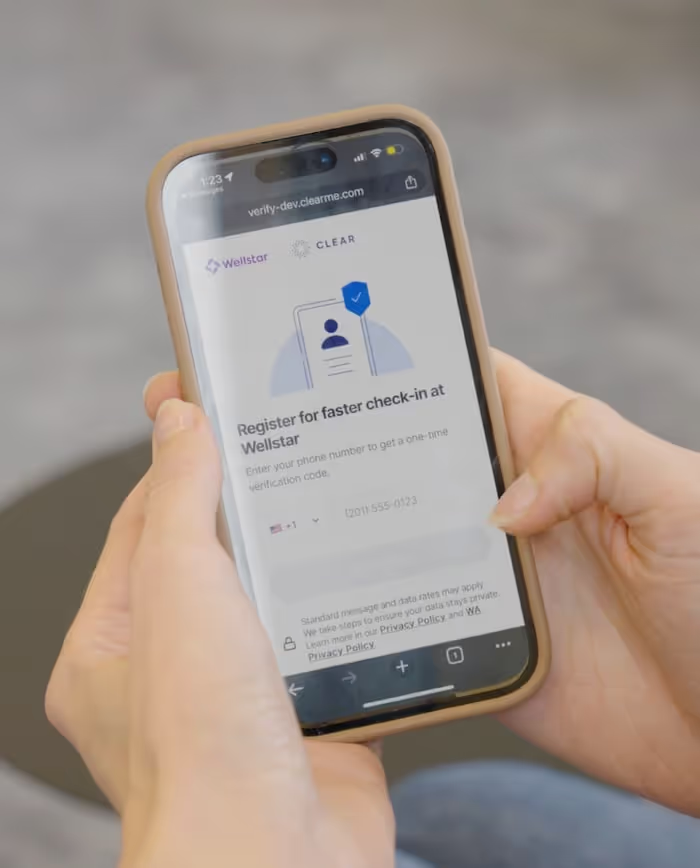
Once a provider verifies with CLEAR, they create a reusable identity that can be used across ongoing interactions—enabling them to re-verify who they are with just a selfie, wherever CLEAR is integrated.
The result is a system that is both more secure and more efficient:
- Reduced fraud risk through higher-assurance identity confirmation
- Improved data integrity across provider records
- Faster onboarding with fewer drop-offs
- A scalable approach that supports ongoing compliance
…all while maintaining a more seamless provider experience.
Evidence in Practice
CLEAR’s approach to identity is already in use across leading healthcare organizations.
From national networks to health systems and digital platforms, organizations are adopting a multi-layered approach to strengthen security while improving provider access and experience. These implementations show that identity can be both high-assurance and scalable without adding friction.
For example, in partnership with Surescripts, CLEAR helped establish an identity framework that meets NIST IAL2 standards while improving both security and provider experience. The results included higher verification success rates, faster onboarding, and stronger overall network integrity.
This is what identity infrastructure looks like when it is built to scale: consistent, reusable, and embedded across systems rather than layered on top.
Looking Beyond the Audit
The 50-state audit is not a one-time compliance exercise. It reflects a broader shift in how program integrity is defined and enforced. States can respond by adding incremental controls, or they can address the underlying issue by strengthening identity at the foundation.
Because program integrity does not begin with audits or reporting—it begins with knowing, clearly and consistently, who is in the system.
The Path Forward
As the Secretary of the Louisiana Department of Health has emphasized, identity is foundational to program integrity.
"Program integrity begins with knowing who is in your system. Without a high level of confidence in provider identity, every downstream control becomes less effective. As states modernize, investing in high-assurance identity is not just a safeguard—it’s the foundation for secure, efficient, and trustworthy programs that deliver for the people who depend on them."
- Bruce Greenstein, Secretary, Louisiana Department of Health
States that invest in high-assurance, multi-layered identity now will be better positioned not only to meet current expectations, but to manage evolving risks—all while maintaining access and efficiency across their programs.
Written by David Bardan, SVP, Head of Healthcare & GovTech
A Growing Gap in Provider Identity Assurance
On April 22, 2026, CMS announced a coordinated 50-state audit of Medicaid provider oversight. While this isn’t a new regulation, it reinforces a clear expectation: states need to strengthen how they verify providers, maintain accurate records, and protect against fraud, waste, and abuse.
At the center of that expectation is a fundamental issue: many systems still lack a reliable way to confirm who is actually in their provider network.
For years, provider verification has been treated as a compliance step—completed during enrollment and revisited only when necessary. That approach worked in a simpler environment, but it doesn’t usually hold up against today’s risks, where identity is directly tied to how programs prevent fraud and manage access.
The Limits of Traditional Approaches
The nature of fraud has changed; it is no longer limited to bad data or isolated bad actors. Today’s threats include stolen credentials, synthetic identities, and coordinated attempts to exploit gaps across systems.
Meanwhile, most verification processes still rely on manual review, document-only checks, and point-in-time validation. These approaches may appear rigorous, but they leave meaningful gaps—especially as identity data becomes easier to steal, replicate, and manipulate. And when identity is treated as a static record rather than something that must be continuously validated, those gaps persist.
Addressing these gaps requires a shift in how identity is handled. This is what CMS is signaling: strengthening program integrity means moving identity earlier in the process and treating it as a core part of how systems operate—not just something checked after the fact.
The State-Level Reality
For state agencies, the challenge isn’t simply adding more verification. It’s strengthening security while maintaining seamless access for providers.
That balance is difficult with existing systems—many of which are fragmented across agencies and vendors, dependent on manual processes, and difficult to scale across large provider populations. Data inconsistencies and duplicate records are common, and maintaining accuracy over time requires significant effort.
Efforts to close these gaps often introduce more complexity with additional steps, more documentation, and increased friction for providers. In practice, this slows enrollment and can limit participation. As a result, states are often forced into a tradeoff between stronger controls and a functional provider experience.
A Different Approach to Identity
CLEAR1 is a new standard in identity, moving beyond traditional verification to support identity across the full provider journey. Rather than relying on single checks, CLEAR1 draws on hundreds of signals across biometrics, documents, devices, and authoritative data sources to consistently and reliably confirm that an individual is who they claim to be.
In practice, fraud doesn’t break one control—it works around several. A multi-layered approach like CLEAR1’s makes that significantly harder by validating identity across multiple signals at once.
Once a provider verifies with CLEAR, they create a reusable identity that can be used across ongoing interactions—enabling them to re-verify who they are with just a selfie, wherever CLEAR is integrated.
The result is a system that is both more secure and more efficient:
- Reduced fraud risk through higher-assurance identity confirmation
- Improved data integrity across provider records
- Faster onboarding with fewer drop-offs
- A scalable approach that supports ongoing compliance
…all while maintaining a more seamless provider experience.
Evidence in Practice
CLEAR’s approach to identity is already in use across leading healthcare organizations.
From national networks to health systems and digital platforms, organizations are adopting a multi-layered approach to strengthen security while improving provider access and experience. These implementations show that identity can be both high-assurance and scalable without adding friction.
For example, in partnership with Surescripts, CLEAR helped establish an identity framework that meets NIST IAL2 standards while improving both security and provider experience. The results included higher verification success rates, faster onboarding, and stronger overall network integrity.
This is what identity infrastructure looks like when it is built to scale: consistent, reusable, and embedded across systems rather than layered on top.
Looking Beyond the Audit
The 50-state audit is not a one-time compliance exercise. It reflects a broader shift in how program integrity is defined and enforced. States can respond by adding incremental controls, or they can address the underlying issue by strengthening identity at the foundation.
Because program integrity does not begin with audits or reporting—it begins with knowing, clearly and consistently, who is in the system.
The Path Forward
As the Secretary of the Louisiana Department of Health has emphasized, identity is foundational to program integrity.
"Program integrity begins with knowing who is in your system. Without a high level of confidence in provider identity, every downstream control becomes less effective. As states modernize, investing in high-assurance identity is not just a safeguard—it’s the foundation for secure, efficient, and trustworthy programs that deliver for the people who depend on them."
- Bruce Greenstein, Secretary, Louisiana Department of Health
States that invest in high-assurance, multi-layered identity now will be better positioned not only to meet current expectations, but to manage evolving risks—all while maintaining access and efficiency across their programs.


