









Gartner®, Deepfake Identity Threats: Mitigate Risk in Identity Verification and Face Biometrics, Akif Khan, Nayara Sangiorgio, James Hoover, 11 May 2026
Gartner® is a trademark of Gartner, Inc. and/or its affiliates.



Share


Share
Key Takeaways
- Digital patient check-in has become the new front door for medical identity fraud, because most check-in flows collect data but typically don’t confirm the patient.
- Stopping fraud at check-in requires verifying the person: a selfie with liveness, a real document check, and a match against verified data sources.
- Returning patients should get a reusable verified identity, which cuts repeat friction and closes the gap impostors use at follow-up visits.
- The compliance bar for patient identity verification at check-in is HIPAA-aligned handling, with some organizations looking for alignment with NIST IAL2/AAL2 and PAD2-certified liveness.
- CLEAR1 is a reusable digital identity platform, perfect for large healthcare organizations, that confirms each patient with a multi-layered approach and integrates with EHRs.
Although tablets, kiosks, and portals modernized the front desk by replacing clipboards and waiting-room lines, the identity check itself didn’t keep up. Most digital patient check-in flows still collect data without confirming the person, and that gap has become the new front door for medical identity fraud, prescription abuse, and account takeover.
At the same time, healthcare data breaches are among the most expensive in the world. Synthetic identity fraud alone is estimated to drive $40B in losses annually, with deepfake-enabled fraud adding hundreds of millions more in damage each year.
CLEAR1 was built for this reality, bringing a multi-layered approach to the moment patients check in. With that lens in mind, this guide walks through six best practices that turn digital patient check-in into a true identity checkpoint.
Patient Check-in Quietly Became the Most Important Identity Check in Healthcare
For years, identity in healthcare was anchored at the front desk. Staff compared faces to ID cards, cross-checked demographics, and reconciled records in real time.
Today, the “front desk” is everywhere—pre-visit portals, on-site kiosks and tablets, mobile check-in, and telehealth links. Across all of these surfaces, the same decision is being made: who is this patient, and which record should we trust?
When digital patient check-in behaves like a data-entry form, that decision is made on faith: if the demographics look plausible or the portal credentials work, the visit moves forward. But a visit isn’t just an appointment slot—it’s access to protected health information, prescriptions, referrals, and payment credentials.
That’s why digital patient check-in can’t stop at “does the data look right?” It has to answer the question, “is this person really who they claim to be?” It’s no longer a data-entry workflow—it’s an identity decision.
The Fraud Already Walking Through Your Digital Patient Check-in
Most of the fraud that touches healthcare doesn’t start with a dramatic perimeter breach. It starts with someone successfully “being” a patient they’re not.
Common patterns include:
1. Medical identity theft at first registration
Stolen or fabricated identities are used to obtain care, prescriptions, or coverage. A convincing set of demographics and an ID image—whether authentic, forged, or purchased on the dark web—can be enough to establish a new patient record if identity is never truly confirmed.
2. Patient portal account takeover at follow-up
Once a patient is in the system, their portal account becomes a high-value target. Credential stuffing, phishing, and social engineering attacks all converge on the same goal: hijack a trusted account and move invisibly inside the perimeter.
3. Kiosk and tablet impersonation on site
On shared devices in clinics and hospitals, it’s increasingly common for one person to check in under another’s name—for benefits fraud, insurance coverage, or access to controlled-substance refills. Without a strong identity check tied to the person behind the device, these attempts are hard to distinguish from legitimate check-ins.
4. Synthetic “patients” in the portal
Fraudsters can stitch together identities from partial real data (often including children’s Social Security numbers) and fabricated attributes, then use legacy demographic checks to create entirely new “patients” that look clean on paper.
Why Data Entry Alone Can’t Pass for Patient Identity Verification Anymore
Traditional patient check-in flows tend to treat identity verification and data collection as the same step: if the form is complete and the information looks right, the identity is assumed.
Demographic and bureau checks are built to decide whether each input looks real in isolation—name, date of birth, address, and insurance details can all appear legitimate and even line up with third-party data sources—but they’re far less effective at answering the real question: is the person in front of the screen the same human that data belongs to?
That’s where modern fraud lives—in the gap between “the data on the form is plausible” and “the person sitting there is who the data says they are.” With AI-driven tools, it’s easier than ever to generate convincing fraudulent documents and fabricate identities that pass through static checks.
Closing this gap requires a simple but critical shift: patient identity verification at check-in has to confirm the person, not just the data. That means verifying a live presence, matching biometrics to the ID, aligning identity details across real-world, verified data sources, and checking that the device behaves like a legitimate endpoint, not an emulated or tampered one.
6 Best Practices for a Digital Patient Check-in That Actually Stops Fraud
1. Confirm the person with a selfie and liveness check
Start by verifying a real, live person—not just a completed form. PAD2 (ISO-30107-3)-certified liveness helps distinguish a live face from a deepfake, photo, or mask, while biometric matching between the selfie and the ID photo confirms the same individual is behind both. This step shifts the decision from “this data looks correct” to “this person is real and matches the claimed identity.”
2. Authenticate the document, not just the image
A clean image of an ID isn’t enough. Government-issued IDs should be checked for security features like fonts, holograms, and layout—and, where supported, validated via NFC chip reads to detect non-original or tampered documents. Treating the document as one layer in a broader identity picture—rather than the source of truth—helps prevent forged or purchased IDs from bootstrapping fraudulent patient records.
3. Corroborate identity details against verified data sources
Trusted identity has to exist beyond a single credential. Cross-checking name, date of birth, and other identifiers across authoritative data sources shows whether the story holds together—exposing synthetic identities built from real-but-fragmented data and anchoring the person being verified to a real-world, traceable identity, not just a convincing document.
4. Add device and behavioral signals at the portal
Identity is multidimensional—and so is risk. Device security assessments can flag tampering, emulation, or other high-risk patterns, while signals like residential proxy use or abnormal device behavior help surface suspicious activity in patient portals, and account recovery flows. These checks add a quiet but powerful layer of defense, strengthening security without adding friction.
5. Issue a reusable verified identity for returning patients
Once a patient has been through a multi-layered verification, they shouldn’t have to start from scratch every time. A reusable verified identity that can be reasserted with just a selfie dramatically reduces friction for known patients while also securing returning visits, follow-up appointments, and ongoing portal access.
6. Anchor verified identity in your system of record
Identity can’t live off to the side. Writing verification outcomes back to the EHR anchors encounters to a verified identity that clinicians, registration, and security teams can all see. Aligning digital patient check-in with HIPAA—and, for higher-risk flows, with NIST IAL2/AAL2 and PAD2-certified liveness—creates an auditable trail per visit, so identity assurance supports both security posture and compliance without adding manual overhead.
What a Verified Patient Check-in Looks Like, End to End
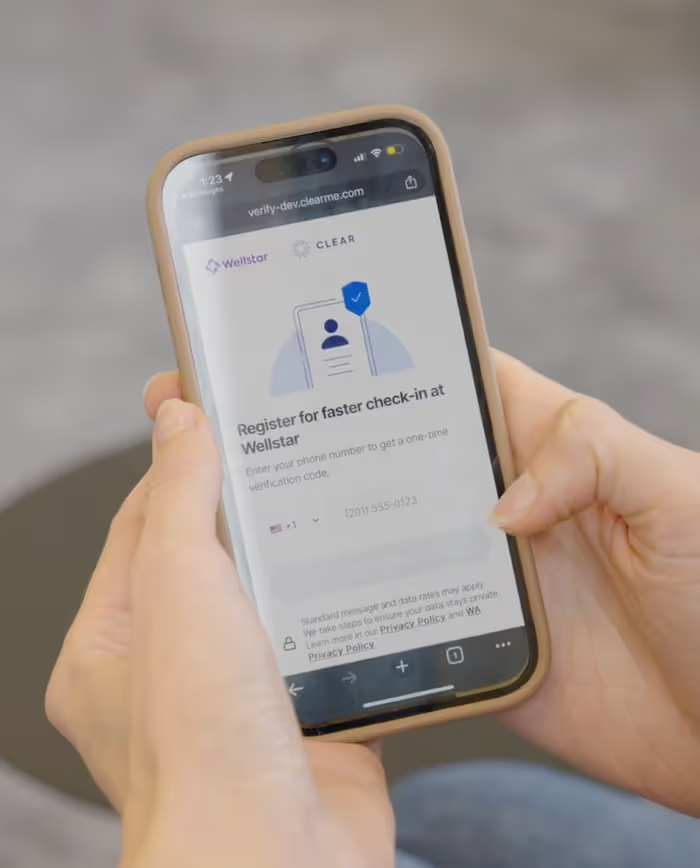
For patients, a verified digital check-in flow, like the one CLEAR1 provides, can feel simple, consistent, and fast. First-time patients upload or scan a government-issued ID then take a quick selfie. Returning patients take a quick selfie then move straight into the visit.
The same experience works across kiosks, tablets, mobile, and web portals, so identity doesn’t depend on where the patient starts. From the patient perspective, it’s a familiar, low-friction flow: document and selfie once, then selfie after that.
Behind the scenes, a multi-layered identity check runs quietly in the background—critical for security but invisible to the patient. Here’s how it works:
- Biometric verification compares the selfie to the ID photo and incorporates liveness detection to confirm a real person is present
- Document authentication (and, where supported, NFC reads) validates the ID itself.
- Identity details (name, DOB, and other identifiers) are corroborated against verified data sources.
- Device security signals help flag tampering or suspicious behavior.
- A real-time decision is made and written back into the EHR, anchoring the encounter to a verified identity.
All of this is essential for securing downstream workflows and helping stop fraud. Health systems are already moving in this direction—for example, CLEAR and Wellstar partnered to modernize the patient check-in experience with a secure, digital-first flow. Read the Wellstar case study.
How CLEAR1 Rebuilds Trust at the Patient Check-in
CLEAR has spent more than 16 years verifying identity in highly regulated environments, and CLEAR1 brings that same multi-layered approach to digital patient check-in. Treating check-in as an identity decision—and layering in biometrics, document checks, device intelligence, and reusable identity—helps protect what matters most: patients, clinicians, and the trust that connects them.
With CLEAR1, health systems can:
Run multi-layered verification on the first visit
CLEAR1 combines selfie-based biometric verification with PAD2 (ISO-30107-3)–certified liveness, document authenticity checks, device security signals, and validation against authoritative data sources—returning a real-time decision at check-in.
Issue a reusable verified identity for every patient
After a quick, one-time setup, patients in CLEAR’s 43M+ member network can verify with just a selfie on subsequent visits, and new patients gain the same reusable verified identity after their first verification. Known patients move through check-in cleanly, while impostors lose anonymity at follow-up.
Embed identity where check-in already lives
CLEAR1 integrates directly with Epic Welcome via Connection Hub and supports flexible APIs and hosted flows, so identity assurance runs inside existing check-in experiences rather than as a separate, bolted-on step.
Support security and compliance from day one
CLEAR1’s approach to patient identity verification is aligned with NIST IAL2 and AAL2, and the platform is independently audited for HIPAA and SOC2. Liveness is PAD2 certified, and biometric data is handled by CLEAR as the biometric controller, so healthcare organizations never have to touch or store it themselves.
Frequently Asked Questions
What is digital patient check-in software?
Digital patient check-in software replaces clipboards and manual registration with self-service experiences across portals, kiosks, tablets, and mobile. It collects demographics, insurance details, and visit-specific information and passes that data into the EHR and other downstream systems. The most effective solutions go a step further: they embed patient identity verification into the flow so the organization isn’t just collecting information—it’s confirming the person behind it.
Can digital patient check-in help stop medical identity theft?
It can, but only if it goes beyond data-only checks. Traditional flows can catch typos and missing fields, but they rarely stop someone who arrives with realistic data or a convincing ID image. To meaningfully reduce medical identity theft and prescription fraud, digital patient check-in should confirm a live person is present (liveness), match that person to an ID (biometrics plus document authentication), corroborate identity details against verified data sources, and recognize returning patients with a reusable verified identity. When these elements work together, check-in becomes a powerful control point before fraud reaches clinical or billing workflows.
What compliance frameworks should the check-in flow meet?
For patient identity verification at check-in, the baseline is HIPAA-aligned data handling and security controls. Many organizations also look for alignment with NIST IAL2 and AAL2 to strengthen identity assurance and authentication, along with PAD2 (ISO-30107-3)–certified liveness to defend against deepfakes and spoofing. Each verification event should generate an auditable trail that security, compliance, and privacy teams can rely on during reviews or investigations.
Although tablets, kiosks, and portals modernized the front desk by replacing clipboards and waiting-room lines, the identity check itself didn’t keep up. Most digital patient check-in flows still collect data without confirming the person, and that gap has become the new front door for medical identity fraud, prescription abuse, and account takeover.
At the same time, healthcare data breaches are among the most expensive in the world. Synthetic identity fraud alone is estimated to drive $40B in losses annually, with deepfake-enabled fraud adding hundreds of millions more in damage each year.
CLEAR1 was built for this reality, bringing a multi-layered approach to the moment patients check in. With that lens in mind, this guide walks through six best practices that turn digital patient check-in into a true identity checkpoint.
Patient Check-in Quietly Became the Most Important Identity Check in Healthcare
For years, identity in healthcare was anchored at the front desk. Staff compared faces to ID cards, cross-checked demographics, and reconciled records in real time.
Today, the “front desk” is everywhere—pre-visit portals, on-site kiosks and tablets, mobile check-in, and telehealth links. Across all of these surfaces, the same decision is being made: who is this patient, and which record should we trust?
When digital patient check-in behaves like a data-entry form, that decision is made on faith: if the demographics look plausible or the portal credentials work, the visit moves forward. But a visit isn’t just an appointment slot—it’s access to protected health information, prescriptions, referrals, and payment credentials.
That’s why digital patient check-in can’t stop at “does the data look right?” It has to answer the question, “is this person really who they claim to be?” It’s no longer a data-entry workflow—it’s an identity decision.
The Fraud Already Walking Through Your Digital Patient Check-in
Most of the fraud that touches healthcare doesn’t start with a dramatic perimeter breach. It starts with someone successfully “being” a patient they’re not.
Common patterns include:
1. Medical identity theft at first registration
Stolen or fabricated identities are used to obtain care, prescriptions, or coverage. A convincing set of demographics and an ID image—whether authentic, forged, or purchased on the dark web—can be enough to establish a new patient record if identity is never truly confirmed.
2. Patient portal account takeover at follow-up
Once a patient is in the system, their portal account becomes a high-value target. Credential stuffing, phishing, and social engineering attacks all converge on the same goal: hijack a trusted account and move invisibly inside the perimeter.
3. Kiosk and tablet impersonation on site
On shared devices in clinics and hospitals, it’s increasingly common for one person to check in under another’s name—for benefits fraud, insurance coverage, or access to controlled-substance refills. Without a strong identity check tied to the person behind the device, these attempts are hard to distinguish from legitimate check-ins.
4. Synthetic “patients” in the portal
Fraudsters can stitch together identities from partial real data (often including children’s Social Security numbers) and fabricated attributes, then use legacy demographic checks to create entirely new “patients” that look clean on paper.
Why Data Entry Alone Can’t Pass for Patient Identity Verification Anymore
Traditional patient check-in flows tend to treat identity verification and data collection as the same step: if the form is complete and the information looks right, the identity is assumed.
Demographic and bureau checks are built to decide whether each input looks real in isolation—name, date of birth, address, and insurance details can all appear legitimate and even line up with third-party data sources—but they’re far less effective at answering the real question: is the person in front of the screen the same human that data belongs to?
That’s where modern fraud lives—in the gap between “the data on the form is plausible” and “the person sitting there is who the data says they are.” With AI-driven tools, it’s easier than ever to generate convincing fraudulent documents and fabricate identities that pass through static checks.
Closing this gap requires a simple but critical shift: patient identity verification at check-in has to confirm the person, not just the data. That means verifying a live presence, matching biometrics to the ID, aligning identity details across real-world, verified data sources, and checking that the device behaves like a legitimate endpoint, not an emulated or tampered one.
6 Best Practices for a Digital Patient Check-in That Actually Stops Fraud
1. Confirm the person with a selfie and liveness check
Start by verifying a real, live person—not just a completed form. PAD2 (ISO-30107-3)-certified liveness helps distinguish a live face from a deepfake, photo, or mask, while biometric matching between the selfie and the ID photo confirms the same individual is behind both. This step shifts the decision from “this data looks correct” to “this person is real and matches the claimed identity.”
2. Authenticate the document, not just the image
A clean image of an ID isn’t enough. Government-issued IDs should be checked for security features like fonts, holograms, and layout—and, where supported, validated via NFC chip reads to detect non-original or tampered documents. Treating the document as one layer in a broader identity picture—rather than the source of truth—helps prevent forged or purchased IDs from bootstrapping fraudulent patient records.
3. Corroborate identity details against verified data sources
Trusted identity has to exist beyond a single credential. Cross-checking name, date of birth, and other identifiers across authoritative data sources shows whether the story holds together—exposing synthetic identities built from real-but-fragmented data and anchoring the person being verified to a real-world, traceable identity, not just a convincing document.
4. Add device and behavioral signals at the portal
Identity is multidimensional—and so is risk. Device security assessments can flag tampering, emulation, or other high-risk patterns, while signals like residential proxy use or abnormal device behavior help surface suspicious activity in patient portals, and account recovery flows. These checks add a quiet but powerful layer of defense, strengthening security without adding friction.
5. Issue a reusable verified identity for returning patients
Once a patient has been through a multi-layered verification, they shouldn’t have to start from scratch every time. A reusable verified identity that can be reasserted with just a selfie dramatically reduces friction for known patients while also securing returning visits, follow-up appointments, and ongoing portal access.
6. Anchor verified identity in your system of record
Identity can’t live off to the side. Writing verification outcomes back to the EHR anchors encounters to a verified identity that clinicians, registration, and security teams can all see. Aligning digital patient check-in with HIPAA—and, for higher-risk flows, with NIST IAL2/AAL2 and PAD2-certified liveness—creates an auditable trail per visit, so identity assurance supports both security posture and compliance without adding manual overhead.
What a Verified Patient Check-in Looks Like, End to End
For patients, a verified digital check-in flow, like the one CLEAR1 provides, can feel simple, consistent, and fast. First-time patients upload or scan a government-issued ID then take a quick selfie. Returning patients take a quick selfie then move straight into the visit.
The same experience works across kiosks, tablets, mobile, and web portals, so identity doesn’t depend on where the patient starts. From the patient perspective, it’s a familiar, low-friction flow: document and selfie once, then selfie after that.
Behind the scenes, a multi-layered identity check runs quietly in the background—critical for security but invisible to the patient. Here’s how it works:
- Biometric verification compares the selfie to the ID photo and incorporates liveness detection to confirm a real person is present
- Document authentication (and, where supported, NFC reads) validates the ID itself.
- Identity details (name, DOB, and other identifiers) are corroborated against verified data sources.
- Device security signals help flag tampering or suspicious behavior.
- A real-time decision is made and written back into the EHR, anchoring the encounter to a verified identity.
All of this is essential for securing downstream workflows and helping stop fraud. Health systems are already moving in this direction—for example, CLEAR and Wellstar partnered to modernize the patient check-in experience with a secure, digital-first flow. Read the Wellstar case study.
How CLEAR1 Rebuilds Trust at the Patient Check-in
CLEAR has spent more than 16 years verifying identity in highly regulated environments, and CLEAR1 brings that same multi-layered approach to digital patient check-in. Treating check-in as an identity decision—and layering in biometrics, document checks, device intelligence, and reusable identity—helps protect what matters most: patients, clinicians, and the trust that connects them.
With CLEAR1, health systems can:
Run multi-layered verification on the first visit
CLEAR1 combines selfie-based biometric verification with PAD2 (ISO-30107-3)–certified liveness, document authenticity checks, device security signals, and validation against authoritative data sources—returning a real-time decision at check-in.
Issue a reusable verified identity for every patient
After a quick, one-time setup, patients in CLEAR’s 43M+ member network can verify with just a selfie on subsequent visits, and new patients gain the same reusable verified identity after their first verification. Known patients move through check-in cleanly, while impostors lose anonymity at follow-up.
Embed identity where check-in already lives
CLEAR1 integrates directly with Epic Welcome via Connection Hub and supports flexible APIs and hosted flows, so identity assurance runs inside existing check-in experiences rather than as a separate, bolted-on step.
Support security and compliance from day one
CLEAR1’s approach to patient identity verification is aligned with NIST IAL2 and AAL2, and the platform is independently audited for HIPAA and SOC2. Liveness is PAD2 certified, and biometric data is handled by CLEAR as the biometric controller, so healthcare organizations never have to touch or store it themselves.


