
blog

5 of the Best Healthcare Identity Verification Tools in 2026

July 31, 2026

Key Takeaways

  • Identity verification in the healthcare industry is especially demanding because solutions must integrate with EHRs, comply with HIPAA, and protect against medical identity theft and patient-portal account takeover.
  • The strongest healthcare identity verification tools combine biometric verification, document authentication, device security signals, and verified data source validation instead of relying on a single signal.
  • Pre-built integrations with EHRs like Epic and Oracle and IAM platforms like Okta, Ping, and Microsoft Entra can significantly shorten rollout time and reduce IT lift.
  • CLEAR1 is a trusted digital identity platform built for highly regulated industries, helping healthcare organizations verify both patients and providers across the care journey while aligning to standards such as IAL2, AAL2, and HIPAA.

Why Healthcare Identity Verification is Uniquely Complex

In healthcare, identity isn’t a one-and-done check—it’s a constant thread running through every interaction. From EHR logins and patient portals to telehealth visits, prescription workflows, and clinician access to PHI, identity verification has to work across a web of interconnected systems and high-stakes touchpoints.

Unlike identity verification in other industries, healthcare identity verification tools must protect against specific threats such as medical identity theft, patient-portal account takeover, and duplicate or mismatched records that introduce clinical and administrative risk. Healthcare identity verification tools also need to align with HIPAA and higher-assurance standards such as NIST IAL2 and AAL2, as well as integrate with EHRs like Epic and Oracle and IAM platforms like Okta, Ping, and Microsoft Entra—all without disrupting existing workflows.


What to Look for in Top Healthcare Identity Verification Tools

Before comparing solutions, use these criteria to evaluate healthcare identity verification tools:

  • Healthcare-specific workflows: Choose tools that support patient portal enrollment and login, telehealth access, clinician identity checks, and staff account recovery, not just generic onboarding flows.
  • Multi-layered identity assurance: The strongest tools go beyond document-only checks or basic MFA, combining biometric verification, document authenticity, device assurance, and validation against authoritative and credible data sources to confidently verify that a person is who they say they are.
  • Reusable identity: A one-time identity setup that can be reused across interactions (and even across organizations) keeps friction low for patients and providers while maintaining a high bar for trust.
  • EHR and IAM integrations: Pre-built integrations with EHRs like Epic and Oracle and leading IAM platforms like Okta, Ping, and Microsoft Entra can dramatically shorten deployment timelines and reduce custom engineering work.
  • Compliance and privacy posture: In healthcare, alignment with HIPAA and higher-assurance frameworks such as NIST IAL2 and AAL2 is table stakes. It’s also critical that vendors handle biometrics and other sensitive data in a way that keeps users in control and limits what touches your environment.

With this framework in mind, here are five healthcare identity verification tools to consider in 2026.

1. CLEAR1

CLEAR1 helps organizations verify both patients and providers at critical points throughout the healthcare journey, including patient portal enrollment, account recovery, telehealth access, and clinician access to sensitive systems. By acting as a reusable, persistent identity layer for healthcare systems, CLEAR1 strengthens security at every touchpoint without adding operational complexity.

Best for: Healthcare organizations that want an end-to-end, multi-layered identity platform for both patients and providers, with strong assurance and a seamless user experience.

Key strengths:

  • Multi-layered identity assurance: Rather than relying on a single check, CLEAR1 confirms identity by analyzing hundreds of real-time signals across biometrics, government-issued IDs, devices, and verified data sources.
  • Reusable identity and the CLEAR network: Over 41 million users in CLEAR’s network can verify instantly with just a selfie, while new users complete a quick, one-time setup and then enjoy the same fast, secure experience across partners. That reusable identity is particularly powerful for patients and clinicians who interact with multiple healthcare organizations or move across many touchpoints within a single health system.
  • Built for regulated environments: CLEAR1 is designed for highly regulated use cases and aligns with NIST IAL2 and AAL2, is HIPAA-compliant, and is independently audited for SOC2 and PAD2 (ISO-30107-3).
  • EHR and IAM integrations: CLEAR1 offers out-of-the-box integrations with Epic (including MyChart and EpicCare Link) and Oracle and leading IAM platforms like Okta, Ping, and Microsoft Entra, helping organizations add identity assurance without rebuilding their stack.
  • Proven outcomes in healthcare: Healthcare partners have reported outcomes such as a 54% reduction in account-related support calls at Community Health Network; 40% faster verification and a 2x higher verification success rate at Surescripts; and 5x growth in digital check-in adoption and a 95% patient match rate at Wellstar Health System.
  • Biometric controller model: CLEAR handles the most sensitive part of verification—biometrics—so healthcare organizations never have to touch or store them, sharing back only the data organizations have requested and users have consented to share.

Considerations: Organizations looking to build a long-term, high-assurance identity layer across the care lifecycle, not a one-off point solution. Teams typically see the most value when they connect CLEAR1 to multiple workflows—for example, patient portal enrollment, account recovery, and clinician access—instead of deploying it as a single add-on.

2. Imprivata PatientSecure

Imprivata PatientSecure focuses on positive patient identification at registration and check-in, using biometric identifiers to link patients to the correct medical record at the point of care.

Best for: Health systems that want to strengthen in-person patient identification and reduce duplicate or overlaid medical records at check-in.

Key strengths:

  • Per G2 and KLAS reviewers, Imprivata PatientSecure is often credited with improving positive patient identification at the front desk and reducing misidentification risk.
  • Frequently noted to fit naturally into hospital registration workflows and existing EHR processes.
  • Described by many large health systems as an enterprise-ready option for in-person patient ID at scale.

Considerations: Some reviewers mention that deploying biometric hardware across locations can be resource-intensive, benefitting from thoughtful rollout planning that can include training front-line registration staff.

3. Experian Health Patient Identity Management

Experian Health’s Patient Identity Management centers on demographic data quality, record deduplication, and identity resolution at pre-registration and throughout the revenue cycle.

Best for: Organizations that need robust patient identity resolution and EMPI capabilities to support clean records and accurate billing.

Key strengths:

  • Per KLAS and Gartner Peer Insights reviewers, Experian Health’s Patient Identity Management is often highlighted for strong EMPI and referential matching that help consolidate fragmented patient records.
  • Many customers report improvements in data quality and fewer duplicates across large patient populations.
  • Frequently positioned as a good fit for teams focused on revenue cycle performance and back-office accuracy.

Considerations: Some reviewers note that configuration and integration into existing EHR and data environments can take time, often requiring close partnership with IT and data-governance teams.

4. LexisNexis Risk Solutions (LexID for Healthcare)

LexisNexis Risk Solutions’ LexID for Healthcare uses a large-scale identity graph to support identity proofing, fraud detection, and patient identity resolution across care settings.

Best for: Healthcare organizations that want deep, data-graph-driven identity resolution and risk signals woven into fraud, access, and analytics workflows.

Key strengths:

  • Per G2 and Gartner Peer Insights reviewers, LexID for Healthcare is often praised for the depth of its identity data and referential matching, helping link and better understand patient records.
  • Many customers say the added risk and fraud indicators are valuable inputs to patient access and onboarding decisions.
  • Sometimes positioned as a strong choice for organizations seeking consistent identity capabilities across healthcare and other regulated industries.

Considerations: Some reviewers observe that fully tuning risk rules and workflows can require collaboration between internal analytics teams and LexisNexis experts to get the most value from the data.

5. Vouched

Vouched offers document-and-selfie-based identity verification with healthcare- and telehealth-focused workflows for remote patient onboarding and access.

Best for: Telehealth and digital health organizations that need flexible, digital-first identity verification for patients outside the four walls of the hospital.

Key strengths:

  • Per G2 and Capterra reviewers, Vouched is often described as relatively easy to embed into web and mobile experiences for remote onboarding.
  • Many customers say workflows adapt well to healthcare and telehealth scenarios rather than feeling like purely generic KYC flows.
  • Sometimes positioned as a good option for teams that want to add document-and-selfie checks without a heavy in-house build.

Considerations: Some reviewers indicate they would like additional out-of-the-box templates, analytics, or configuration options tailored more specifically to healthcare workflows.

Maximize Healthcare Identity Assurance with CLEAR1

CLEAR1 gives healthcare organizations a reusable, multi-layered identity layer for patients and providers across portals, telehealth, and clinician access, maximizing security and minimizing friction at every touchpoint. 

Request a demo to learn more.

Frequently Asked Questions

What is healthcare identity verification?

Healthcare identity verification is the process of confirming that a patient, clinician, or staff member is who they claim to be before granting access to systems, data, or services. In practice, this can cover everything from patient portal enrollment and login to telehealth visit check-in, clinician access to EHRs and other clinical systems, account recovery and password reset, and high-risk actions like prescription access, sensitive data retrieval, or changes to contact information.

Why do hospitals need identity verification tools?

Hospitals and health systems face a growing mix of risks: medical identity theft, portal account takeover, fraudulent access to clinical networks, and the creation of duplicate or mismatched records that can affect safety and billing. At the same time, healthcare breaches are among the costliest and slowest to contain, and AI-driven threats are raising the bar even further. Identity verification tools help healthcare organizations reduce medical identity theft and account takeover, protect PHI and sensitive clinical systems, improve record accuracy for safer care and fewer administrative errors, and reduce help desk volumes by enabling secure self-service for account recovery and access.

How do healthcare identity verification tools differ from generic IDV?

Generic IDV tools often focus on one-off document checks or basic KYC/KYB flows. Healthcare identity verification tools add several important layers: deeper integration with EHRs and clinical systems such as Epic and health information networks; alignment with HIPAA and higher-assurance frameworks like IAL2 and AAL2 for high-stakes access to PHI; workflows tailored to patient portals, telehealth, clinician access, and workforce account recovery; and stronger expectations around privacy, consent, and data handling given the sensitivity of medical information.

What features should a healthcare identity verification tool have?

While every organization has its own requirements, most healthcare buyers look for a few core capabilities. First is multi-layered verification, where signals from biometrics, documents, devices, and verified data sources work together instead of relying on a single factor. Second is reusable identity, so patients and clinicians can complete a one-time setup and then re-verify quickly with something like a selfie across multiple workflows and, where appropriate, across organizations. Third is a robust integration footprint, with support for Epic and other EHRs plus IAM platforms like Okta, Ping, and Microsoft Entra to avoid heavy custom development and speed time to value. Finally, a strong privacy and compliance posture is essential, including alignment with HIPAA, IAL2, and AAL2; clear consent flows; and architectures that keep biometrics and other sensitive data under tight control, ideally with a biometric controller model where the vendor handles the most sensitive data so your systems don’t have to.

Why Healthcare Identity Verification is Uniquely Complex

In healthcare, identity isn’t a one-and-done check—it’s a constant thread running through every interaction. From EHR logins and patient portals to telehealth visits, prescription workflows, and clinician access to PHI, identity verification has to work across a web of interconnected systems and high-stakes touchpoints.

Unlike identity verification in other industries, healthcare identity verification tools must protect against specific threats such as medical identity theft, patient-portal account takeover, and duplicate or mismatched records that introduce clinical and administrative risk. Healthcare identity verification tools also need to align with HIPAA and higher-assurance standards such as NIST IAL2 and AAL2, as well as integrate with EHRs like Epic and Oracle and IAM platforms like Okta, Ping, and Microsoft Entra—all without disrupting existing workflows.


What to Look for in Top Healthcare Identity Verification Tools

Before comparing solutions, use these criteria to evaluate healthcare identity verification tools:

  • Healthcare-specific workflows: Choose tools that support patient portal enrollment and login, telehealth access, clinician identity checks, and staff account recovery, not just generic onboarding flows.
  • Multi-layered identity assurance: The strongest tools go beyond document-only checks or basic MFA, combining biometric verification, document authenticity, device assurance, and validation against authoritative and credible data sources to confidently verify that a person is who they say they are.
  • Reusable identity: A one-time identity setup that can be reused across interactions (and even across organizations) keeps friction low for patients and providers while maintaining a high bar for trust.
  • EHR and IAM integrations: Pre-built integrations with EHRs like Epic and Oracle and leading IAM platforms like Okta, Ping, and Microsoft Entra can dramatically shorten deployment timelines and reduce custom engineering work.
  • Compliance and privacy posture: In healthcare, alignment with HIPAA and higher-assurance frameworks such as NIST IAL2 and AAL2 is table stakes. It’s also critical that vendors handle biometrics and other sensitive data in a way that keeps users in control and limits what touches your environment.

With this framework in mind, here are five healthcare identity verification tools to consider in 2026.

1. CLEAR1

CLEAR1 helps organizations verify both patients and providers at critical points throughout the healthcare journey, including patient portal enrollment, account recovery, telehealth access, and clinician access to sensitive systems. By acting as a reusable, persistent identity layer for healthcare systems, CLEAR1 strengthens security at every touchpoint without adding operational complexity.

Best for: Healthcare organizations that want an end-to-end, multi-layered identity platform for both patients and providers, with strong assurance and a seamless user experience.

Key strengths:

  • Multi-layered identity assurance: Rather than relying on a single check, CLEAR1 confirms identity by analyzing hundreds of real-time signals across biometrics, government-issued IDs, devices, and verified data sources.
  • Reusable identity and the CLEAR network: Over 41 million users in CLEAR’s network can verify instantly with just a selfie, while new users complete a quick, one-time setup and then enjoy the same fast, secure experience across partners. That reusable identity is particularly powerful for patients and clinicians who interact with multiple healthcare organizations or move across many touchpoints within a single health system.
  • Built for regulated environments: CLEAR1 is designed for highly regulated use cases and aligns with NIST IAL2 and AAL2, is HIPAA-compliant, and is independently audited for SOC2 and PAD2 (ISO-30107-3).
  • EHR and IAM integrations: CLEAR1 offers out-of-the-box integrations with Epic (including MyChart and EpicCare Link) and Oracle and leading IAM platforms like Okta, Ping, and Microsoft Entra, helping organizations add identity assurance without rebuilding their stack.
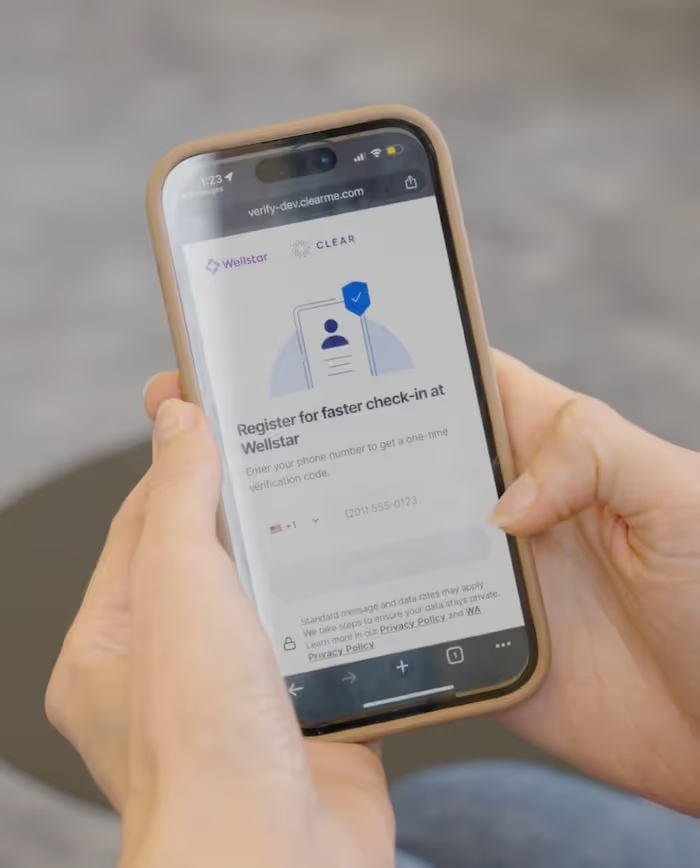
  • Proven outcomes in healthcare: Healthcare partners have reported outcomes such as a 54% reduction in account-related support calls at Community Health Network; 40% faster verification and a 2x higher verification success rate at Surescripts; and 5x growth in digital check-in adoption and a 95% patient match rate at Wellstar Health System.
  • Biometric controller model: CLEAR handles the most sensitive part of verification—biometrics—so healthcare organizations never have to touch or store them, sharing back only the data organizations have requested and users have consented to share.

Considerations: Organizations looking to build a long-term, high-assurance identity layer across the care lifecycle, not a one-off point solution. Teams typically see the most value when they connect CLEAR1 to multiple workflows—for example, patient portal enrollment, account recovery, and clinician access—instead of deploying it as a single add-on.

2. Imprivata PatientSecure

Imprivata PatientSecure focuses on positive patient identification at registration and check-in, using biometric identifiers to link patients to the correct medical record at the point of care.

Best for: Health systems that want to strengthen in-person patient identification and reduce duplicate or overlaid medical records at check-in.

Key strengths:

  • Per G2 and KLAS reviewers, Imprivata PatientSecure is often credited with improving positive patient identification at the front desk and reducing misidentification risk.
  • Frequently noted to fit naturally into hospital registration workflows and existing EHR processes.
  • Described by many large health systems as an enterprise-ready option for in-person patient ID at scale.

Considerations: Some reviewers mention that deploying biometric hardware across locations can be resource-intensive, benefitting from thoughtful rollout planning that can include training front-line registration staff.

3. Experian Health Patient Identity Management

Experian Health’s Patient Identity Management centers on demographic data quality, record deduplication, and identity resolution at pre-registration and throughout the revenue cycle.

Best for: Organizations that need robust patient identity resolution and EMPI capabilities to support clean records and accurate billing.

Key strengths:

  • Per KLAS and Gartner Peer Insights reviewers, Experian Health’s Patient Identity Management is often highlighted for strong EMPI and referential matching that help consolidate fragmented patient records.
  • Many customers report improvements in data quality and fewer duplicates across large patient populations.
  • Frequently positioned as a good fit for teams focused on revenue cycle performance and back-office accuracy.

Considerations: Some reviewers note that configuration and integration into existing EHR and data environments can take time, often requiring close partnership with IT and data-governance teams.

4. LexisNexis Risk Solutions (LexID for Healthcare)

LexisNexis Risk Solutions’ LexID for Healthcare uses a large-scale identity graph to support identity proofing, fraud detection, and patient identity resolution across care settings.

Best for: Healthcare organizations that want deep, data-graph-driven identity resolution and risk signals woven into fraud, access, and analytics workflows.

Key strengths:

  • Per G2 and Gartner Peer Insights reviewers, LexID for Healthcare is often praised for the depth of its identity data and referential matching, helping link and better understand patient records.
  • Many customers say the added risk and fraud indicators are valuable inputs to patient access and onboarding decisions.
  • Sometimes positioned as a strong choice for organizations seeking consistent identity capabilities across healthcare and other regulated industries.

Considerations: Some reviewers observe that fully tuning risk rules and workflows can require collaboration between internal analytics teams and LexisNexis experts to get the most value from the data.

5. Vouched

Vouched offers document-and-selfie-based identity verification with healthcare- and telehealth-focused workflows for remote patient onboarding and access.

Best for: Telehealth and digital health organizations that need flexible, digital-first identity verification for patients outside the four walls of the hospital.

Key strengths:

  • Per G2 and Capterra reviewers, Vouched is often described as relatively easy to embed into web and mobile experiences for remote onboarding.
  • Many customers say workflows adapt well to healthcare and telehealth scenarios rather than feeling like purely generic KYC flows.
  • Sometimes positioned as a good option for teams that want to add document-and-selfie checks without a heavy in-house build.

Considerations: Some reviewers indicate they would like additional out-of-the-box templates, analytics, or configuration options tailored more specifically to healthcare workflows.

Maximize Healthcare Identity Assurance with CLEAR1

CLEAR1 gives healthcare organizations a reusable, multi-layered identity layer for patients and providers across portals, telehealth, and clinician access, maximizing security and minimizing friction at every touchpoint. 

Request a demo to learn more.

Maximize security, minimize friction with CLEAR

Reach out to uncover what problems you can solve when you solve for identity.

By submitting my personal data, I consent to CLEAR collecting, processing, and storing my information in accordance with the CLEAR Privacy Notice.
blog

5 of the Best Healthcare Identity Verification Tools in 2026

July 31, 2026

Why Healthcare Identity Verification is Uniquely Complex

In healthcare, identity isn’t a one-and-done check—it’s a constant thread running through every interaction. From EHR logins and patient portals to telehealth visits, prescription workflows, and clinician access to PHI, identity verification has to work across a web of interconnected systems and high-stakes touchpoints.

Unlike identity verification in other industries, healthcare identity verification tools must protect against specific threats such as medical identity theft, patient-portal account takeover, and duplicate or mismatched records that introduce clinical and administrative risk. Healthcare identity verification tools also need to align with HIPAA and higher-assurance standards such as NIST IAL2 and AAL2, as well as integrate with EHRs like Epic and Oracle and IAM platforms like Okta, Ping, and Microsoft Entra—all without disrupting existing workflows.


What to Look for in Top Healthcare Identity Verification Tools

Before comparing solutions, use these criteria to evaluate healthcare identity verification tools:

  • Healthcare-specific workflows: Choose tools that support patient portal enrollment and login, telehealth access, clinician identity checks, and staff account recovery, not just generic onboarding flows.
  • Multi-layered identity assurance: The strongest tools go beyond document-only checks or basic MFA, combining biometric verification, document authenticity, device assurance, and validation against authoritative and credible data sources to confidently verify that a person is who they say they are.
  • Reusable identity: A one-time identity setup that can be reused across interactions (and even across organizations) keeps friction low for patients and providers while maintaining a high bar for trust.
  • EHR and IAM integrations: Pre-built integrations with EHRs like Epic and Oracle and leading IAM platforms like Okta, Ping, and Microsoft Entra can dramatically shorten deployment timelines and reduce custom engineering work.
  • Compliance and privacy posture: In healthcare, alignment with HIPAA and higher-assurance frameworks such as NIST IAL2 and AAL2 is table stakes. It’s also critical that vendors handle biometrics and other sensitive data in a way that keeps users in control and limits what touches your environment.

With this framework in mind, here are five healthcare identity verification tools to consider in 2026.

1. CLEAR1

CLEAR1 helps organizations verify both patients and providers at critical points throughout the healthcare journey, including patient portal enrollment, account recovery, telehealth access, and clinician access to sensitive systems. By acting as a reusable, persistent identity layer for healthcare systems, CLEAR1 strengthens security at every touchpoint without adding operational complexity.

Best for: Healthcare organizations that want an end-to-end, multi-layered identity platform for both patients and providers, with strong assurance and a seamless user experience.

Key strengths:

  • Multi-layered identity assurance: Rather than relying on a single check, CLEAR1 confirms identity by analyzing hundreds of real-time signals across biometrics, government-issued IDs, devices, and verified data sources.
  • Reusable identity and the CLEAR network: Over 41 million users in CLEAR’s network can verify instantly with just a selfie, while new users complete a quick, one-time setup and then enjoy the same fast, secure experience across partners. That reusable identity is particularly powerful for patients and clinicians who interact with multiple healthcare organizations or move across many touchpoints within a single health system.
  • Built for regulated environments: CLEAR1 is designed for highly regulated use cases and aligns with NIST IAL2 and AAL2, is HIPAA-compliant, and is independently audited for SOC2 and PAD2 (ISO-30107-3).
  • EHR and IAM integrations: CLEAR1 offers out-of-the-box integrations with Epic (including MyChart and EpicCare Link) and Oracle and leading IAM platforms like Okta, Ping, and Microsoft Entra, helping organizations add identity assurance without rebuilding their stack.
  • Proven outcomes in healthcare: Healthcare partners have reported outcomes such as a 54% reduction in account-related support calls at Community Health Network; 40% faster verification and a 2x higher verification success rate at Surescripts; and 5x growth in digital check-in adoption and a 95% patient match rate at Wellstar Health System.
  • Biometric controller model: CLEAR handles the most sensitive part of verification—biometrics—so healthcare organizations never have to touch or store them, sharing back only the data organizations have requested and users have consented to share.

Considerations: Organizations looking to build a long-term, high-assurance identity layer across the care lifecycle, not a one-off point solution. Teams typically see the most value when they connect CLEAR1 to multiple workflows—for example, patient portal enrollment, account recovery, and clinician access—instead of deploying it as a single add-on.

2. Imprivata PatientSecure

Imprivata PatientSecure focuses on positive patient identification at registration and check-in, using biometric identifiers to link patients to the correct medical record at the point of care.

Best for: Health systems that want to strengthen in-person patient identification and reduce duplicate or overlaid medical records at check-in.

Key strengths:

  • Per G2 and KLAS reviewers, Imprivata PatientSecure is often credited with improving positive patient identification at the front desk and reducing misidentification risk.
  • Frequently noted to fit naturally into hospital registration workflows and existing EHR processes.
  • Described by many large health systems as an enterprise-ready option for in-person patient ID at scale.

Considerations: Some reviewers mention that deploying biometric hardware across locations can be resource-intensive, benefitting from thoughtful rollout planning that can include training front-line registration staff.

3. Experian Health Patient Identity Management

Experian Health’s Patient Identity Management centers on demographic data quality, record deduplication, and identity resolution at pre-registration and throughout the revenue cycle.

Best for: Organizations that need robust patient identity resolution and EMPI capabilities to support clean records and accurate billing.

Key strengths:

  • Per KLAS and Gartner Peer Insights reviewers, Experian Health’s Patient Identity Management is often highlighted for strong EMPI and referential matching that help consolidate fragmented patient records.
  • Many customers report improvements in data quality and fewer duplicates across large patient populations.
  • Frequently positioned as a good fit for teams focused on revenue cycle performance and back-office accuracy.

Considerations: Some reviewers note that configuration and integration into existing EHR and data environments can take time, often requiring close partnership with IT and data-governance teams.

4. LexisNexis Risk Solutions (LexID for Healthcare)

LexisNexis Risk Solutions’ LexID for Healthcare uses a large-scale identity graph to support identity proofing, fraud detection, and patient identity resolution across care settings.

Best for: Healthcare organizations that want deep, data-graph-driven identity resolution and risk signals woven into fraud, access, and analytics workflows.

Key strengths:

  • Per G2 and Gartner Peer Insights reviewers, LexID for Healthcare is often praised for the depth of its identity data and referential matching, helping link and better understand patient records.
  • Many customers say the added risk and fraud indicators are valuable inputs to patient access and onboarding decisions.
  • Sometimes positioned as a strong choice for organizations seeking consistent identity capabilities across healthcare and other regulated industries.

Considerations: Some reviewers observe that fully tuning risk rules and workflows can require collaboration between internal analytics teams and LexisNexis experts to get the most value from the data.

5. Vouched

Vouched offers document-and-selfie-based identity verification with healthcare- and telehealth-focused workflows for remote patient onboarding and access.

Best for: Telehealth and digital health organizations that need flexible, digital-first identity verification for patients outside the four walls of the hospital.

Key strengths:

  • Per G2 and Capterra reviewers, Vouched is often described as relatively easy to embed into web and mobile experiences for remote onboarding.
  • Many customers say workflows adapt well to healthcare and telehealth scenarios rather than feeling like purely generic KYC flows.
  • Sometimes positioned as a good option for teams that want to add document-and-selfie checks without a heavy in-house build.

Considerations: Some reviewers indicate they would like additional out-of-the-box templates, analytics, or configuration options tailored more specifically to healthcare workflows.

Maximize Healthcare Identity Assurance with CLEAR1

CLEAR1 gives healthcare organizations a reusable, multi-layered identity layer for patients and providers across portals, telehealth, and clinician access, maximizing security and minimizing friction at every touchpoint. 

Request a demo to learn more.

Why Healthcare Identity Verification is Uniquely Complex

In healthcare, identity isn’t a one-and-done check—it’s a constant thread running through every interaction. From EHR logins and patient portals to telehealth visits, prescription workflows, and clinician access to PHI, identity verification has to work across a web of interconnected systems and high-stakes touchpoints.

Unlike identity verification in other industries, healthcare identity verification tools must protect against specific threats such as medical identity theft, patient-portal account takeover, and duplicate or mismatched records that introduce clinical and administrative risk. Healthcare identity verification tools also need to align with HIPAA and higher-assurance standards such as NIST IAL2 and AAL2, as well as integrate with EHRs like Epic and Oracle and IAM platforms like Okta, Ping, and Microsoft Entra—all without disrupting existing workflows.


What to Look for in Top Healthcare Identity Verification Tools

Before comparing solutions, use these criteria to evaluate healthcare identity verification tools:

  • Healthcare-specific workflows: Choose tools that support patient portal enrollment and login, telehealth access, clinician identity checks, and staff account recovery, not just generic onboarding flows.
  • Multi-layered identity assurance: The strongest tools go beyond document-only checks or basic MFA, combining biometric verification, document authenticity, device assurance, and validation against authoritative and credible data sources to confidently verify that a person is who they say they are.
  • Reusable identity: A one-time identity setup that can be reused across interactions (and even across organizations) keeps friction low for patients and providers while maintaining a high bar for trust.
  • EHR and IAM integrations: Pre-built integrations with EHRs like Epic and Oracle and leading IAM platforms like Okta, Ping, and Microsoft Entra can dramatically shorten deployment timelines and reduce custom engineering work.
  • Compliance and privacy posture: In healthcare, alignment with HIPAA and higher-assurance frameworks such as NIST IAL2 and AAL2 is table stakes. It’s also critical that vendors handle biometrics and other sensitive data in a way that keeps users in control and limits what touches your environment.

With this framework in mind, here are five healthcare identity verification tools to consider in 2026.

1. CLEAR1

CLEAR1 helps organizations verify both patients and providers at critical points throughout the healthcare journey, including patient portal enrollment, account recovery, telehealth access, and clinician access to sensitive systems. By acting as a reusable, persistent identity layer for healthcare systems, CLEAR1 strengthens security at every touchpoint without adding operational complexity.

Best for: Healthcare organizations that want an end-to-end, multi-layered identity platform for both patients and providers, with strong assurance and a seamless user experience.

Key strengths:

  • Multi-layered identity assurance: Rather than relying on a single check, CLEAR1 confirms identity by analyzing hundreds of real-time signals across biometrics, government-issued IDs, devices, and verified data sources.
  • Reusable identity and the CLEAR network: Over 41 million users in CLEAR’s network can verify instantly with just a selfie, while new users complete a quick, one-time setup and then enjoy the same fast, secure experience across partners. That reusable identity is particularly powerful for patients and clinicians who interact with multiple healthcare organizations or move across many touchpoints within a single health system.
  • Built for regulated environments: CLEAR1 is designed for highly regulated use cases and aligns with NIST IAL2 and AAL2, is HIPAA-compliant, and is independently audited for SOC2 and PAD2 (ISO-30107-3).
  • EHR and IAM integrations: CLEAR1 offers out-of-the-box integrations with Epic (including MyChart and EpicCare Link) and Oracle and leading IAM platforms like Okta, Ping, and Microsoft Entra, helping organizations add identity assurance without rebuilding their stack.
  • Proven outcomes in healthcare: Healthcare partners have reported outcomes such as a 54% reduction in account-related support calls at Community Health Network; 40% faster verification and a 2x higher verification success rate at Surescripts; and 5x growth in digital check-in adoption and a 95% patient match rate at Wellstar Health System.
  • Biometric controller model: CLEAR handles the most sensitive part of verification—biometrics—so healthcare organizations never have to touch or store them, sharing back only the data organizations have requested and users have consented to share.

Considerations: Organizations looking to build a long-term, high-assurance identity layer across the care lifecycle, not a one-off point solution. Teams typically see the most value when they connect CLEAR1 to multiple workflows—for example, patient portal enrollment, account recovery, and clinician access—instead of deploying it as a single add-on.

2. Imprivata PatientSecure

Imprivata PatientSecure focuses on positive patient identification at registration and check-in, using biometric identifiers to link patients to the correct medical record at the point of care.

Best for: Health systems that want to strengthen in-person patient identification and reduce duplicate or overlaid medical records at check-in.

Key strengths:

  • Per G2 and KLAS reviewers, Imprivata PatientSecure is often credited with improving positive patient identification at the front desk and reducing misidentification risk.
  • Frequently noted to fit naturally into hospital registration workflows and existing EHR processes.
  • Described by many large health systems as an enterprise-ready option for in-person patient ID at scale.

Considerations: Some reviewers mention that deploying biometric hardware across locations can be resource-intensive, benefitting from thoughtful rollout planning that can include training front-line registration staff.

3. Experian Health Patient Identity Management

Experian Health’s Patient Identity Management centers on demographic data quality, record deduplication, and identity resolution at pre-registration and throughout the revenue cycle.

Best for: Organizations that need robust patient identity resolution and EMPI capabilities to support clean records and accurate billing.

Key strengths:

  • Per KLAS and Gartner Peer Insights reviewers, Experian Health’s Patient Identity Management is often highlighted for strong EMPI and referential matching that help consolidate fragmented patient records.
  • Many customers report improvements in data quality and fewer duplicates across large patient populations.
  • Frequently positioned as a good fit for teams focused on revenue cycle performance and back-office accuracy.

Considerations: Some reviewers note that configuration and integration into existing EHR and data environments can take time, often requiring close partnership with IT and data-governance teams.

4. LexisNexis Risk Solutions (LexID for Healthcare)

LexisNexis Risk Solutions’ LexID for Healthcare uses a large-scale identity graph to support identity proofing, fraud detection, and patient identity resolution across care settings.

Best for: Healthcare organizations that want deep, data-graph-driven identity resolution and risk signals woven into fraud, access, and analytics workflows.

Key strengths:

  • Per G2 and Gartner Peer Insights reviewers, LexID for Healthcare is often praised for the depth of its identity data and referential matching, helping link and better understand patient records.
  • Many customers say the added risk and fraud indicators are valuable inputs to patient access and onboarding decisions.
  • Sometimes positioned as a strong choice for organizations seeking consistent identity capabilities across healthcare and other regulated industries.

Considerations: Some reviewers observe that fully tuning risk rules and workflows can require collaboration between internal analytics teams and LexisNexis experts to get the most value from the data.

5. Vouched

Vouched offers document-and-selfie-based identity verification with healthcare- and telehealth-focused workflows for remote patient onboarding and access.

Best for: Telehealth and digital health organizations that need flexible, digital-first identity verification for patients outside the four walls of the hospital.

Key strengths:

  • Per G2 and Capterra reviewers, Vouched is often described as relatively easy to embed into web and mobile experiences for remote onboarding.
  • Many customers say workflows adapt well to healthcare and telehealth scenarios rather than feeling like purely generic KYC flows.
  • Sometimes positioned as a good option for teams that want to add document-and-selfie checks without a heavy in-house build.

Considerations: Some reviewers indicate they would like additional out-of-the-box templates, analytics, or configuration options tailored more specifically to healthcare workflows.

Maximize Healthcare Identity Assurance with CLEAR1

CLEAR1 gives healthcare organizations a reusable, multi-layered identity layer for patients and providers across portals, telehealth, and clinician access, maximizing security and minimizing friction at every touchpoint. 

Request a demo to learn more.

Maximize security, minimize friction with CLEAR

Reach out to uncover what problems you can solve when you solve for identity.

By submitting my personal data, I consent to CLEAR collecting, processing, and storing my information in accordance with the CLEAR Privacy Notice.
blog

5 of the Best Healthcare Identity Verification Tools in 2026

July 31, 2026

Why Healthcare Identity Verification is Uniquely Complex

In healthcare, identity isn’t a one-and-done check—it’s a constant thread running through every interaction. From EHR logins and patient portals to telehealth visits, prescription workflows, and clinician access to PHI, identity verification has to work across a web of interconnected systems and high-stakes touchpoints.

Unlike identity verification in other industries, healthcare identity verification tools must protect against specific threats such as medical identity theft, patient-portal account takeover, and duplicate or mismatched records that introduce clinical and administrative risk. Healthcare identity verification tools also need to align with HIPAA and higher-assurance standards such as NIST IAL2 and AAL2, as well as integrate with EHRs like Epic and Oracle and IAM platforms like Okta, Ping, and Microsoft Entra—all without disrupting existing workflows.


What to Look for in Top Healthcare Identity Verification Tools

Before comparing solutions, use these criteria to evaluate healthcare identity verification tools:

  • Healthcare-specific workflows: Choose tools that support patient portal enrollment and login, telehealth access, clinician identity checks, and staff account recovery, not just generic onboarding flows.
  • Multi-layered identity assurance: The strongest tools go beyond document-only checks or basic MFA, combining biometric verification, document authenticity, device assurance, and validation against authoritative and credible data sources to confidently verify that a person is who they say they are.
  • Reusable identity: A one-time identity setup that can be reused across interactions (and even across organizations) keeps friction low for patients and providers while maintaining a high bar for trust.
  • EHR and IAM integrations: Pre-built integrations with EHRs like Epic and Oracle and leading IAM platforms like Okta, Ping, and Microsoft Entra can dramatically shorten deployment timelines and reduce custom engineering work.
  • Compliance and privacy posture: In healthcare, alignment with HIPAA and higher-assurance frameworks such as NIST IAL2 and AAL2 is table stakes. It’s also critical that vendors handle biometrics and other sensitive data in a way that keeps users in control and limits what touches your environment.

With this framework in mind, here are five healthcare identity verification tools to consider in 2026.

1. CLEAR1

CLEAR1 helps organizations verify both patients and providers at critical points throughout the healthcare journey, including patient portal enrollment, account recovery, telehealth access, and clinician access to sensitive systems. By acting as a reusable, persistent identity layer for healthcare systems, CLEAR1 strengthens security at every touchpoint without adding operational complexity.

Best for: Healthcare organizations that want an end-to-end, multi-layered identity platform for both patients and providers, with strong assurance and a seamless user experience.

Key strengths:

  • Multi-layered identity assurance: Rather than relying on a single check, CLEAR1 confirms identity by analyzing hundreds of real-time signals across biometrics, government-issued IDs, devices, and verified data sources.
  • Reusable identity and the CLEAR network: Over 41 million users in CLEAR’s network can verify instantly with just a selfie, while new users complete a quick, one-time setup and then enjoy the same fast, secure experience across partners. That reusable identity is particularly powerful for patients and clinicians who interact with multiple healthcare organizations or move across many touchpoints within a single health system.
  • Built for regulated environments: CLEAR1 is designed for highly regulated use cases and aligns with NIST IAL2 and AAL2, is HIPAA-compliant, and is independently audited for SOC2 and PAD2 (ISO-30107-3).
  • EHR and IAM integrations: CLEAR1 offers out-of-the-box integrations with Epic (including MyChart and EpicCare Link) and Oracle and leading IAM platforms like Okta, Ping, and Microsoft Entra, helping organizations add identity assurance without rebuilding their stack.
  • Proven outcomes in healthcare: Healthcare partners have reported outcomes such as a 54% reduction in account-related support calls at Community Health Network; 40% faster verification and a 2x higher verification success rate at Surescripts; and 5x growth in digital check-in adoption and a 95% patient match rate at Wellstar Health System.
  • Biometric controller model: CLEAR handles the most sensitive part of verification—biometrics—so healthcare organizations never have to touch or store them, sharing back only the data organizations have requested and users have consented to share.

Considerations: Organizations looking to build a long-term, high-assurance identity layer across the care lifecycle, not a one-off point solution. Teams typically see the most value when they connect CLEAR1 to multiple workflows—for example, patient portal enrollment, account recovery, and clinician access—instead of deploying it as a single add-on.

2. Imprivata PatientSecure

Imprivata PatientSecure focuses on positive patient identification at registration and check-in, using biometric identifiers to link patients to the correct medical record at the point of care.

Best for: Health systems that want to strengthen in-person patient identification and reduce duplicate or overlaid medical records at check-in.

Key strengths:

  • Per G2 and KLAS reviewers, Imprivata PatientSecure is often credited with improving positive patient identification at the front desk and reducing misidentification risk.
  • Frequently noted to fit naturally into hospital registration workflows and existing EHR processes.
  • Described by many large health systems as an enterprise-ready option for in-person patient ID at scale.

Considerations: Some reviewers mention that deploying biometric hardware across locations can be resource-intensive, benefitting from thoughtful rollout planning that can include training front-line registration staff.

3. Experian Health Patient Identity Management

Experian Health’s Patient Identity Management centers on demographic data quality, record deduplication, and identity resolution at pre-registration and throughout the revenue cycle.

Best for: Organizations that need robust patient identity resolution and EMPI capabilities to support clean records and accurate billing.

Key strengths:

  • Per KLAS and Gartner Peer Insights reviewers, Experian Health’s Patient Identity Management is often highlighted for strong EMPI and referential matching that help consolidate fragmented patient records.
  • Many customers report improvements in data quality and fewer duplicates across large patient populations.
  • Frequently positioned as a good fit for teams focused on revenue cycle performance and back-office accuracy.

Considerations: Some reviewers note that configuration and integration into existing EHR and data environments can take time, often requiring close partnership with IT and data-governance teams.

4. LexisNexis Risk Solutions (LexID for Healthcare)

LexisNexis Risk Solutions’ LexID for Healthcare uses a large-scale identity graph to support identity proofing, fraud detection, and patient identity resolution across care settings.

Best for: Healthcare organizations that want deep, data-graph-driven identity resolution and risk signals woven into fraud, access, and analytics workflows.

Key strengths:

  • Per G2 and Gartner Peer Insights reviewers, LexID for Healthcare is often praised for the depth of its identity data and referential matching, helping link and better understand patient records.
  • Many customers say the added risk and fraud indicators are valuable inputs to patient access and onboarding decisions.
  • Sometimes positioned as a strong choice for organizations seeking consistent identity capabilities across healthcare and other regulated industries.

Considerations: Some reviewers observe that fully tuning risk rules and workflows can require collaboration between internal analytics teams and LexisNexis experts to get the most value from the data.

5. Vouched

Vouched offers document-and-selfie-based identity verification with healthcare- and telehealth-focused workflows for remote patient onboarding and access.

Best for: Telehealth and digital health organizations that need flexible, digital-first identity verification for patients outside the four walls of the hospital.

Key strengths:

  • Per G2 and Capterra reviewers, Vouched is often described as relatively easy to embed into web and mobile experiences for remote onboarding.
  • Many customers say workflows adapt well to healthcare and telehealth scenarios rather than feeling like purely generic KYC flows.
  • Sometimes positioned as a good option for teams that want to add document-and-selfie checks without a heavy in-house build.

Considerations: Some reviewers indicate they would like additional out-of-the-box templates, analytics, or configuration options tailored more specifically to healthcare workflows.

Maximize Healthcare Identity Assurance with CLEAR1

CLEAR1 gives healthcare organizations a reusable, multi-layered identity layer for patients and providers across portals, telehealth, and clinician access, maximizing security and minimizing friction at every touchpoint. 

Request a demo to learn more.

Why Healthcare Identity Verification is Uniquely Complex

In healthcare, identity isn’t a one-and-done check—it’s a constant thread running through every interaction. From EHR logins and patient portals to telehealth visits, prescription workflows, and clinician access to PHI, identity verification has to work across a web of interconnected systems and high-stakes touchpoints.

Unlike identity verification in other industries, healthcare identity verification tools must protect against specific threats such as medical identity theft, patient-portal account takeover, and duplicate or mismatched records that introduce clinical and administrative risk. Healthcare identity verification tools also need to align with HIPAA and higher-assurance standards such as NIST IAL2 and AAL2, as well as integrate with EHRs like Epic and Oracle and IAM platforms like Okta, Ping, and Microsoft Entra—all without disrupting existing workflows.


What to Look for in Top Healthcare Identity Verification Tools

Before comparing solutions, use these criteria to evaluate healthcare identity verification tools:

  • Healthcare-specific workflows: Choose tools that support patient portal enrollment and login, telehealth access, clinician identity checks, and staff account recovery, not just generic onboarding flows.
  • Multi-layered identity assurance: The strongest tools go beyond document-only checks or basic MFA, combining biometric verification, document authenticity, device assurance, and validation against authoritative and credible data sources to confidently verify that a person is who they say they are.
  • Reusable identity: A one-time identity setup that can be reused across interactions (and even across organizations) keeps friction low for patients and providers while maintaining a high bar for trust.
  • EHR and IAM integrations: Pre-built integrations with EHRs like Epic and Oracle and leading IAM platforms like Okta, Ping, and Microsoft Entra can dramatically shorten deployment timelines and reduce custom engineering work.
  • Compliance and privacy posture: In healthcare, alignment with HIPAA and higher-assurance frameworks such as NIST IAL2 and AAL2 is table stakes. It’s also critical that vendors handle biometrics and other sensitive data in a way that keeps users in control and limits what touches your environment.

With this framework in mind, here are five healthcare identity verification tools to consider in 2026.

1. CLEAR1

CLEAR1 helps organizations verify both patients and providers at critical points throughout the healthcare journey, including patient portal enrollment, account recovery, telehealth access, and clinician access to sensitive systems. By acting as a reusable, persistent identity layer for healthcare systems, CLEAR1 strengthens security at every touchpoint without adding operational complexity.

Best for: Healthcare organizations that want an end-to-end, multi-layered identity platform for both patients and providers, with strong assurance and a seamless user experience.

Key strengths:

  • Multi-layered identity assurance: Rather than relying on a single check, CLEAR1 confirms identity by analyzing hundreds of real-time signals across biometrics, government-issued IDs, devices, and verified data sources.
  • Reusable identity and the CLEAR network: Over 41 million users in CLEAR’s network can verify instantly with just a selfie, while new users complete a quick, one-time setup and then enjoy the same fast, secure experience across partners. That reusable identity is particularly powerful for patients and clinicians who interact with multiple healthcare organizations or move across many touchpoints within a single health system.
  • Built for regulated environments: CLEAR1 is designed for highly regulated use cases and aligns with NIST IAL2 and AAL2, is HIPAA-compliant, and is independently audited for SOC2 and PAD2 (ISO-30107-3).
  • EHR and IAM integrations: CLEAR1 offers out-of-the-box integrations with Epic (including MyChart and EpicCare Link) and Oracle and leading IAM platforms like Okta, Ping, and Microsoft Entra, helping organizations add identity assurance without rebuilding their stack.
  • Proven outcomes in healthcare: Healthcare partners have reported outcomes such as a 54% reduction in account-related support calls at Community Health Network; 40% faster verification and a 2x higher verification success rate at Surescripts; and 5x growth in digital check-in adoption and a 95% patient match rate at Wellstar Health System.
  • Biometric controller model: CLEAR handles the most sensitive part of verification—biometrics—so healthcare organizations never have to touch or store them, sharing back only the data organizations have requested and users have consented to share.

Considerations: Organizations looking to build a long-term, high-assurance identity layer across the care lifecycle, not a one-off point solution. Teams typically see the most value when they connect CLEAR1 to multiple workflows—for example, patient portal enrollment, account recovery, and clinician access—instead of deploying it as a single add-on.

2. Imprivata PatientSecure

Imprivata PatientSecure focuses on positive patient identification at registration and check-in, using biometric identifiers to link patients to the correct medical record at the point of care.

Best for: Health systems that want to strengthen in-person patient identification and reduce duplicate or overlaid medical records at check-in.

Key strengths:

  • Per G2 and KLAS reviewers, Imprivata PatientSecure is often credited with improving positive patient identification at the front desk and reducing misidentification risk.
  • Frequently noted to fit naturally into hospital registration workflows and existing EHR processes.
  • Described by many large health systems as an enterprise-ready option for in-person patient ID at scale.

Considerations: Some reviewers mention that deploying biometric hardware across locations can be resource-intensive, benefitting from thoughtful rollout planning that can include training front-line registration staff.

3. Experian Health Patient Identity Management

Experian Health’s Patient Identity Management centers on demographic data quality, record deduplication, and identity resolution at pre-registration and throughout the revenue cycle.

Best for: Organizations that need robust patient identity resolution and EMPI capabilities to support clean records and accurate billing.

Key strengths:

  • Per KLAS and Gartner Peer Insights reviewers, Experian Health’s Patient Identity Management is often highlighted for strong EMPI and referential matching that help consolidate fragmented patient records.
  • Many customers report improvements in data quality and fewer duplicates across large patient populations.
  • Frequently positioned as a good fit for teams focused on revenue cycle performance and back-office accuracy.

Considerations: Some reviewers note that configuration and integration into existing EHR and data environments can take time, often requiring close partnership with IT and data-governance teams.

4. LexisNexis Risk Solutions (LexID for Healthcare)

LexisNexis Risk Solutions’ LexID for Healthcare uses a large-scale identity graph to support identity proofing, fraud detection, and patient identity resolution across care settings.

Best for: Healthcare organizations that want deep, data-graph-driven identity resolution and risk signals woven into fraud, access, and analytics workflows.

Key strengths:

  • Per G2 and Gartner Peer Insights reviewers, LexID for Healthcare is often praised for the depth of its identity data and referential matching, helping link and better understand patient records.
  • Many customers say the added risk and fraud indicators are valuable inputs to patient access and onboarding decisions.
  • Sometimes positioned as a strong choice for organizations seeking consistent identity capabilities across healthcare and other regulated industries.

Considerations: Some reviewers observe that fully tuning risk rules and workflows can require collaboration between internal analytics teams and LexisNexis experts to get the most value from the data.

5. Vouched

Vouched offers document-and-selfie-based identity verification with healthcare- and telehealth-focused workflows for remote patient onboarding and access.

Best for: Telehealth and digital health organizations that need flexible, digital-first identity verification for patients outside the four walls of the hospital.

Key strengths:

  • Per G2 and Capterra reviewers, Vouched is often described as relatively easy to embed into web and mobile experiences for remote onboarding.
  • Many customers say workflows adapt well to healthcare and telehealth scenarios rather than feeling like purely generic KYC flows.
  • Sometimes positioned as a good option for teams that want to add document-and-selfie checks without a heavy in-house build.

Considerations: Some reviewers indicate they would like additional out-of-the-box templates, analytics, or configuration options tailored more specifically to healthcare workflows.

Maximize Healthcare Identity Assurance with CLEAR1

CLEAR1 gives healthcare organizations a reusable, multi-layered identity layer for patients and providers across portals, telehealth, and clinician access, maximizing security and minimizing friction at every touchpoint. 

Request a demo to learn more.

Maximize security, minimize friction with CLEAR

Reach out to uncover what problems you can solve when you solve for identity.

By submitting my personal data, I consent to CLEAR collecting, processing, and storing my information in accordance with the CLEAR Privacy Notice.
blog

5 of the Best Healthcare Identity Verification Tools in 2026

July 31, 2026

Why Healthcare Identity Verification is Uniquely Complex

In healthcare, identity isn’t a one-and-done check—it’s a constant thread running through every interaction. From EHR logins and patient portals to telehealth visits, prescription workflows, and clinician access to PHI, identity verification has to work across a web of interconnected systems and high-stakes touchpoints.

Unlike identity verification in other industries, healthcare identity verification tools must protect against specific threats such as medical identity theft, patient-portal account takeover, and duplicate or mismatched records that introduce clinical and administrative risk. Healthcare identity verification tools also need to align with HIPAA and higher-assurance standards such as NIST IAL2 and AAL2, as well as integrate with EHRs like Epic and Oracle and IAM platforms like Okta, Ping, and Microsoft Entra—all without disrupting existing workflows.


What to Look for in Top Healthcare Identity Verification Tools

Before comparing solutions, use these criteria to evaluate healthcare identity verification tools:

  • Healthcare-specific workflows: Choose tools that support patient portal enrollment and login, telehealth access, clinician identity checks, and staff account recovery, not just generic onboarding flows.
  • Multi-layered identity assurance: The strongest tools go beyond document-only checks or basic MFA, combining biometric verification, document authenticity, device assurance, and validation against authoritative and credible data sources to confidently verify that a person is who they say they are.
  • Reusable identity: A one-time identity setup that can be reused across interactions (and even across organizations) keeps friction low for patients and providers while maintaining a high bar for trust.
  • EHR and IAM integrations: Pre-built integrations with EHRs like Epic and Oracle and leading IAM platforms like Okta, Ping, and Microsoft Entra can dramatically shorten deployment timelines and reduce custom engineering work.
  • Compliance and privacy posture: In healthcare, alignment with HIPAA and higher-assurance frameworks such as NIST IAL2 and AAL2 is table stakes. It’s also critical that vendors handle biometrics and other sensitive data in a way that keeps users in control and limits what touches your environment.

With this framework in mind, here are five healthcare identity verification tools to consider in 2026.

1. CLEAR1

CLEAR1 helps organizations verify both patients and providers at critical points throughout the healthcare journey, including patient portal enrollment, account recovery, telehealth access, and clinician access to sensitive systems. By acting as a reusable, persistent identity layer for healthcare systems, CLEAR1 strengthens security at every touchpoint without adding operational complexity.

Best for: Healthcare organizations that want an end-to-end, multi-layered identity platform for both patients and providers, with strong assurance and a seamless user experience.

Key strengths:

  • Multi-layered identity assurance: Rather than relying on a single check, CLEAR1 confirms identity by analyzing hundreds of real-time signals across biometrics, government-issued IDs, devices, and verified data sources.
  • Reusable identity and the CLEAR network: Over 41 million users in CLEAR’s network can verify instantly with just a selfie, while new users complete a quick, one-time setup and then enjoy the same fast, secure experience across partners. That reusable identity is particularly powerful for patients and clinicians who interact with multiple healthcare organizations or move across many touchpoints within a single health system.
  • Built for regulated environments: CLEAR1 is designed for highly regulated use cases and aligns with NIST IAL2 and AAL2, is HIPAA-compliant, and is independently audited for SOC2 and PAD2 (ISO-30107-3).
  • EHR and IAM integrations: CLEAR1 offers out-of-the-box integrations with Epic (including MyChart and EpicCare Link) and Oracle and leading IAM platforms like Okta, Ping, and Microsoft Entra, helping organizations add identity assurance without rebuilding their stack.
  • Proven outcomes in healthcare: Healthcare partners have reported outcomes such as a 54% reduction in account-related support calls at Community Health Network; 40% faster verification and a 2x higher verification success rate at Surescripts; and 5x growth in digital check-in adoption and a 95% patient match rate at Wellstar Health System.
  • Biometric controller model: CLEAR handles the most sensitive part of verification—biometrics—so healthcare organizations never have to touch or store them, sharing back only the data organizations have requested and users have consented to share.

Considerations: Organizations looking to build a long-term, high-assurance identity layer across the care lifecycle, not a one-off point solution. Teams typically see the most value when they connect CLEAR1 to multiple workflows—for example, patient portal enrollment, account recovery, and clinician access—instead of deploying it as a single add-on.

2. Imprivata PatientSecure

Imprivata PatientSecure focuses on positive patient identification at registration and check-in, using biometric identifiers to link patients to the correct medical record at the point of care.

Best for: Health systems that want to strengthen in-person patient identification and reduce duplicate or overlaid medical records at check-in.

Key strengths:

  • Per G2 and KLAS reviewers, Imprivata PatientSecure is often credited with improving positive patient identification at the front desk and reducing misidentification risk.
  • Frequently noted to fit naturally into hospital registration workflows and existing EHR processes.
  • Described by many large health systems as an enterprise-ready option for in-person patient ID at scale.

Considerations: Some reviewers mention that deploying biometric hardware across locations can be resource-intensive, benefitting from thoughtful rollout planning that can include training front-line registration staff.

3. Experian Health Patient Identity Management

Experian Health’s Patient Identity Management centers on demographic data quality, record deduplication, and identity resolution at pre-registration and throughout the revenue cycle.

Best for: Organizations that need robust patient identity resolution and EMPI capabilities to support clean records and accurate billing.

Key strengths:

  • Per KLAS and Gartner Peer Insights reviewers, Experian Health’s Patient Identity Management is often highlighted for strong EMPI and referential matching that help consolidate fragmented patient records.
  • Many customers report improvements in data quality and fewer duplicates across large patient populations.
  • Frequently positioned as a good fit for teams focused on revenue cycle performance and back-office accuracy.

Considerations: Some reviewers note that configuration and integration into existing EHR and data environments can take time, often requiring close partnership with IT and data-governance teams.

4. LexisNexis Risk Solutions (LexID for Healthcare)

LexisNexis Risk Solutions’ LexID for Healthcare uses a large-scale identity graph to support identity proofing, fraud detection, and patient identity resolution across care settings.

Best for: Healthcare organizations that want deep, data-graph-driven identity resolution and risk signals woven into fraud, access, and analytics workflows.

Key strengths:

  • Per G2 and Gartner Peer Insights reviewers, LexID for Healthcare is often praised for the depth of its identity data and referential matching, helping link and better understand patient records.
  • Many customers say the added risk and fraud indicators are valuable inputs to patient access and onboarding decisions.
  • Sometimes positioned as a strong choice for organizations seeking consistent identity capabilities across healthcare and other regulated industries.

Considerations: Some reviewers observe that fully tuning risk rules and workflows can require collaboration between internal analytics teams and LexisNexis experts to get the most value from the data.

5. Vouched

Vouched offers document-and-selfie-based identity verification with healthcare- and telehealth-focused workflows for remote patient onboarding and access.

Best for: Telehealth and digital health organizations that need flexible, digital-first identity verification for patients outside the four walls of the hospital.

Key strengths:

  • Per G2 and Capterra reviewers, Vouched is often described as relatively easy to embed into web and mobile experiences for remote onboarding.
  • Many customers say workflows adapt well to healthcare and telehealth scenarios rather than feeling like purely generic KYC flows.
  • Sometimes positioned as a good option for teams that want to add document-and-selfie checks without a heavy in-house build.

Considerations: Some reviewers indicate they would like additional out-of-the-box templates, analytics, or configuration options tailored more specifically to healthcare workflows.

Maximize Healthcare Identity Assurance with CLEAR1

CLEAR1 gives healthcare organizations a reusable, multi-layered identity layer for patients and providers across portals, telehealth, and clinician access, maximizing security and minimizing friction at every touchpoint. 

Request a demo to learn more.

Why Healthcare Identity Verification is Uniquely Complex

In healthcare, identity isn’t a one-and-done check—it’s a constant thread running through every interaction. From EHR logins and patient portals to telehealth visits, prescription workflows, and clinician access to PHI, identity verification has to work across a web of interconnected systems and high-stakes touchpoints.

Unlike identity verification in other industries, healthcare identity verification tools must protect against specific threats such as medical identity theft, patient-portal account takeover, and duplicate or mismatched records that introduce clinical and administrative risk. Healthcare identity verification tools also need to align with HIPAA and higher-assurance standards such as NIST IAL2 and AAL2, as well as integrate with EHRs like Epic and Oracle and IAM platforms like Okta, Ping, and Microsoft Entra—all without disrupting existing workflows.


What to Look for in Top Healthcare Identity Verification Tools

Before comparing solutions, use these criteria to evaluate healthcare identity verification tools:

  • Healthcare-specific workflows: Choose tools that support patient portal enrollment and login, telehealth access, clinician identity checks, and staff account recovery, not just generic onboarding flows.
  • Multi-layered identity assurance: The strongest tools go beyond document-only checks or basic MFA, combining biometric verification, document authenticity, device assurance, and validation against authoritative and credible data sources to confidently verify that a person is who they say they are.
  • Reusable identity: A one-time identity setup that can be reused across interactions (and even across organizations) keeps friction low for patients and providers while maintaining a high bar for trust.
  • EHR and IAM integrations: Pre-built integrations with EHRs like Epic and Oracle and leading IAM platforms like Okta, Ping, and Microsoft Entra can dramatically shorten deployment timelines and reduce custom engineering work.
  • Compliance and privacy posture: In healthcare, alignment with HIPAA and higher-assurance frameworks such as NIST IAL2 and AAL2 is table stakes. It’s also critical that vendors handle biometrics and other sensitive data in a way that keeps users in control and limits what touches your environment.

With this framework in mind, here are five healthcare identity verification tools to consider in 2026.

1. CLEAR1

CLEAR1 helps organizations verify both patients and providers at critical points throughout the healthcare journey, including patient portal enrollment, account recovery, telehealth access, and clinician access to sensitive systems. By acting as a reusable, persistent identity layer for healthcare systems, CLEAR1 strengthens security at every touchpoint without adding operational complexity.

Best for: Healthcare organizations that want an end-to-end, multi-layered identity platform for both patients and providers, with strong assurance and a seamless user experience.

Key strengths:

  • Multi-layered identity assurance: Rather than relying on a single check, CLEAR1 confirms identity by analyzing hundreds of real-time signals across biometrics, government-issued IDs, devices, and verified data sources.
  • Reusable identity and the CLEAR network: Over 41 million users in CLEAR’s network can verify instantly with just a selfie, while new users complete a quick, one-time setup and then enjoy the same fast, secure experience across partners. That reusable identity is particularly powerful for patients and clinicians who interact with multiple healthcare organizations or move across many touchpoints within a single health system.
  • Built for regulated environments: CLEAR1 is designed for highly regulated use cases and aligns with NIST IAL2 and AAL2, is HIPAA-compliant, and is independently audited for SOC2 and PAD2 (ISO-30107-3).
  • EHR and IAM integrations: CLEAR1 offers out-of-the-box integrations with Epic (including MyChart and EpicCare Link) and Oracle and leading IAM platforms like Okta, Ping, and Microsoft Entra, helping organizations add identity assurance without rebuilding their stack.
  • Proven outcomes in healthcare: Healthcare partners have reported outcomes such as a 54% reduction in account-related support calls at Community Health Network; 40% faster verification and a 2x higher verification success rate at Surescripts; and 5x growth in digital check-in adoption and a 95% patient match rate at Wellstar Health System.
  • Biometric controller model: CLEAR handles the most sensitive part of verification—biometrics—so healthcare organizations never have to touch or store them, sharing back only the data organizations have requested and users have consented to share.

Considerations: Organizations looking to build a long-term, high-assurance identity layer across the care lifecycle, not a one-off point solution. Teams typically see the most value when they connect CLEAR1 to multiple workflows—for example, patient portal enrollment, account recovery, and clinician access—instead of deploying it as a single add-on.

2. Imprivata PatientSecure

Imprivata PatientSecure focuses on positive patient identification at registration and check-in, using biometric identifiers to link patients to the correct medical record at the point of care.

Best for: Health systems that want to strengthen in-person patient identification and reduce duplicate or overlaid medical records at check-in.

Key strengths:

  • Per G2 and KLAS reviewers, Imprivata PatientSecure is often credited with improving positive patient identification at the front desk and reducing misidentification risk.
  • Frequently noted to fit naturally into hospital registration workflows and existing EHR processes.
  • Described by many large health systems as an enterprise-ready option for in-person patient ID at scale.

Considerations: Some reviewers mention that deploying biometric hardware across locations can be resource-intensive, benefitting from thoughtful rollout planning that can include training front-line registration staff.

3. Experian Health Patient Identity Management

Experian Health’s Patient Identity Management centers on demographic data quality, record deduplication, and identity resolution at pre-registration and throughout the revenue cycle.

Best for: Organizations that need robust patient identity resolution and EMPI capabilities to support clean records and accurate billing.

Key strengths:

  • Per KLAS and Gartner Peer Insights reviewers, Experian Health’s Patient Identity Management is often highlighted for strong EMPI and referential matching that help consolidate fragmented patient records.
  • Many customers report improvements in data quality and fewer duplicates across large patient populations.
  • Frequently positioned as a good fit for teams focused on revenue cycle performance and back-office accuracy.

Considerations: Some reviewers note that configuration and integration into existing EHR and data environments can take time, often requiring close partnership with IT and data-governance teams.

4. LexisNexis Risk Solutions (LexID for Healthcare)

LexisNexis Risk Solutions’ LexID for Healthcare uses a large-scale identity graph to support identity proofing, fraud detection, and patient identity resolution across care settings.

Best for: Healthcare organizations that want deep, data-graph-driven identity resolution and risk signals woven into fraud, access, and analytics workflows.

Key strengths:

  • Per G2 and Gartner Peer Insights reviewers, LexID for Healthcare is often praised for the depth of its identity data and referential matching, helping link and better understand patient records.
  • Many customers say the added risk and fraud indicators are valuable inputs to patient access and onboarding decisions.
  • Sometimes positioned as a strong choice for organizations seeking consistent identity capabilities across healthcare and other regulated industries.

Considerations: Some reviewers observe that fully tuning risk rules and workflows can require collaboration between internal analytics teams and LexisNexis experts to get the most value from the data.

5. Vouched

Vouched offers document-and-selfie-based identity verification with healthcare- and telehealth-focused workflows for remote patient onboarding and access.

Best for: Telehealth and digital health organizations that need flexible, digital-first identity verification for patients outside the four walls of the hospital.

Key strengths:

  • Per G2 and Capterra reviewers, Vouched is often described as relatively easy to embed into web and mobile experiences for remote onboarding.
  • Many customers say workflows adapt well to healthcare and telehealth scenarios rather than feeling like purely generic KYC flows.
  • Sometimes positioned as a good option for teams that want to add document-and-selfie checks without a heavy in-house build.

Considerations: Some reviewers indicate they would like additional out-of-the-box templates, analytics, or configuration options tailored more specifically to healthcare workflows.

Maximize Healthcare Identity Assurance with CLEAR1

CLEAR1 gives healthcare organizations a reusable, multi-layered identity layer for patients and providers across portals, telehealth, and clinician access, maximizing security and minimizing friction at every touchpoint. 

Request a demo to learn more.

More product updates

VIEW ALL RELEASE NOTES
No items found.
blog

5 of the Best Healthcare Identity Verification Tools in 2026

July 31, 2026

Why Healthcare Identity Verification is Uniquely Complex

In healthcare, identity isn’t a one-and-done check—it’s a constant thread running through every interaction. From EHR logins and patient portals to telehealth visits, prescription workflows, and clinician access to PHI, identity verification has to work across a web of interconnected systems and high-stakes touchpoints.

Unlike identity verification in other industries, healthcare identity verification tools must protect against specific threats such as medical identity theft, patient-portal account takeover, and duplicate or mismatched records that introduce clinical and administrative risk. Healthcare identity verification tools also need to align with HIPAA and higher-assurance standards such as NIST IAL2 and AAL2, as well as integrate with EHRs like Epic and Oracle and IAM platforms like Okta, Ping, and Microsoft Entra—all without disrupting existing workflows.


What to Look for in Top Healthcare Identity Verification Tools

Before comparing solutions, use these criteria to evaluate healthcare identity verification tools:

  • Healthcare-specific workflows: Choose tools that support patient portal enrollment and login, telehealth access, clinician identity checks, and staff account recovery, not just generic onboarding flows.
  • Multi-layered identity assurance: The strongest tools go beyond document-only checks or basic MFA, combining biometric verification, document authenticity, device assurance, and validation against authoritative and credible data sources to confidently verify that a person is who they say they are.
  • Reusable identity: A one-time identity setup that can be reused across interactions (and even across organizations) keeps friction low for patients and providers while maintaining a high bar for trust.
  • EHR and IAM integrations: Pre-built integrations with EHRs like Epic and Oracle and leading IAM platforms like Okta, Ping, and Microsoft Entra can dramatically shorten deployment timelines and reduce custom engineering work.
  • Compliance and privacy posture: In healthcare, alignment with HIPAA and higher-assurance frameworks such as NIST IAL2 and AAL2 is table stakes. It’s also critical that vendors handle biometrics and other sensitive data in a way that keeps users in control and limits what touches your environment.

With this framework in mind, here are five healthcare identity verification tools to consider in 2026.

1. CLEAR1

CLEAR1 helps organizations verify both patients and providers at critical points throughout the healthcare journey, including patient portal enrollment, account recovery, telehealth access, and clinician access to sensitive systems. By acting as a reusable, persistent identity layer for healthcare systems, CLEAR1 strengthens security at every touchpoint without adding operational complexity.

Best for: Healthcare organizations that want an end-to-end, multi-layered identity platform for both patients and providers, with strong assurance and a seamless user experience.

Key strengths:

  • Multi-layered identity assurance: Rather than relying on a single check, CLEAR1 confirms identity by analyzing hundreds of real-time signals across biometrics, government-issued IDs, devices, and verified data sources.
  • Reusable identity and the CLEAR network: Over 41 million users in CLEAR’s network can verify instantly with just a selfie, while new users complete a quick, one-time setup and then enjoy the same fast, secure experience across partners. That reusable identity is particularly powerful for patients and clinicians who interact with multiple healthcare organizations or move across many touchpoints within a single health system.
  • Built for regulated environments: CLEAR1 is designed for highly regulated use cases and aligns with NIST IAL2 and AAL2, is HIPAA-compliant, and is independently audited for SOC2 and PAD2 (ISO-30107-3).
  • EHR and IAM integrations: CLEAR1 offers out-of-the-box integrations with Epic (including MyChart and EpicCare Link) and Oracle and leading IAM platforms like Okta, Ping, and Microsoft Entra, helping organizations add identity assurance without rebuilding their stack.
  • Proven outcomes in healthcare: Healthcare partners have reported outcomes such as a 54% reduction in account-related support calls at Community Health Network; 40% faster verification and a 2x higher verification success rate at Surescripts; and 5x growth in digital check-in adoption and a 95% patient match rate at Wellstar Health System.
  • Biometric controller model: CLEAR handles the most sensitive part of verification—biometrics—so healthcare organizations never have to touch or store them, sharing back only the data organizations have requested and users have consented to share.

Considerations: Organizations looking to build a long-term, high-assurance identity layer across the care lifecycle, not a one-off point solution. Teams typically see the most value when they connect CLEAR1 to multiple workflows—for example, patient portal enrollment, account recovery, and clinician access—instead of deploying it as a single add-on.

2. Imprivata PatientSecure

Imprivata PatientSecure focuses on positive patient identification at registration and check-in, using biometric identifiers to link patients to the correct medical record at the point of care.

Best for: Health systems that want to strengthen in-person patient identification and reduce duplicate or overlaid medical records at check-in.

Key strengths:

  • Per G2 and KLAS reviewers, Imprivata PatientSecure is often credited with improving positive patient identification at the front desk and reducing misidentification risk.
  • Frequently noted to fit naturally into hospital registration workflows and existing EHR processes.
  • Described by many large health systems as an enterprise-ready option for in-person patient ID at scale.

Considerations: Some reviewers mention that deploying biometric hardware across locations can be resource-intensive, benefitting from thoughtful rollout planning that can include training front-line registration staff.

3. Experian Health Patient Identity Management

Experian Health’s Patient Identity Management centers on demographic data quality, record deduplication, and identity resolution at pre-registration and throughout the revenue cycle.

Best for: Organizations that need robust patient identity resolution and EMPI capabilities to support clean records and accurate billing.

Key strengths:

  • Per KLAS and Gartner Peer Insights reviewers, Experian Health’s Patient Identity Management is often highlighted for strong EMPI and referential matching that help consolidate fragmented patient records.
  • Many customers report improvements in data quality and fewer duplicates across large patient populations.
  • Frequently positioned as a good fit for teams focused on revenue cycle performance and back-office accuracy.

Considerations: Some reviewers note that configuration and integration into existing EHR and data environments can take time, often requiring close partnership with IT and data-governance teams.

4. LexisNexis Risk Solutions (LexID for Healthcare)

LexisNexis Risk Solutions’ LexID for Healthcare uses a large-scale identity graph to support identity proofing, fraud detection, and patient identity resolution across care settings.

Best for: Healthcare organizations that want deep, data-graph-driven identity resolution and risk signals woven into fraud, access, and analytics workflows.

Key strengths:

  • Per G2 and Gartner Peer Insights reviewers, LexID for Healthcare is often praised for the depth of its identity data and referential matching, helping link and better understand patient records.
  • Many customers say the added risk and fraud indicators are valuable inputs to patient access and onboarding decisions.
  • Sometimes positioned as a strong choice for organizations seeking consistent identity capabilities across healthcare and other regulated industries.

Considerations: Some reviewers observe that fully tuning risk rules and workflows can require collaboration between internal analytics teams and LexisNexis experts to get the most value from the data.

5. Vouched

Vouched offers document-and-selfie-based identity verification with healthcare- and telehealth-focused workflows for remote patient onboarding and access.

Best for: Telehealth and digital health organizations that need flexible, digital-first identity verification for patients outside the four walls of the hospital.

Key strengths:

  • Per G2 and Capterra reviewers, Vouched is often described as relatively easy to embed into web and mobile experiences for remote onboarding.
  • Many customers say workflows adapt well to healthcare and telehealth scenarios rather than feeling like purely generic KYC flows.
  • Sometimes positioned as a good option for teams that want to add document-and-selfie checks without a heavy in-house build.

Considerations: Some reviewers indicate they would like additional out-of-the-box templates, analytics, or configuration options tailored more specifically to healthcare workflows.

Maximize Healthcare Identity Assurance with CLEAR1

CLEAR1 gives healthcare organizations a reusable, multi-layered identity layer for patients and providers across portals, telehealth, and clinician access, maximizing security and minimizing friction at every touchpoint. 

Request a demo to learn more.

Why Healthcare Identity Verification is Uniquely Complex

In healthcare, identity isn’t a one-and-done check—it’s a constant thread running through every interaction. From EHR logins and patient portals to telehealth visits, prescription workflows, and clinician access to PHI, identity verification has to work across a web of interconnected systems and high-stakes touchpoints.

Unlike identity verification in other industries, healthcare identity verification tools must protect against specific threats such as medical identity theft, patient-portal account takeover, and duplicate or mismatched records that introduce clinical and administrative risk. Healthcare identity verification tools also need to align with HIPAA and higher-assurance standards such as NIST IAL2 and AAL2, as well as integrate with EHRs like Epic and Oracle and IAM platforms like Okta, Ping, and Microsoft Entra—all without disrupting existing workflows.


What to Look for in Top Healthcare Identity Verification Tools

Before comparing solutions, use these criteria to evaluate healthcare identity verification tools:

  • Healthcare-specific workflows: Choose tools that support patient portal enrollment and login, telehealth access, clinician identity checks, and staff account recovery, not just generic onboarding flows.
  • Multi-layered identity assurance: The strongest tools go beyond document-only checks or basic MFA, combining biometric verification, document authenticity, device assurance, and validation against authoritative and credible data sources to confidently verify that a person is who they say they are.
  • Reusable identity: A one-time identity setup that can be reused across interactions (and even across organizations) keeps friction low for patients and providers while maintaining a high bar for trust.
  • EHR and IAM integrations: Pre-built integrations with EHRs like Epic and Oracle and leading IAM platforms like Okta, Ping, and Microsoft Entra can dramatically shorten deployment timelines and reduce custom engineering work.
  • Compliance and privacy posture: In healthcare, alignment with HIPAA and higher-assurance frameworks such as NIST IAL2 and AAL2 is table stakes. It’s also critical that vendors handle biometrics and other sensitive data in a way that keeps users in control and limits what touches your environment.

With this framework in mind, here are five healthcare identity verification tools to consider in 2026.

1. CLEAR1

CLEAR1 helps organizations verify both patients and providers at critical points throughout the healthcare journey, including patient portal enrollment, account recovery, telehealth access, and clinician access to sensitive systems. By acting as a reusable, persistent identity layer for healthcare systems, CLEAR1 strengthens security at every touchpoint without adding operational complexity.

Best for: Healthcare organizations that want an end-to-end, multi-layered identity platform for both patients and providers, with strong assurance and a seamless user experience.

Key strengths:

  • Multi-layered identity assurance: Rather than relying on a single check, CLEAR1 confirms identity by analyzing hundreds of real-time signals across biometrics, government-issued IDs, devices, and verified data sources.
  • Reusable identity and the CLEAR network: Over 41 million users in CLEAR’s network can verify instantly with just a selfie, while new users complete a quick, one-time setup and then enjoy the same fast, secure experience across partners. That reusable identity is particularly powerful for patients and clinicians who interact with multiple healthcare organizations or move across many touchpoints within a single health system.
  • Built for regulated environments: CLEAR1 is designed for highly regulated use cases and aligns with NIST IAL2 and AAL2, is HIPAA-compliant, and is independently audited for SOC2 and PAD2 (ISO-30107-3).
  • EHR and IAM integrations: CLEAR1 offers out-of-the-box integrations with Epic (including MyChart and EpicCare Link) and Oracle and leading IAM platforms like Okta, Ping, and Microsoft Entra, helping organizations add identity assurance without rebuilding their stack.
  • Proven outcomes in healthcare: Healthcare partners have reported outcomes such as a 54% reduction in account-related support calls at Community Health Network; 40% faster verification and a 2x higher verification success rate at Surescripts; and 5x growth in digital check-in adoption and a 95% patient match rate at Wellstar Health System.
  • Biometric controller model: CLEAR handles the most sensitive part of verification—biometrics—so healthcare organizations never have to touch or store them, sharing back only the data organizations have requested and users have consented to share.

Considerations: Organizations looking to build a long-term, high-assurance identity layer across the care lifecycle, not a one-off point solution. Teams typically see the most value when they connect CLEAR1 to multiple workflows—for example, patient portal enrollment, account recovery, and clinician access—instead of deploying it as a single add-on.

2. Imprivata PatientSecure

Imprivata PatientSecure focuses on positive patient identification at registration and check-in, using biometric identifiers to link patients to the correct medical record at the point of care.

Best for: Health systems that want to strengthen in-person patient identification and reduce duplicate or overlaid medical records at check-in.

Key strengths:

  • Per G2 and KLAS reviewers, Imprivata PatientSecure is often credited with improving positive patient identification at the front desk and reducing misidentification risk.
  • Frequently noted to fit naturally into hospital registration workflows and existing EHR processes.
  • Described by many large health systems as an enterprise-ready option for in-person patient ID at scale.

Considerations: Some reviewers mention that deploying biometric hardware across locations can be resource-intensive, benefitting from thoughtful rollout planning that can include training front-line registration staff.

3. Experian Health Patient Identity Management

Experian Health’s Patient Identity Management centers on demographic data quality, record deduplication, and identity resolution at pre-registration and throughout the revenue cycle.

Best for: Organizations that need robust patient identity resolution and EMPI capabilities to support clean records and accurate billing.

Key strengths:

  • Per KLAS and Gartner Peer Insights reviewers, Experian Health’s Patient Identity Management is often highlighted for strong EMPI and referential matching that help consolidate fragmented patient records.
  • Many customers report improvements in data quality and fewer duplicates across large patient populations.
  • Frequently positioned as a good fit for teams focused on revenue cycle performance and back-office accuracy.

Considerations: Some reviewers note that configuration and integration into existing EHR and data environments can take time, often requiring close partnership with IT and data-governance teams.

4. LexisNexis Risk Solutions (LexID for Healthcare)

LexisNexis Risk Solutions’ LexID for Healthcare uses a large-scale identity graph to support identity proofing, fraud detection, and patient identity resolution across care settings.

Best for: Healthcare organizations that want deep, data-graph-driven identity resolution and risk signals woven into fraud, access, and analytics workflows.

Key strengths:

  • Per G2 and Gartner Peer Insights reviewers, LexID for Healthcare is often praised for the depth of its identity data and referential matching, helping link and better understand patient records.
  • Many customers say the added risk and fraud indicators are valuable inputs to patient access and onboarding decisions.
  • Sometimes positioned as a strong choice for organizations seeking consistent identity capabilities across healthcare and other regulated industries.

Considerations: Some reviewers observe that fully tuning risk rules and workflows can require collaboration between internal analytics teams and LexisNexis experts to get the most value from the data.

5. Vouched

Vouched offers document-and-selfie-based identity verification with healthcare- and telehealth-focused workflows for remote patient onboarding and access.

Best for: Telehealth and digital health organizations that need flexible, digital-first identity verification for patients outside the four walls of the hospital.

Key strengths:

  • Per G2 and Capterra reviewers, Vouched is often described as relatively easy to embed into web and mobile experiences for remote onboarding.
  • Many customers say workflows adapt well to healthcare and telehealth scenarios rather than feeling like purely generic KYC flows.
  • Sometimes positioned as a good option for teams that want to add document-and-selfie checks without a heavy in-house build.

Considerations: Some reviewers indicate they would like additional out-of-the-box templates, analytics, or configuration options tailored more specifically to healthcare workflows.

Maximize Healthcare Identity Assurance with CLEAR1

CLEAR1 gives healthcare organizations a reusable, multi-layered identity layer for patients and providers across portals, telehealth, and clinician access, maximizing security and minimizing friction at every touchpoint. 

Request a demo to learn more.

blog

5 of the Best Healthcare Identity Verification Tools in 2026

July 31, 2026

Why Healthcare Identity Verification is Uniquely Complex

In healthcare, identity isn’t a one-and-done check—it’s a constant thread running through every interaction. From EHR logins and patient portals to telehealth visits, prescription workflows, and clinician access to PHI, identity verification has to work across a web of interconnected systems and high-stakes touchpoints.

Unlike identity verification in other industries, healthcare identity verification tools must protect against specific threats such as medical identity theft, patient-portal account takeover, and duplicate or mismatched records that introduce clinical and administrative risk. Healthcare identity verification tools also need to align with HIPAA and higher-assurance standards such as NIST IAL2 and AAL2, as well as integrate with EHRs like Epic and Oracle and IAM platforms like Okta, Ping, and Microsoft Entra—all without disrupting existing workflows.


What to Look for in Top Healthcare Identity Verification Tools

Before comparing solutions, use these criteria to evaluate healthcare identity verification tools:

  • Healthcare-specific workflows: Choose tools that support patient portal enrollment and login, telehealth access, clinician identity checks, and staff account recovery, not just generic onboarding flows.
  • Multi-layered identity assurance: The strongest tools go beyond document-only checks or basic MFA, combining biometric verification, document authenticity, device assurance, and validation against authoritative and credible data sources to confidently verify that a person is who they say they are.
  • Reusable identity: A one-time identity setup that can be reused across interactions (and even across organizations) keeps friction low for patients and providers while maintaining a high bar for trust.
  • EHR and IAM integrations: Pre-built integrations with EHRs like Epic and Oracle and leading IAM platforms like Okta, Ping, and Microsoft Entra can dramatically shorten deployment timelines and reduce custom engineering work.
  • Compliance and privacy posture: In healthcare, alignment with HIPAA and higher-assurance frameworks such as NIST IAL2 and AAL2 is table stakes. It’s also critical that vendors handle biometrics and other sensitive data in a way that keeps users in control and limits what touches your environment.

With this framework in mind, here are five healthcare identity verification tools to consider in 2026.

1. CLEAR1

CLEAR1 helps organizations verify both patients and providers at critical points throughout the healthcare journey, including patient portal enrollment, account recovery, telehealth access, and clinician access to sensitive systems. By acting as a reusable, persistent identity layer for healthcare systems, CLEAR1 strengthens security at every touchpoint without adding operational complexity.

Best for: Healthcare organizations that want an end-to-end, multi-layered identity platform for both patients and providers, with strong assurance and a seamless user experience.

Key strengths:

  • Multi-layered identity assurance: Rather than relying on a single check, CLEAR1 confirms identity by analyzing hundreds of real-time signals across biometrics, government-issued IDs, devices, and verified data sources.
  • Reusable identity and the CLEAR network: Over 41 million users in CLEAR’s network can verify instantly with just a selfie, while new users complete a quick, one-time setup and then enjoy the same fast, secure experience across partners. That reusable identity is particularly powerful for patients and clinicians who interact with multiple healthcare organizations or move across many touchpoints within a single health system.
  • Built for regulated environments: CLEAR1 is designed for highly regulated use cases and aligns with NIST IAL2 and AAL2, is HIPAA-compliant, and is independently audited for SOC2 and PAD2 (ISO-30107-3).
  • EHR and IAM integrations: CLEAR1 offers out-of-the-box integrations with Epic (including MyChart and EpicCare Link) and Oracle and leading IAM platforms like Okta, Ping, and Microsoft Entra, helping organizations add identity assurance without rebuilding their stack.
  • Proven outcomes in healthcare: Healthcare partners have reported outcomes such as a 54% reduction in account-related support calls at Community Health Network; 40% faster verification and a 2x higher verification success rate at Surescripts; and 5x growth in digital check-in adoption and a 95% patient match rate at Wellstar Health System.
  • Biometric controller model: CLEAR handles the most sensitive part of verification—biometrics—so healthcare organizations never have to touch or store them, sharing back only the data organizations have requested and users have consented to share.

Considerations: Organizations looking to build a long-term, high-assurance identity layer across the care lifecycle, not a one-off point solution. Teams typically see the most value when they connect CLEAR1 to multiple workflows—for example, patient portal enrollment, account recovery, and clinician access—instead of deploying it as a single add-on.

2. Imprivata PatientSecure

Imprivata PatientSecure focuses on positive patient identification at registration and check-in, using biometric identifiers to link patients to the correct medical record at the point of care.

Best for: Health systems that want to strengthen in-person patient identification and reduce duplicate or overlaid medical records at check-in.

Key strengths:

  • Per G2 and KLAS reviewers, Imprivata PatientSecure is often credited with improving positive patient identification at the front desk and reducing misidentification risk.
  • Frequently noted to fit naturally into hospital registration workflows and existing EHR processes.
  • Described by many large health systems as an enterprise-ready option for in-person patient ID at scale.

Considerations: Some reviewers mention that deploying biometric hardware across locations can be resource-intensive, benefitting from thoughtful rollout planning that can include training front-line registration staff.

3. Experian Health Patient Identity Management

Experian Health’s Patient Identity Management centers on demographic data quality, record deduplication, and identity resolution at pre-registration and throughout the revenue cycle.

Best for: Organizations that need robust patient identity resolution and EMPI capabilities to support clean records and accurate billing.

Key strengths:

  • Per KLAS and Gartner Peer Insights reviewers, Experian Health’s Patient Identity Management is often highlighted for strong EMPI and referential matching that help consolidate fragmented patient records.
  • Many customers report improvements in data quality and fewer duplicates across large patient populations.
  • Frequently positioned as a good fit for teams focused on revenue cycle performance and back-office accuracy.

Considerations: Some reviewers note that configuration and integration into existing EHR and data environments can take time, often requiring close partnership with IT and data-governance teams.

4. LexisNexis Risk Solutions (LexID for Healthcare)

LexisNexis Risk Solutions’ LexID for Healthcare uses a large-scale identity graph to support identity proofing, fraud detection, and patient identity resolution across care settings.

Best for: Healthcare organizations that want deep, data-graph-driven identity resolution and risk signals woven into fraud, access, and analytics workflows.

Key strengths:

  • Per G2 and Gartner Peer Insights reviewers, LexID for Healthcare is often praised for the depth of its identity data and referential matching, helping link and better understand patient records.
  • Many customers say the added risk and fraud indicators are valuable inputs to patient access and onboarding decisions.
  • Sometimes positioned as a strong choice for organizations seeking consistent identity capabilities across healthcare and other regulated industries.

Considerations: Some reviewers observe that fully tuning risk rules and workflows can require collaboration between internal analytics teams and LexisNexis experts to get the most value from the data.

5. Vouched

Vouched offers document-and-selfie-based identity verification with healthcare- and telehealth-focused workflows for remote patient onboarding and access.

Best for: Telehealth and digital health organizations that need flexible, digital-first identity verification for patients outside the four walls of the hospital.

Key strengths:

  • Per G2 and Capterra reviewers, Vouched is often described as relatively easy to embed into web and mobile experiences for remote onboarding.
  • Many customers say workflows adapt well to healthcare and telehealth scenarios rather than feeling like purely generic KYC flows.
  • Sometimes positioned as a good option for teams that want to add document-and-selfie checks without a heavy in-house build.

Considerations: Some reviewers indicate they would like additional out-of-the-box templates, analytics, or configuration options tailored more specifically to healthcare workflows.

Maximize Healthcare Identity Assurance with CLEAR1

CLEAR1 gives healthcare organizations a reusable, multi-layered identity layer for patients and providers across portals, telehealth, and clinician access, maximizing security and minimizing friction at every touchpoint. 

Request a demo to learn more.

Why Healthcare Identity Verification is Uniquely Complex

In healthcare, identity isn’t a one-and-done check—it’s a constant thread running through every interaction. From EHR logins and patient portals to telehealth visits, prescription workflows, and clinician access to PHI, identity verification has to work across a web of interconnected systems and high-stakes touchpoints.

Unlike identity verification in other industries, healthcare identity verification tools must protect against specific threats such as medical identity theft, patient-portal account takeover, and duplicate or mismatched records that introduce clinical and administrative risk. Healthcare identity verification tools also need to align with HIPAA and higher-assurance standards such as NIST IAL2 and AAL2, as well as integrate with EHRs like Epic and Oracle and IAM platforms like Okta, Ping, and Microsoft Entra—all without disrupting existing workflows.


What to Look for in Top Healthcare Identity Verification Tools

Before comparing solutions, use these criteria to evaluate healthcare identity verification tools:

  • Healthcare-specific workflows: Choose tools that support patient portal enrollment and login, telehealth access, clinician identity checks, and staff account recovery, not just generic onboarding flows.
  • Multi-layered identity assurance: The strongest tools go beyond document-only checks or basic MFA, combining biometric verification, document authenticity, device assurance, and validation against authoritative and credible data sources to confidently verify that a person is who they say they are.
  • Reusable identity: A one-time identity setup that can be reused across interactions (and even across organizations) keeps friction low for patients and providers while maintaining a high bar for trust.
  • EHR and IAM integrations: Pre-built integrations with EHRs like Epic and Oracle and leading IAM platforms like Okta, Ping, and Microsoft Entra can dramatically shorten deployment timelines and reduce custom engineering work.
  • Compliance and privacy posture: In healthcare, alignment with HIPAA and higher-assurance frameworks such as NIST IAL2 and AAL2 is table stakes. It’s also critical that vendors handle biometrics and other sensitive data in a way that keeps users in control and limits what touches your environment.

With this framework in mind, here are five healthcare identity verification tools to consider in 2026.

1. CLEAR1

CLEAR1 helps organizations verify both patients and providers at critical points throughout the healthcare journey, including patient portal enrollment, account recovery, telehealth access, and clinician access to sensitive systems. By acting as a reusable, persistent identity layer for healthcare systems, CLEAR1 strengthens security at every touchpoint without adding operational complexity.

Best for: Healthcare organizations that want an end-to-end, multi-layered identity platform for both patients and providers, with strong assurance and a seamless user experience.

Key strengths:

  • Multi-layered identity assurance: Rather than relying on a single check, CLEAR1 confirms identity by analyzing hundreds of real-time signals across biometrics, government-issued IDs, devices, and verified data sources.
  • Reusable identity and the CLEAR network: Over 41 million users in CLEAR’s network can verify instantly with just a selfie, while new users complete a quick, one-time setup and then enjoy the same fast, secure experience across partners. That reusable identity is particularly powerful for patients and clinicians who interact with multiple healthcare organizations or move across many touchpoints within a single health system.
  • Built for regulated environments: CLEAR1 is designed for highly regulated use cases and aligns with NIST IAL2 and AAL2, is HIPAA-compliant, and is independently audited for SOC2 and PAD2 (ISO-30107-3).
  • EHR and IAM integrations: CLEAR1 offers out-of-the-box integrations with Epic (including MyChart and EpicCare Link) and Oracle and leading IAM platforms like Okta, Ping, and Microsoft Entra, helping organizations add identity assurance without rebuilding their stack.
  • Proven outcomes in healthcare: Healthcare partners have reported outcomes such as a 54% reduction in account-related support calls at Community Health Network; 40% faster verification and a 2x higher verification success rate at Surescripts; and 5x growth in digital check-in adoption and a 95% patient match rate at Wellstar Health System.
  • Biometric controller model: CLEAR handles the most sensitive part of verification—biometrics—so healthcare organizations never have to touch or store them, sharing back only the data organizations have requested and users have consented to share.

Considerations: Organizations looking to build a long-term, high-assurance identity layer across the care lifecycle, not a one-off point solution. Teams typically see the most value when they connect CLEAR1 to multiple workflows—for example, patient portal enrollment, account recovery, and clinician access—instead of deploying it as a single add-on.

2. Imprivata PatientSecure

Imprivata PatientSecure focuses on positive patient identification at registration and check-in, using biometric identifiers to link patients to the correct medical record at the point of care.

Best for: Health systems that want to strengthen in-person patient identification and reduce duplicate or overlaid medical records at check-in.

Key strengths:

  • Per G2 and KLAS reviewers, Imprivata PatientSecure is often credited with improving positive patient identification at the front desk and reducing misidentification risk.
  • Frequently noted to fit naturally into hospital registration workflows and existing EHR processes.
  • Described by many large health systems as an enterprise-ready option for in-person patient ID at scale.

Considerations: Some reviewers mention that deploying biometric hardware across locations can be resource-intensive, benefitting from thoughtful rollout planning that can include training front-line registration staff.

3. Experian Health Patient Identity Management

Experian Health’s Patient Identity Management centers on demographic data quality, record deduplication, and identity resolution at pre-registration and throughout the revenue cycle.

Best for: Organizations that need robust patient identity resolution and EMPI capabilities to support clean records and accurate billing.

Key strengths:

  • Per KLAS and Gartner Peer Insights reviewers, Experian Health’s Patient Identity Management is often highlighted for strong EMPI and referential matching that help consolidate fragmented patient records.
  • Many customers report improvements in data quality and fewer duplicates across large patient populations.
  • Frequently positioned as a good fit for teams focused on revenue cycle performance and back-office accuracy.

Considerations: Some reviewers note that configuration and integration into existing EHR and data environments can take time, often requiring close partnership with IT and data-governance teams.

4. LexisNexis Risk Solutions (LexID for Healthcare)

LexisNexis Risk Solutions’ LexID for Healthcare uses a large-scale identity graph to support identity proofing, fraud detection, and patient identity resolution across care settings.

Best for: Healthcare organizations that want deep, data-graph-driven identity resolution and risk signals woven into fraud, access, and analytics workflows.

Key strengths:

  • Per G2 and Gartner Peer Insights reviewers, LexID for Healthcare is often praised for the depth of its identity data and referential matching, helping link and better understand patient records.
  • Many customers say the added risk and fraud indicators are valuable inputs to patient access and onboarding decisions.
  • Sometimes positioned as a strong choice for organizations seeking consistent identity capabilities across healthcare and other regulated industries.

Considerations: Some reviewers observe that fully tuning risk rules and workflows can require collaboration between internal analytics teams and LexisNexis experts to get the most value from the data.

5. Vouched

Vouched offers document-and-selfie-based identity verification with healthcare- and telehealth-focused workflows for remote patient onboarding and access.

Best for: Telehealth and digital health organizations that need flexible, digital-first identity verification for patients outside the four walls of the hospital.

Key strengths:

  • Per G2 and Capterra reviewers, Vouched is often described as relatively easy to embed into web and mobile experiences for remote onboarding.
  • Many customers say workflows adapt well to healthcare and telehealth scenarios rather than feeling like purely generic KYC flows.
  • Sometimes positioned as a good option for teams that want to add document-and-selfie checks without a heavy in-house build.

Considerations: Some reviewers indicate they would like additional out-of-the-box templates, analytics, or configuration options tailored more specifically to healthcare workflows.

Maximize Healthcare Identity Assurance with CLEAR1

CLEAR1 gives healthcare organizations a reusable, multi-layered identity layer for patients and providers across portals, telehealth, and clinician access, maximizing security and minimizing friction at every touchpoint. 

Request a demo to learn more.

PARTNER SPOTLIGHT
INDUSTRY
Workforce
COMPANY SIZE
INDUSTRY
Workforce
COMPANY SIZE

Maximize security, minimize friction with CLEAR

Reach out to uncover what problems you can solve when you solve for identity.

By submitting my personal data, I consent to CLEAR collecting, processing, and storing my information in accordance with the CLEAR Privacy Notice.
blog
Person looking at CLEAR Multi-Layered Identity Screen
By submitting my personal data, I consent to CLEAR collecting, processing, and storing my information in accordance with the CLEAR Privacy Notice.
Gartner®, Deepfake Identity Threats: Mitigate Risk in Identity Verification and Face Biometrics, Akif Khan, Nayara Sangiorgio, James Hoover, 11 May 2026

Gartner® is a trademark of Gartner, Inc. and/or its affiliates.

blog
By submitting my personal data, I consent to CLEAR collecting, processing, and storing my information in accordance with the CLEAR Privacy Notice.
Thank you! You are being redirected

Thank you! View the webinar below.

Oops! Something went wrong while submitting the form.
blog

5 of the Best Healthcare Identity Verification Tools in 2026

July 31, 2026

More webinars

VIEW ALL WEBINARS
No items found.