









Gartner®, Deepfake Identity Threats: Mitigate Risk in Identity Verification and Face Biometrics, Akif Khan, Nayara Sangiorgio, James Hoover, 11 May 2026
Gartner® is a trademark of Gartner, Inc. and/or its affiliates.



Share


Share
Key Takeaways
- Document verification is necessary but does not prove that the person presenting the document is its rightful owner. High-risk workflows need person-based verification paired with other signals that connect the person to the legitimate identity.
- A minimum assurance baseline matters. Configurability can help teams adapt to risk, but optional critical checks can create inconsistent protection.
- A first verification should support what happens next. CLEAR1’s reusable identity is one example of how returning users can complete account recovery, sensitive access, and other high-risk actions without repeating the full document workflow.
- Biometric privacy belongs in enterprise procurement alongside coverage, integrations, compliance, and pricing. Ask what the vendor collects, stores, controls, shares, and returns.
- There is no single best provider for every organization. This comparison uses CLEAR1 as a reference point for multi-layered verification and evaluates each provider based on use case, risk, geography, existing identity stack, compliance needs, deployment model, and total cost.
Document verification can confirm that an ID is real, but a genuine document can still be presented by someone who isn't its owner. Identity verification goes a step further, asking: Does the person presenting the ID match the identity on the document?
For security, product, compliance, and operations leaders, that distinction matters. The right platform should do more than inspect a document at high-risk moments—it should help confirm the person behind it, defend against deepfake attacks, protect critical touchpoints such as account recovery, and keep repeat verification fast for legitimate users.
This guide evaluates nine leading providers against the same criteria: document and biometric checks, liveness and presentation attack detection, reusable identity, privacy design, integrations, compliance coverage, user experience, and pricing. CLEAR1 publishes this comparison and appears first as the multi-layered benchmark. The remaining services aren't ranked against one another. Instead, this guide focuses on fit: each provider's capabilities, ideal use cases, and role in an enterprise identity program.
What is an Identity Verification Service?
An identity verification service helps an organization determine whether a person is who they claim to be. Depending on the use case, the service may inspect a government-issued document, compare a live selfie to the document photo, assess liveness, corroborate identity details against trusted sources, analyze device signals, or combine several of these checks.
The distinction between verification and authentication matters. Verification establishes or strengthens the connection between a person and a real-world identity. Authentication helps recognize that person when they return. In a typical recovery flow, a user may reset a password, replace an MFA factor, or use a backup code. Those steps restore access, but they don't establish that the person requesting the reset is the account holder. Identity verification closes that gap by confirming that the person requesting access matches the verified identity associated with the account.
What to Look for in an Identity Verification Service
The best identity verification solutions aren't about the number of checks—they're about how those checks work together, how consistently they're applied, and what happens after the first successful verification. Use these questions to evaluate each vendor during a demo.
Person-based verification, not document verification alone
A genuine document doesn't prove that the person presenting it is the owner. Document-only verification may be sufficient for low-risk, one-time onboarding, but it provides less assurance when a user returns to recover an account, access sensitive data, or complete a high-risk action. Look for a match between the selfie and the ID portrait, liveness detection, and other checks that link the document to the person in front of the camera. Ask: “What confirms that the person presenting the document is the person named on it?”
Liveness and presentation attack detection
A selfie check should distinguish a live person from a photo, replayed video, mask, deepfake, or injected media. Ask: “How do you test for presentation attacks and injection attacks, and what independent certification or testing supports that claim?”
A clear minimum assurance bar
Configurability can help teams adapt to different risk levels, but it can also create inconsistency when critical checks are optional. Ask: “Which checks are always required, and can teams turn off biometric verification or rely on document-only verification instead?”
Reusable identity and the returning user experience
A one-time verification should create value beyond the first interaction. Reusable identity can let returning users verify with a selfie instead of repeating document capture. Ask: “How does the experience work when a returning user needs account recovery, step-up access, or another high-risk action?”
Privacy and biometric data control
Enterprise buyers should understand what the vendor collects, stores, shares, and deletes. A secure biometric controller can manage the sensitive biometric layer and return only the verification result and consented attributes. Ask: “Do we receive raw biometric data, or only the decision and the data the user explicitly consented to share?”
Integrations and deployment effort
The right platform should fit the identity stack already in place. Look for native or pre-built integrations with IAM platforms such as Okta, Ping, and Microsoft Entra, along with other enterprise and healthcare systems and tools where relevant. Ask: “How much custom development is required to deploy, test, monitor, and update the verification flow?”
Coverage, compliance, and total cost
Review document and geographic coverage, how the service fits into KYC and AML workflows, and how it supports applicable privacy and compliance requirements, including GDPR, HIPAA, and BIPA. Also evaluate audit evidence, manual review, retries, and support. Pricing may be per verification, per completed session, subscription-based, or sales-led. Ask: “What is the effective cost per verified person after retries, escalations, manual review, and repeat verification?”
The 9 Best Identity Verification Services for 2026
In the list below, CLEAR1 appears first as the multi-layered benchmark for person-based verification and reusable identity. The remaining eight entries aren't ranked against one another; each takes a different approach to coverage, configurability, data depth, ecosystem fit, and deployment model.
1. CLEAR1
Best for: Enterprises in regulated industries that need person-based assurance during onboarding and reusable identity for returning users.
What it is: CLEAR1 is an identity platform that takes a multi-layered approach, combining biometric verification, document authenticity, biometric matching, liveness detection, source validation, and device security signals.
Key capabilities: CLEAR1 analyzes hundreds of real-time signals across biometrics, documents, devices, and verified data sources. Its identity framework starts with Vertix, a minimum assurance baseline that can't be configured away. That baseline is designed to create consistent identity assurance across implementations rather than leaving critical controls to the preferences of an individual workflow builder. Organizations can then apply additional controls for higher-risk use cases.
The model also supports reusable identity. More than 43 million existing CLEAR users can verify with a selfie, while new users complete a one-time setup before re-verifying across participating CLEAR partners. That's especially valuable at account recovery, MFA enrollment, and step-up access.
Privacy and integrations: CLEAR1 acts as a secure biometric controller. It handles the sensitive biometric layer, providing the verification result and only the attributes the user has explicitly consented to share. That approach makes the collection and processing of biometric data a procurement question rather than an implementation afterthought.
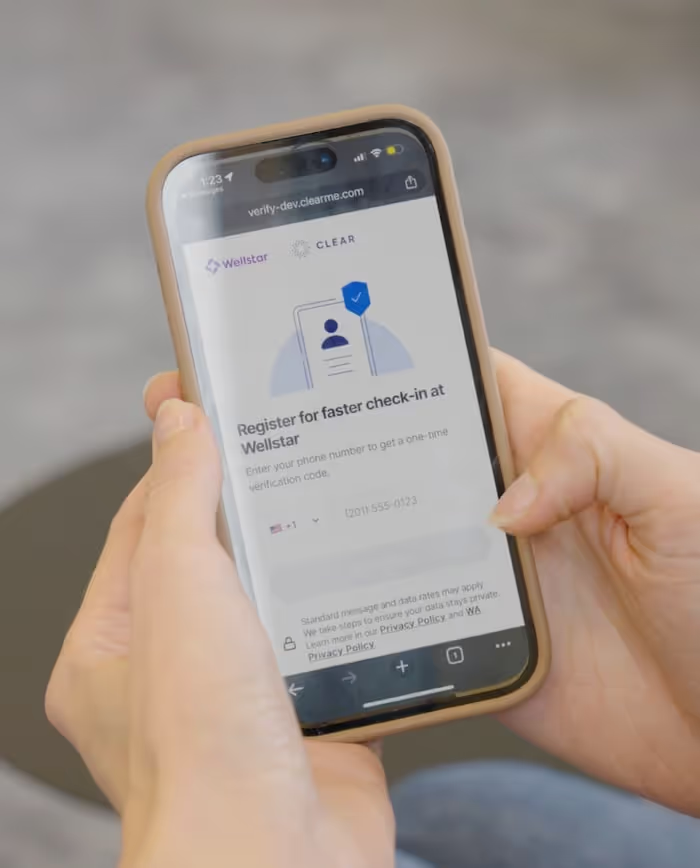
CLEAR1 offers pre-built integrations with Okta, Ping, and Microsoft Entra amongst other enterprise systems, as well as Epic integrations for healthcare workflows. Organizations can integrate natively into iOS and Android apps or deploy across desktop and mobile web. CLEAR1 is designed to meet IAL2, AAL2, and HIPAA requirements, and its presentation attack detection is PAD2 certified. CLEAR1 is also backed by more than 16 years of experience operating in highly regulated environments.
Where it fits and where it doesn't: CLEAR1 is built for enterprise and regulated deployments where person-based assurance, privacy, and repeat verification matter. Its network advantage is strongest with U.S. consumer audiences and organizations that expect users to return across multiple workflows. Teams seeking a broader fraud, AML, or transaction-monitoring platform may pair it with complementary risk tools.
Pricing model: Sales-led and quote-based, typically shaped by use case, volume, integrations, assurance requirements, and support model.
Proof points include a 54% reduction in account-related support calls at Community Health Network and 30 fraudulent applicants flagged per day at Snappt. See the Community Health Network case study and Snappt case study.
2. Persona
Best for: Teams that want to assemble and iterate on their own verification workflows.
What it is: Persona is a configurable platform built around modular workflows. Teams can combine document checks, biometrics, database verification, watchlists, case management, and other controls for different journeys and risk levels. Its no-code workflow builder and developer tools make it a natural fit for product teams that want control over the verification experience rather than a fixed, vendor-defined path.
Key capabilities: Persona is commonly considered across KYC, KYB, AML, age assurance, fraud investigations, and identity verification. Its flexibility can support different flows for different markets, customer types, or risk levels.
Where it fits and where it doesn't: Persona is a strong candidate for organizations with the product and compliance resources to design, govern, test, and maintain verification logic. The tradeoff is that configurability puts more responsibility on the buyer. Layers that can be switched off can become layers that aren't applied consistently, so teams should define a minimum assurance standard before building workflows.
Pricing model: Public plan options may be available for smaller deployments, with enterprise pricing typically quote-based. Confirm current tiers, inclusions, and volume terms directly with Persona.
3. Jumio
Best for: Large regulated enterprises that want identity verification and AML/KYC screening under one contract.
What it is: Jumio combines identity document checks, selfie verification, liveness detection, risk signals, and compliance screening in an enterprise platform. Its product is oriented toward onboarding and ongoing customer verification in regulated industries.
Key capabilities: Jumio’s identity verification flow evaluates an ID, a selfie with liveness detection, and risk-based signals. Its broader portfolio includes AML screening, watchlist checks, government database checks, address checks, and ongoing monitoring. This gives regulated teams a path to combine identity proofing and compliance workflows in one operating model.
Where it fits and where it doesn't: Jumio fits organizations that need mature document coverage, compliance functionality, and enterprise-scale operations. Buyers should still ask how the platform connects the verified document to the person presenting it, how repeat verification works, and which controls are required versus optional. Sales-led enterprise contracts and add-on modules may put the platform out of range for smaller deployments.
Pricing model: Quote-based and sales-led. Pricing depends on volume, document and country coverage, screening modules, monitoring, implementation, and support.
4. Onfido (now Entrust IDV)
Best for: Buyers who want identity verification within a broader digital trust, PKI, authentication, and security portfolio.
What it is: Onfido is now Entrust Identity Verification following Entrust’s acquisition of Onfido in 2024. The offering combines document verification, biometric verification, data verification, fraud detection, and workflow tooling. Readers searching for Onfido will find the product and documentation increasingly under the Entrust IDV name.
Key capabilities: Entrust IDV supports mobile capture, document and biometric checks, liveness, data verification, and workflow orchestration. Entrust also positions identity verification alongside account recovery, workforce verification, authentication, and digital signing. Its integrations with platforms such as Microsoft Entra and Okta can help teams connect identity proofing to existing access workflows.
Where it fits and where it doesn't: Entrust IDV is a fit for organizations that want identity verification to sit inside a broader security and trust portfolio. Its center of gravity remains document and biometric capture at onboarding, so buyers should evaluate how much of the wider portfolio they actually need and how reusable identity works across their own journeys.
Pricing model: Enterprise, sales-led, and generally quote-based. Confirm current contract structure, minimums, modules, and data-processing terms.
5. Socure
Best for: U.S. financial services teams whose primary threat is synthetic identity and first-party fraud.
What it is: Socure takes a data-centric approach to identity decisioning. Rather than making document capture the starting point for every user, it can evaluate identity, behavioral, contact, and other risk signals first, escalating users to additional checks when needed.
Key capabilities: Socure is known for predictive identity models, data corroboration, fraud decisioning, and tools designed to support financial services and other high-volume U.S. use cases. This data-first approach can reduce friction for users who can be verified through trusted signals without completing a full document-and-selfie flow.
Where it fits and where it doesn't: Socure is a strong fit when the primary challenge is synthetic identity, thin-file identity, or fraud decisioning in the U.S. Its central tradeoff is the distinction between corroborating that an identity exists and confirming that the person in the current session is its owner. Buyers protecting account recovery, sensitive data access, or other high-risk moments should ask how Socure confirms the live person behind the identity data.
Pricing model: Quote-based and shaped by volume, data modules, risk products, and deployment scope.
6. Stripe Identity
Best for: Teams already building on Stripe that want a verification step without onboarding a separate identity vendor.
What it is: Stripe Identity provides a hosted and embeddable document-and-selfie verification flow that fits naturally into the Stripe ecosystem. It's designed for teams that want to add identity verification to an existing payment, marketplace, or platform workflow.
Key capabilities: Stripe Identity supports document capture, selfie checks, liveness, APIs, webhooks, and dashboard-based review. The developer experience and native Stripe connection can make implementation straightforward for teams that already use Stripe for payments and account operations.
Where it fits and where it doesn't: Stripe Identity is a practical choice for a focused verification requirement inside the Stripe stack. It's less suited to organizations looking for a broader enterprise identity program with extensive IAM integrations, a configurable assurance framework, or a reusable identity network that spans multiple ecosystems and high-risk moments.
Pricing model: Usage-based and publicly priced for core checks, with current rates subject to change. Confirm pricing, country coverage, retries, and any volume terms directly with Stripe.
7. Veriff
Best for: High-volume consumer onboarding where conversion rate, speed, and international document coverage drive the buying decision.
What it is: Veriff provides automated identity verification with document analysis, biometric signals, liveness, and session-level fraud indicators. Its platform is designed for digital businesses verifying consumers across markets and user populations.
Key capabilities: Veriff is known for broad document and country coverage, hosted verification pages, web and mobile SDKs, automated decisions, analytics, and review workflows. This can help teams scale an onboarding flow without building every capture and review capability in-house.
Where it fits and where it doesn't: Veriff is a natural candidate for organizations prioritizing document-led verification across many markets and wanting a high-volume onboarding operation. Buyers whose users return frequently should evaluate the repeat experience carefully. If returning users must capture documents or complete the same onboarding flow again, the conversion advantage may be concentrated in the first verification rather than the full identity lifecycle.
Pricing model: Usage-based or quote-based depending on volume, plan, and support requirements. Confirm current per-verification pricing, minimums, retries, and manual review terms.
8. Mitek
Best for: Large financial institutions and organizations with document-heavy verification requirements.
What it is: Mitek has a long history in mobile capture, document imaging, and financial services workflows. Its identity capabilities support document verification, biometric checks, data signals, and enterprise integrations, with particular depth in document-led use cases.
Key capabilities: Mitek is known for document capture, document authenticity analysis, mobile SDKs, and NFC chip reading for supported passports and identity documents. Its broader platform can connect identity proofing with risk assessment and ongoing authentication, depending on the product configuration.
Where it fits and where it doesn't: Mitek fits financial institutions and other enterprises that already rely on document imaging or need deep document and capture capabilities. Its document-centric design can be an advantage when the workflow is built around credential validation. Buyers should also examine how the platform verifies the person behind the document, how repeat verification works, and how much implementation and procurement effort the deployment requires.
Pricing model: Enterprise and generally sales-quoted. Confirm whether the proposed model is per verification, per authentication, per user, or a broader platform license.
9. LexisNexis Risk Solutions
Best for: Buyers that need deep U.S. identity data corroboration at scale, often alongside existing risk and compliance workflows.
What it is: LexisNexis Risk Solutions offers identity verification and identity intelligence products that draw on extensive data assets, risk signals, and fraud and compliance tooling. It helps organizations validate identity information against trusted data sources.
Key capabilities: The portfolio includes data matching, risk scoring, device intelligence, identity verification, and fraud prevention tools. These signals can help organizations evaluate whether identity details are consistent, connected, and plausible within a larger risk decision.
Where it fits and where it doesn't: LexisNexis Risk Solutions is a strong fit for U.S.-centric organizations with data-rich verification and risk requirements. It's also a useful place to retire knowledge-based authentication as a default standard. Last-four-of-SSN questions, addresses, and other out-of-wallet facts may be available in breached data, so knowing the answer doesn't prove that the person requesting access is the identity owner. Teams that need direct person-level verification should ask how data corroboration is paired with biometric or other live-person controls.
Pricing model: Enterprise and quote-based, shaped by data products, transaction volume, risk modules, implementation, and coverage.
Identity Verification Services Compared: How They Stack Up
The comparison below keeps the questions practical: what type of verification model does each provider use, what happens when a user returns, how are biometrics handled, and how well does the service fit an existing identity stack?
The table highlights the central tradeoff: document-led and data-led services can fit focused onboarding or fraud use cases, while multi-layered platforms connect the document to the live person and corroborate both with device signals and verified data from onboarding through account recovery and other high-risk actions.
Which Identity Verification Service is Right for You?
Choose among identity verification companies based on the moments you need to protect, not on a generic feature checklist. The right choice depends on your users, risk, geography, existing stack, and how often people return after their first verification.
You operate in a regulated industry and have returning users.
Start with CLEAR1, Jumio, or Entrust IDV. Compare person-based assurance, repeat verification, privacy design, and how each service connects to account recovery, sensitive access, and other high-risk workflows. A document-only onboarding decision may not carry enough assurance into the rest of the customer lifecycle.
You need global consumer onboarding at high volume.
Evaluate Veriff, Jumio, Entrust IDV, and Mitek based on document coverage, decision speed, manual review, completion by cohort, and geographic reach. Ask what returning users do after onboarding and whether the platform avoids repeat document capture or sends them through the initial flow again.
Your product team needs to build custom workflows.
Persona is a natural candidate when configurability, branded experiences, and workflow ownership are central requirements. Make sure your team can define a minimum assurance baseline, manage change control, and measure whether the flexibility improves outcomes rather than creating inconsistent controls.
You already run on Stripe.
Stripe Identity may be the most efficient option when the requirement is a focused verification step inside an existing Stripe workflow. Its ecosystem fit and usage-based model can outweigh the need for a broader identity program, especially for a straightforward onboarding or marketplace use case.
Your primary problem is U.S. synthetic identity or first-party fraud.
Socure and LexisNexis Risk Solutions are worth evaluating for data-rich identity decisioning, risk signals, and corroboration. If the workflow protects account recovery or high-value access, add a direct question about how the platform confirms the person in the current session.
You need workforce and IAM-driven verification.
Compare CLEAR1 and Persona with your existing Okta, Ping, or Microsoft Entra architecture. Native Microsoft Entra integration can help move identity-first recovery and access decisions into existing workflows. The Community Health Network case study shows how this can reduce help desk pressure.
The Future of Identity Verification
The next 12 to 18 months will raise expectations for identity assurance. Deepfake and injection attacks are targeting remote capture, while synthetic identity campaigns are making it easier to assemble convincing but incomplete identities at scale. Document-only checks remain useful, but they're increasingly insufficient for high-risk decisions that depend on verifying the person behind the document.
These threats are also changing how enterprise buyers evaluate identity verification providers. NIST 800-63 is prompting more detailed procurement conversations, and security teams want to know where biometric data goes after verification, who controls it, and what the organization actually receives. In response, multi-layered identity verification, explicit consent, and data minimization are becoming part of the buying standard.
Those expectations extend beyond the first verification. A successful first verification should make the next high-risk interaction faster, rather than force a person to repeat the same document workflow. Reusable identity is becoming an important part of that conversation because it can help people move through later high-risk interactions without starting over. The multi-layered identity framework explains how identity verification can support that model.
See How CLEAR1 Sets the Standard for Identity Verification Services in 2026
CLEAR1 brings together person-based verification, document authenticity, liveness detection, source validation, and device signals so organizations can verify identity across onboarding, account recovery, sensitive access, and other high-risk workflows.
{{cta-block}}
Frequently Asked Questions
What is an identity verification service?
An identity verification service helps an organization confirm that a person is who they claim to be. Depending on the use case, it may analyze a government-issued document, compare a live selfie to the document photo, check liveness, corroborate identity details, or combine several signals. Verification establishes identity assurance; authentication helps recognize the person when they return.
What should I look for when comparing identity verification providers?
Compare person-based assurance, document authenticity, liveness and presentation attack detection, reusable identity, privacy and biometric data handling, integrations, coverage, compliance, user experience, and pricing. Ask each vendor what happens at account recovery and other high-risk moments, not only at onboarding. The strongest comparison evaluates the complete identity lifecycle.
What is the difference between identity verification and authentication?
Identity verification establishes or strengthens the connection between a person and a real-world identity. Authentication recognizes that person when they return using a credential, device, biometric, or other factor. Authentication can confirm control of an account or device, but it doesn't always prove that the person requesting access is the rightful identity owner.
How do identity verification services handle biometric data?
Identity verification services may process biometric data to perform liveness detection and face matching, but their data practices differ. Ask whether the vendor acts as a biometric controller, whether it shares raw biometric data, how consent and retention work, and whether your organization receives only the verification result and explicitly consented attributes.
Which identity verification service is best for regulated industries?
The best identity verification service for a regulated industry depends on the required assurance level, jurisdictions, integrations, compliance scope, and user journey. CLEAR1, Jumio, and Entrust IDV are candidates for regulated organizations that need document and biometric controls; Socure and LexisNexis Risk Solutions may fit data-centric U.S. risk programs. Validate requirements with legal and compliance teams.
What makes CLEAR1 different from other identity verification services?
CLEAR1 combines multi-layered identity assurance with reusable identity, a minimum assurance baseline, privacy-conscious biometric handling, and pre-built IAM and healthcare integrations. More than 43 million existing CLEAR users can verify with a selfie, while new users complete a one-time setup before re-verifying across participating workflows. CLEAR1 is built to verify the person beyond the device.
Learn how CLEAR1 helps secure organizations.
Get a DemoDocument verification can confirm that an ID is real, but a genuine document can still be presented by someone who isn't its owner. Identity verification goes a step further, asking: Does the person presenting the ID match the identity on the document?
For security, product, compliance, and operations leaders, that distinction matters. The right platform should do more than inspect a document at high-risk moments—it should help confirm the person behind it, defend against deepfake attacks, protect critical touchpoints such as account recovery, and keep repeat verification fast for legitimate users.
This guide evaluates nine leading providers against the same criteria: document and biometric checks, liveness and presentation attack detection, reusable identity, privacy design, integrations, compliance coverage, user experience, and pricing. CLEAR1 publishes this comparison and appears first as the multi-layered benchmark. The remaining services aren't ranked against one another. Instead, this guide focuses on fit: each provider's capabilities, ideal use cases, and role in an enterprise identity program.
What is an Identity Verification Service?
An identity verification service helps an organization determine whether a person is who they claim to be. Depending on the use case, the service may inspect a government-issued document, compare a live selfie to the document photo, assess liveness, corroborate identity details against trusted sources, analyze device signals, or combine several of these checks.
The distinction between verification and authentication matters. Verification establishes or strengthens the connection between a person and a real-world identity. Authentication helps recognize that person when they return. In a typical recovery flow, a user may reset a password, replace an MFA factor, or use a backup code. Those steps restore access, but they don't establish that the person requesting the reset is the account holder. Identity verification closes that gap by confirming that the person requesting access matches the verified identity associated with the account.
What to Look for in an Identity Verification Service
The best identity verification solutions aren't about the number of checks—they're about how those checks work together, how consistently they're applied, and what happens after the first successful verification. Use these questions to evaluate each vendor during a demo.
Person-based verification, not document verification alone
A genuine document doesn't prove that the person presenting it is the owner. Document-only verification may be sufficient for low-risk, one-time onboarding, but it provides less assurance when a user returns to recover an account, access sensitive data, or complete a high-risk action. Look for a match between the selfie and the ID portrait, liveness detection, and other checks that link the document to the person in front of the camera. Ask: “What confirms that the person presenting the document is the person named on it?”
Liveness and presentation attack detection
A selfie check should distinguish a live person from a photo, replayed video, mask, deepfake, or injected media. Ask: “How do you test for presentation attacks and injection attacks, and what independent certification or testing supports that claim?”
A clear minimum assurance bar
Configurability can help teams adapt to different risk levels, but it can also create inconsistency when critical checks are optional. Ask: “Which checks are always required, and can teams turn off biometric verification or rely on document-only verification instead?”
Reusable identity and the returning user experience
A one-time verification should create value beyond the first interaction. Reusable identity can let returning users verify with a selfie instead of repeating document capture. Ask: “How does the experience work when a returning user needs account recovery, step-up access, or another high-risk action?”
Privacy and biometric data control
Enterprise buyers should understand what the vendor collects, stores, shares, and deletes. A secure biometric controller can manage the sensitive biometric layer and return only the verification result and consented attributes. Ask: “Do we receive raw biometric data, or only the decision and the data the user explicitly consented to share?”
Integrations and deployment effort
The right platform should fit the identity stack already in place. Look for native or pre-built integrations with IAM platforms such as Okta, Ping, and Microsoft Entra, along with other enterprise and healthcare systems and tools where relevant. Ask: “How much custom development is required to deploy, test, monitor, and update the verification flow?”
Coverage, compliance, and total cost
Review document and geographic coverage, how the service fits into KYC and AML workflows, and how it supports applicable privacy and compliance requirements, including GDPR, HIPAA, and BIPA. Also evaluate audit evidence, manual review, retries, and support. Pricing may be per verification, per completed session, subscription-based, or sales-led. Ask: “What is the effective cost per verified person after retries, escalations, manual review, and repeat verification?”
The 9 Best Identity Verification Services for 2026
In the list below, CLEAR1 appears first as the multi-layered benchmark for person-based verification and reusable identity. The remaining eight entries aren't ranked against one another; each takes a different approach to coverage, configurability, data depth, ecosystem fit, and deployment model.
1. CLEAR1
Best for: Enterprises in regulated industries that need person-based assurance during onboarding and reusable identity for returning users.
What it is: CLEAR1 is an identity platform that takes a multi-layered approach, combining biometric verification, document authenticity, biometric matching, liveness detection, source validation, and device security signals.
Key capabilities: CLEAR1 analyzes hundreds of real-time signals across biometrics, documents, devices, and verified data sources. Its identity framework starts with Vertix, a minimum assurance baseline that can't be configured away. That baseline is designed to create consistent identity assurance across implementations rather than leaving critical controls to the preferences of an individual workflow builder. Organizations can then apply additional controls for higher-risk use cases.
The model also supports reusable identity. More than 43 million existing CLEAR users can verify with a selfie, while new users complete a one-time setup before re-verifying across participating CLEAR partners. That's especially valuable at account recovery, MFA enrollment, and step-up access.
Privacy and integrations: CLEAR1 acts as a secure biometric controller. It handles the sensitive biometric layer, providing the verification result and only the attributes the user has explicitly consented to share. That approach makes the collection and processing of biometric data a procurement question rather than an implementation afterthought.
CLEAR1 offers pre-built integrations with Okta, Ping, and Microsoft Entra amongst other enterprise systems, as well as Epic integrations for healthcare workflows. Organizations can integrate natively into iOS and Android apps or deploy across desktop and mobile web. CLEAR1 is designed to meet IAL2, AAL2, and HIPAA requirements, and its presentation attack detection is PAD2 certified. CLEAR1 is also backed by more than 16 years of experience operating in highly regulated environments.
Where it fits and where it doesn't: CLEAR1 is built for enterprise and regulated deployments where person-based assurance, privacy, and repeat verification matter. Its network advantage is strongest with U.S. consumer audiences and organizations that expect users to return across multiple workflows. Teams seeking a broader fraud, AML, or transaction-monitoring platform may pair it with complementary risk tools.
Pricing model: Sales-led and quote-based, typically shaped by use case, volume, integrations, assurance requirements, and support model.
Proof points include a 54% reduction in account-related support calls at Community Health Network and 30 fraudulent applicants flagged per day at Snappt. See the Community Health Network case study and Snappt case study.
2. Persona
Best for: Teams that want to assemble and iterate on their own verification workflows.
What it is: Persona is a configurable platform built around modular workflows. Teams can combine document checks, biometrics, database verification, watchlists, case management, and other controls for different journeys and risk levels. Its no-code workflow builder and developer tools make it a natural fit for product teams that want control over the verification experience rather than a fixed, vendor-defined path.
Key capabilities: Persona is commonly considered across KYC, KYB, AML, age assurance, fraud investigations, and identity verification. Its flexibility can support different flows for different markets, customer types, or risk levels.
Where it fits and where it doesn't: Persona is a strong candidate for organizations with the product and compliance resources to design, govern, test, and maintain verification logic. The tradeoff is that configurability puts more responsibility on the buyer. Layers that can be switched off can become layers that aren't applied consistently, so teams should define a minimum assurance standard before building workflows.
Pricing model: Public plan options may be available for smaller deployments, with enterprise pricing typically quote-based. Confirm current tiers, inclusions, and volume terms directly with Persona.
3. Jumio
Best for: Large regulated enterprises that want identity verification and AML/KYC screening under one contract.
What it is: Jumio combines identity document checks, selfie verification, liveness detection, risk signals, and compliance screening in an enterprise platform. Its product is oriented toward onboarding and ongoing customer verification in regulated industries.
Key capabilities: Jumio’s identity verification flow evaluates an ID, a selfie with liveness detection, and risk-based signals. Its broader portfolio includes AML screening, watchlist checks, government database checks, address checks, and ongoing monitoring. This gives regulated teams a path to combine identity proofing and compliance workflows in one operating model.
Where it fits and where it doesn't: Jumio fits organizations that need mature document coverage, compliance functionality, and enterprise-scale operations. Buyers should still ask how the platform connects the verified document to the person presenting it, how repeat verification works, and which controls are required versus optional. Sales-led enterprise contracts and add-on modules may put the platform out of range for smaller deployments.
Pricing model: Quote-based and sales-led. Pricing depends on volume, document and country coverage, screening modules, monitoring, implementation, and support.
4. Onfido (now Entrust IDV)
Best for: Buyers who want identity verification within a broader digital trust, PKI, authentication, and security portfolio.
What it is: Onfido is now Entrust Identity Verification following Entrust’s acquisition of Onfido in 2024. The offering combines document verification, biometric verification, data verification, fraud detection, and workflow tooling. Readers searching for Onfido will find the product and documentation increasingly under the Entrust IDV name.
Key capabilities: Entrust IDV supports mobile capture, document and biometric checks, liveness, data verification, and workflow orchestration. Entrust also positions identity verification alongside account recovery, workforce verification, authentication, and digital signing. Its integrations with platforms such as Microsoft Entra and Okta can help teams connect identity proofing to existing access workflows.
Where it fits and where it doesn't: Entrust IDV is a fit for organizations that want identity verification to sit inside a broader security and trust portfolio. Its center of gravity remains document and biometric capture at onboarding, so buyers should evaluate how much of the wider portfolio they actually need and how reusable identity works across their own journeys.
Pricing model: Enterprise, sales-led, and generally quote-based. Confirm current contract structure, minimums, modules, and data-processing terms.
5. Socure
Best for: U.S. financial services teams whose primary threat is synthetic identity and first-party fraud.
What it is: Socure takes a data-centric approach to identity decisioning. Rather than making document capture the starting point for every user, it can evaluate identity, behavioral, contact, and other risk signals first, escalating users to additional checks when needed.
Key capabilities: Socure is known for predictive identity models, data corroboration, fraud decisioning, and tools designed to support financial services and other high-volume U.S. use cases. This data-first approach can reduce friction for users who can be verified through trusted signals without completing a full document-and-selfie flow.
Where it fits and where it doesn't: Socure is a strong fit when the primary challenge is synthetic identity, thin-file identity, or fraud decisioning in the U.S. Its central tradeoff is the distinction between corroborating that an identity exists and confirming that the person in the current session is its owner. Buyers protecting account recovery, sensitive data access, or other high-risk moments should ask how Socure confirms the live person behind the identity data.
Pricing model: Quote-based and shaped by volume, data modules, risk products, and deployment scope.
6. Stripe Identity
Best for: Teams already building on Stripe that want a verification step without onboarding a separate identity vendor.
What it is: Stripe Identity provides a hosted and embeddable document-and-selfie verification flow that fits naturally into the Stripe ecosystem. It's designed for teams that want to add identity verification to an existing payment, marketplace, or platform workflow.
Key capabilities: Stripe Identity supports document capture, selfie checks, liveness, APIs, webhooks, and dashboard-based review. The developer experience and native Stripe connection can make implementation straightforward for teams that already use Stripe for payments and account operations.
Where it fits and where it doesn't: Stripe Identity is a practical choice for a focused verification requirement inside the Stripe stack. It's less suited to organizations looking for a broader enterprise identity program with extensive IAM integrations, a configurable assurance framework, or a reusable identity network that spans multiple ecosystems and high-risk moments.
Pricing model: Usage-based and publicly priced for core checks, with current rates subject to change. Confirm pricing, country coverage, retries, and any volume terms directly with Stripe.
7. Veriff
Best for: High-volume consumer onboarding where conversion rate, speed, and international document coverage drive the buying decision.
What it is: Veriff provides automated identity verification with document analysis, biometric signals, liveness, and session-level fraud indicators. Its platform is designed for digital businesses verifying consumers across markets and user populations.
Key capabilities: Veriff is known for broad document and country coverage, hosted verification pages, web and mobile SDKs, automated decisions, analytics, and review workflows. This can help teams scale an onboarding flow without building every capture and review capability in-house.
Where it fits and where it doesn't: Veriff is a natural candidate for organizations prioritizing document-led verification across many markets and wanting a high-volume onboarding operation. Buyers whose users return frequently should evaluate the repeat experience carefully. If returning users must capture documents or complete the same onboarding flow again, the conversion advantage may be concentrated in the first verification rather than the full identity lifecycle.
Pricing model: Usage-based or quote-based depending on volume, plan, and support requirements. Confirm current per-verification pricing, minimums, retries, and manual review terms.
8. Mitek
Best for: Large financial institutions and organizations with document-heavy verification requirements.
What it is: Mitek has a long history in mobile capture, document imaging, and financial services workflows. Its identity capabilities support document verification, biometric checks, data signals, and enterprise integrations, with particular depth in document-led use cases.
Key capabilities: Mitek is known for document capture, document authenticity analysis, mobile SDKs, and NFC chip reading for supported passports and identity documents. Its broader platform can connect identity proofing with risk assessment and ongoing authentication, depending on the product configuration.
Where it fits and where it doesn't: Mitek fits financial institutions and other enterprises that already rely on document imaging or need deep document and capture capabilities. Its document-centric design can be an advantage when the workflow is built around credential validation. Buyers should also examine how the platform verifies the person behind the document, how repeat verification works, and how much implementation and procurement effort the deployment requires.
Pricing model: Enterprise and generally sales-quoted. Confirm whether the proposed model is per verification, per authentication, per user, or a broader platform license.
9. LexisNexis Risk Solutions
Best for: Buyers that need deep U.S. identity data corroboration at scale, often alongside existing risk and compliance workflows.
What it is: LexisNexis Risk Solutions offers identity verification and identity intelligence products that draw on extensive data assets, risk signals, and fraud and compliance tooling. It helps organizations validate identity information against trusted data sources.
Key capabilities: The portfolio includes data matching, risk scoring, device intelligence, identity verification, and fraud prevention tools. These signals can help organizations evaluate whether identity details are consistent, connected, and plausible within a larger risk decision.
Where it fits and where it doesn't: LexisNexis Risk Solutions is a strong fit for U.S.-centric organizations with data-rich verification and risk requirements. It's also a useful place to retire knowledge-based authentication as a default standard. Last-four-of-SSN questions, addresses, and other out-of-wallet facts may be available in breached data, so knowing the answer doesn't prove that the person requesting access is the identity owner. Teams that need direct person-level verification should ask how data corroboration is paired with biometric or other live-person controls.
Pricing model: Enterprise and quote-based, shaped by data products, transaction volume, risk modules, implementation, and coverage.
Identity Verification Services Compared: How They Stack Up
The comparison below keeps the questions practical: what type of verification model does each provider use, what happens when a user returns, how are biometrics handled, and how well does the service fit an existing identity stack?
The table highlights the central tradeoff: document-led and data-led services can fit focused onboarding or fraud use cases, while multi-layered platforms connect the document to the live person and corroborate both with device signals and verified data from onboarding through account recovery and other high-risk actions.
Which Identity Verification Service is Right for You?
Choose among identity verification companies based on the moments you need to protect, not on a generic feature checklist. The right choice depends on your users, risk, geography, existing stack, and how often people return after their first verification.
You operate in a regulated industry and have returning users.
Start with CLEAR1, Jumio, or Entrust IDV. Compare person-based assurance, repeat verification, privacy design, and how each service connects to account recovery, sensitive access, and other high-risk workflows. A document-only onboarding decision may not carry enough assurance into the rest of the customer lifecycle.
You need global consumer onboarding at high volume.
Evaluate Veriff, Jumio, Entrust IDV, and Mitek based on document coverage, decision speed, manual review, completion by cohort, and geographic reach. Ask what returning users do after onboarding and whether the platform avoids repeat document capture or sends them through the initial flow again.
Your product team needs to build custom workflows.
Persona is a natural candidate when configurability, branded experiences, and workflow ownership are central requirements. Make sure your team can define a minimum assurance baseline, manage change control, and measure whether the flexibility improves outcomes rather than creating inconsistent controls.
You already run on Stripe.
Stripe Identity may be the most efficient option when the requirement is a focused verification step inside an existing Stripe workflow. Its ecosystem fit and usage-based model can outweigh the need for a broader identity program, especially for a straightforward onboarding or marketplace use case.
Your primary problem is U.S. synthetic identity or first-party fraud.
Socure and LexisNexis Risk Solutions are worth evaluating for data-rich identity decisioning, risk signals, and corroboration. If the workflow protects account recovery or high-value access, add a direct question about how the platform confirms the person in the current session.
You need workforce and IAM-driven verification.
Compare CLEAR1 and Persona with your existing Okta, Ping, or Microsoft Entra architecture. Native Microsoft Entra integration can help move identity-first recovery and access decisions into existing workflows. The Community Health Network case study shows how this can reduce help desk pressure.
The Future of Identity Verification
The next 12 to 18 months will raise expectations for identity assurance. Deepfake and injection attacks are targeting remote capture, while synthetic identity campaigns are making it easier to assemble convincing but incomplete identities at scale. Document-only checks remain useful, but they're increasingly insufficient for high-risk decisions that depend on verifying the person behind the document.
These threats are also changing how enterprise buyers evaluate identity verification providers. NIST 800-63 is prompting more detailed procurement conversations, and security teams want to know where biometric data goes after verification, who controls it, and what the organization actually receives. In response, multi-layered identity verification, explicit consent, and data minimization are becoming part of the buying standard.
Those expectations extend beyond the first verification. A successful first verification should make the next high-risk interaction faster, rather than force a person to repeat the same document workflow. Reusable identity is becoming an important part of that conversation because it can help people move through later high-risk interactions without starting over. The multi-layered identity framework explains how identity verification can support that model.
See How CLEAR1 Sets the Standard for Identity Verification Services in 2026
CLEAR1 brings together person-based verification, document authenticity, liveness detection, source validation, and device signals so organizations can verify identity across onboarding, account recovery, sensitive access, and other high-risk workflows.
{{cta-block}}


