






Gartner®, Deepfake Identity Threats: Mitigate Risk in Identity Verification and Face Biometrics, Akif Khan, Nayara Sangiorgio, James Hoover, 11 May 2026
Gartner® is a trademark of Gartner, Inc. and/or its affiliates.



Share


Share
Key Takeaways
- Medical identity theft is a patient safety and record integrity problem, not just a billing issue.
- Most public guidance asks patients to spot fraud after the fact, even though health systems control the access points where medical identity theft actually begins.
- Modern attacks target portals, call centers, and digital check-in—not just stolen insurance cards at the front desk.
- Proactive, multi-layered patient identity proofing at key touchpoints is becoming the new standard of care—and CLEAR1 brings that identity assurance into the workflows health systems use, maximizing security and minimizing friction across the health journey.
What Medical Identity Theft is, and How It Differs from Financial Identity Theft
Medical identity theft occurs when someone uses another person’s identity, coverage, or credentials to access care, prescriptions, or protected health information.
With financial identity theft, a bank can close a fraudulent account and remove it from a credit report. With healthcare identity theft, the record itself gets contaminated. Clinical data entered under a stolen identity merges into the real patient’s chart and then travels through the EHR, health information exchanges, and claims history. That contamination is hard to see and even harder to unwind.
Another differentiator between the two kinds of theft is discovery. Financial fraud often surfaces within weeks through real-time alerts. Medical identity theft usually surfaces at the next encounter—a denied claim, an unfamiliar explanation of benefits, a collections notice, or a clinician reading a history that doesn’t match the patient in front of them.
The third distinction is who has the power to act. In financial identity theft, people can freeze their credit and close accounts. In medical identity, it’s health systems—not patients—that hold the records, control the access points, and carry the regulatory and patient safety exposure.
How Medical Identity Theft Happens
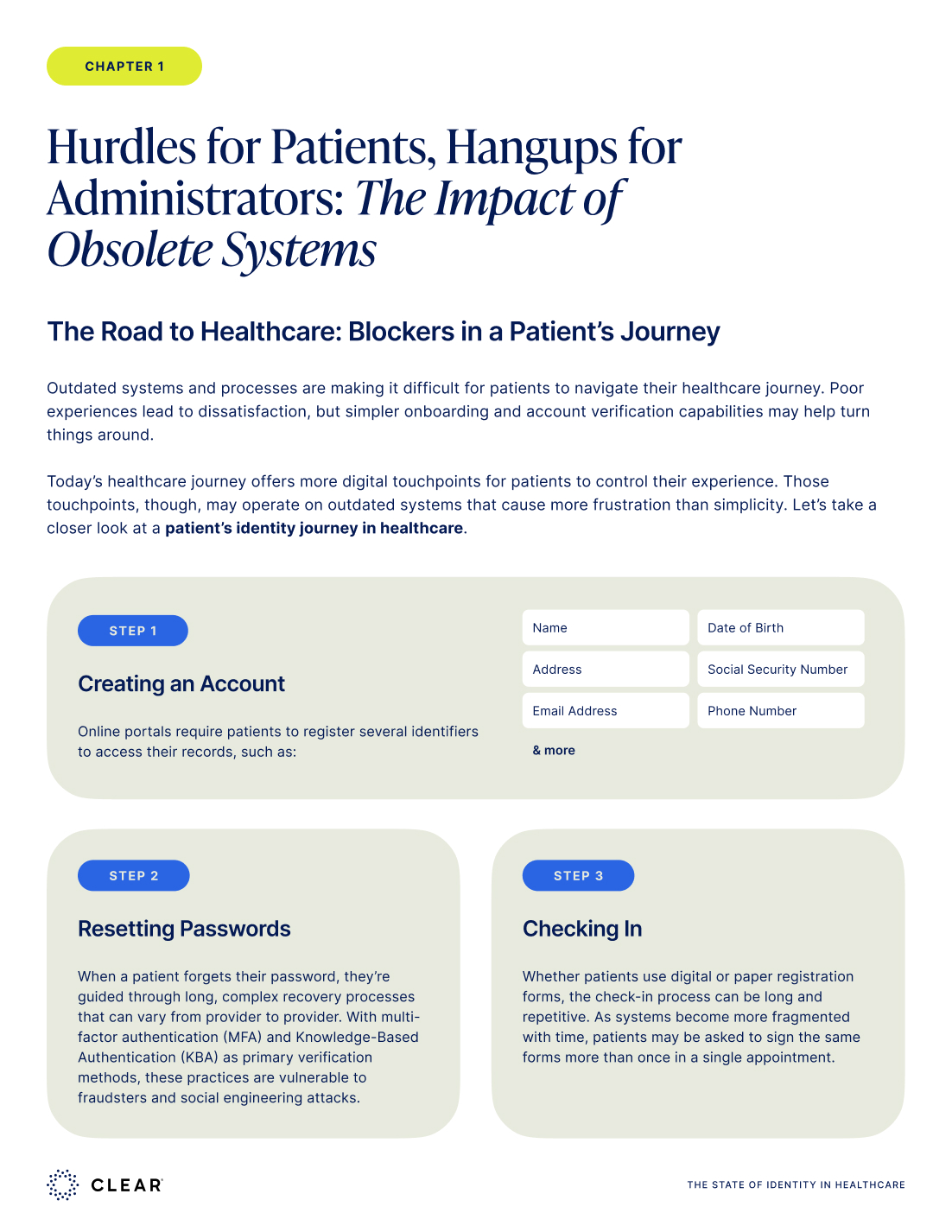
Medical identity theft mostly occurs through the same digital touchpoints that health systems rely on to serve patients. Fraud succeeds when an access point treats identity as a one-time, single-signal check. Common attack paths include:
- Stolen Credentials and Insurance Data
Compromised portal logins, stolen plan IDs, and password reuse let impostors step into an existing digital identity and act as the patient. - Portal Account Takeover
Attackers phish credentials or guess weak passwords, then log into patient portals, change contact details, download records, and schedule visits as the patient. - Password-Reset Social Engineering
Contact centers and help desks are under pressure to resolve issues quickly. When verification relies on static data or knowledge-based questions, a determined attacker can talk their way through a reset. - Synthetic Identities
Fraudsters blend real and fabricated information into believable “patients” that clear demographic validation but don’t correspond to a real person. - Insider Misuse
Staff with legitimate access can inappropriately view or alter records in ways patients can’t see or easily contest. - Impersonation at Check-In
Someone presenting a stolen insurance card at check-in can still get through if front-desk identity proofing is weak or inconsistent.
What It Costs the Health System
Patient Safety and Record Integrity
When an impostor receives care under a real patient’s identity, their diagnoses, medications, allergies, and labs don’t stay in isolation—they become part of that patient’s chart. Clinicians then make decisions on a record they believe they can trust. That’s why medical identity theft is first and foremost a patient safety and record integrity problem, not just a billing issue.
Privacy and Regulatory Exposure
Every incident of healthcare identity theft carries privacy and compliance consequences. When records are corrupted or exposed to the wrong person, health systems may have to notify patients, report a HIPAA breach, and respond to OCR or state investigations. Regulators then expect proof that the root cause is fixed, which means tightening identity controls at the access points where the theft took place.
Operational and Financial Drag
Behind each case is a long tail of work: manual chart reviews, record reconciliation, denials management, extra call-center volume, and coordination across compliance, legal, and revenue cycle teams. Healthcare breaches are among the costliest in any industry, and medical identity theft amplifies that impact by eroding trust in the data that clinicians and operations teams depend on every day.
Why Detection After the Fact is Not a Strategy
Most public guidance on medical identity theft speaks to patients, asking them to clean up after the fact by reviewing explanations of benefits, requesting records, and filing reports. That guidance matters, but it puts the responsibility on patients, who have the least visibility and the least control. By the time a patient spots a problem, the fraudster has already been seen, documented, and billed. The operational damage is done.
For Chief Privacy Officers and patient safety leaders, “wait for the patient to catch it” isn’t a strategy. Instead, treating medical identity theft as an access-control outcome that health systems own focuses defenses on the moments when identity is verified—not just when problems show up.
What Proactive Identity Assurance Looks Like
Preventing medical identity theft starts with moving from one-off checks to true identity assurance, built on four core elements:
- Multi-Layered Verification
In a multi-layered model, identity decisions draw on components such as biometrics, document authenticity, device and network signals, and authoritative data sources—not a single signal like a document image or basic device check. - Reusable Identity Instead of One-Off Proofing
After a strong first-time verification, patients shouldn’t have to re-upload documents or answer new questions at every interaction. A reusable identity model lets returning patients quickly confirm who they are—often with something as simple as a selfie—keeping trusted users moving. - Alignment with Emerging Standards
Treating access to deep medical records as an IAL2-level event—and pairing it with PAD2-certified liveness—helps defend against deepfakes and spoofing. Updated Joint Commission identity standards and NIST frameworks are increasingly shaping what “good” looks like for identity in healthcare. - Embedded in Existing Workflows
Identity assurance should run inside existing EHR, IAM, and contact center workflows—not as a separate portal or disconnected point solution. That way, teams can raise their identity standard without rebuilding their stack or adding new silos.
Where Health Systems Can Actually Stop Medical Identity Theft
The access points that enable medical identity theft are the same places health systems already run critical workflows. Strengthening identity at these touchpoints with CLEAR1 turns a patient burden into an institutional control.
Account Creation
Exposure: Data-only enrollment flows let an impostor with enough information open a portal or app account in someone else’s name and gain durable, remote access to protected health information.
Control: Treat enrollment as patient identity proofing, not just registration. Use multi-layered checks that combine biometric verification, document authenticity, device assurance, and source validation to confirm that the person creating the account is the rightful owner—not just someone who knows their credentials.
Account Recovery
Exposure: Password resets and account recovery are high-friction, high-pressure moments—and attackers know it. Legacy flows often lean on weak or outdated signals.
Control: Make account recovery a patient identity verification event, not just an IT task. CLEAR1 partners add person-based verification—such as selfie checks with PAD2-certified liveness and device assurance—into existing IAM and portal journeys.
Call Center Verification
Exposure: Contact centers and help desks are prime targets for social engineering. Weak scripts and static-data checks make it easier for impostors to change contact details or trigger resets.
Control: Embed step-up, person-based verification into call center flows—for example, by sending a secure link to complete a quick, multi-layered verification on a device. That gives agents a defensible, auditable identity decision instead of relying on a subjective human gut check.
Check-In
Exposure: Digital check-in flows often collect demographics and insurance data without confirming the person behind them, creating a new front door for medical identity theft and prescription abuse.
Control: Modern check-in should confirm that there’s a live person present, that the person matches an authentic government ID, and that identity details corroborate against verified sources.
Medical Record Access at IAL2
Exposure: As more of the longitudinal medical record becomes accessible through portals, APIs, and connected apps, traditional username-and-password authentication leaves deep data exposed to account takeover and healthcare identity theft.
Control: Treat access to full medical records as an IAL2-level event, pairing strong identity proofing with AAL2 authentication and PAD2-certified liveness so only the right person can see and manage their chart.
How Health Systems Are Fighting Back with CLEAR1
Leading health systems are partnering with CLEAR1 to treat medical identity fraud as a preventable access problem instead of an inevitable clean-up exercise, helping reduce medical identity fraud, protect clinical integrity, and improve both patient and workforce experience.
- Tampa General Hospital used CLEAR1 to modernize account recovery, automating 80% of recovery requests, cutting resolution times by 99%, and reducing account-related support calls by 22%.
- Community Health Network secured MyChart account creation with CLEAR1, achieving a 1.5x higher verification success rate, a 54% reduction in support calls, and a five-week time-to-launch.
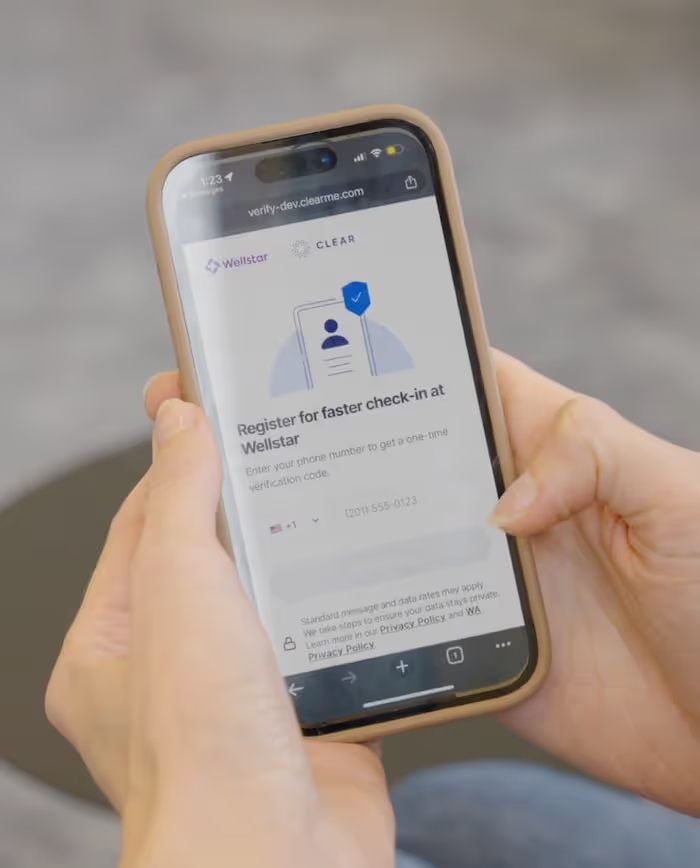
- Wellstar applied CLEAR1 to digital patient check-in, projecting $2M in potential savings per 25,000 patients, driving 5x growth in digital check-in adoption, and freeing more than 1,500 hours for staff to redirect to care.
Prevent Medical Identity Theft with CLEAR1
Medical identity theft isn’t going away, but health systems don’t have to absorb the risk alone.
CLEAR1 brings multi-layered, reusable identity assurance—aligned with NIST IAL2/AAL2, HIPAA, and PAD2-certified liveness—into the patient and workforce workflows you already use. Connect with our team to see how CLEAR1 can help close the identity gap across your access points.
Frequently Asked Questions
What is medical identity theft?
Medical identity theft, sometimes called medical identity fraud, happens when someone uses another person’s identity, insurance, or medical credentials to receive care, prescriptions, or access to protected health information. Unlike financial identity theft, it corrupts the clinical record itself, creating long-lived patient safety, privacy, and regulatory risk.
How does medical identity theft happen?
Healthcare identity theft can occur through stolen insurance cards, compromised portal credentials, social engineering of call centers, synthetic identities that pass demographic checks, insider misuse, or impersonation at check-in. Increasingly, attackers exploit digital touchpoints—like account recovery and digital check-in—where weak or outdated verification relies on static data alone.
How is medical identity theft different from financial identity theft?
Financial identity theft typically affects accounts and credit files that can be closed, disputed, and reissued. Medical identity theft alters the health record itself, blending an impostor’s information with a real patient’s chart. That contaminated record can quietly shape future care decisions and is much harder to unwind than fraudulent charges.
What are the warning signs of medical identity theft in a patient record?
Warning signs include unfamiliar diagnoses, procedures, or medications in the chart; demographic changes the patient didn’t request; explanations of benefits or bills for services they never received; denials tied to exhausted benefits; and portal activity from unusual locations or devices. Any of these can point to medical identity theft.
How can health systems prevent medical identity theft?
Health systems prevent medical identity theft by strengthening patient identity verification and treating identity as a multi-layered, reusable control. That means proofing patients at enrollment and recovery with biometrics, document checks, device assurance, and source validation, and aligning high‑risk actions with standards like NIST IAL2 instead of relying on patient monitoring alone.
What is IAL2, and why does it matter for medical record access?
IAL2 (Identity Assurance Level 2) is a NIST-defined standard for how rigorously an identity must be proofed before granting access. Applying IAL2 to deep medical record access helps ensure only the true patient can see or manage their chart, reducing healthcare identity theft risk while supporting regulatory, accreditation, and payer expectations.
What Medical Identity Theft is, and How It Differs from Financial Identity Theft
Medical identity theft occurs when someone uses another person’s identity, coverage, or credentials to access care, prescriptions, or protected health information.
With financial identity theft, a bank can close a fraudulent account and remove it from a credit report. With healthcare identity theft, the record itself gets contaminated. Clinical data entered under a stolen identity merges into the real patient’s chart and then travels through the EHR, health information exchanges, and claims history. That contamination is hard to see and even harder to unwind.
Another differentiator between the two kinds of theft is discovery. Financial fraud often surfaces within weeks through real-time alerts. Medical identity theft usually surfaces at the next encounter—a denied claim, an unfamiliar explanation of benefits, a collections notice, or a clinician reading a history that doesn’t match the patient in front of them.
The third distinction is who has the power to act. In financial identity theft, people can freeze their credit and close accounts. In medical identity, it’s health systems—not patients—that hold the records, control the access points, and carry the regulatory and patient safety exposure.
How Medical Identity Theft Happens
Medical identity theft mostly occurs through the same digital touchpoints that health systems rely on to serve patients. Fraud succeeds when an access point treats identity as a one-time, single-signal check. Common attack paths include:
- Stolen Credentials and Insurance Data
Compromised portal logins, stolen plan IDs, and password reuse let impostors step into an existing digital identity and act as the patient. - Portal Account Takeover
Attackers phish credentials or guess weak passwords, then log into patient portals, change contact details, download records, and schedule visits as the patient. - Password-Reset Social Engineering
Contact centers and help desks are under pressure to resolve issues quickly. When verification relies on static data or knowledge-based questions, a determined attacker can talk their way through a reset. - Synthetic Identities
Fraudsters blend real and fabricated information into believable “patients” that clear demographic validation but don’t correspond to a real person. - Insider Misuse
Staff with legitimate access can inappropriately view or alter records in ways patients can’t see or easily contest. - Impersonation at Check-In
Someone presenting a stolen insurance card at check-in can still get through if front-desk identity proofing is weak or inconsistent.
What It Costs the Health System
Patient Safety and Record Integrity
When an impostor receives care under a real patient’s identity, their diagnoses, medications, allergies, and labs don’t stay in isolation—they become part of that patient’s chart. Clinicians then make decisions on a record they believe they can trust. That’s why medical identity theft is first and foremost a patient safety and record integrity problem, not just a billing issue.
Privacy and Regulatory Exposure
Every incident of healthcare identity theft carries privacy and compliance consequences. When records are corrupted or exposed to the wrong person, health systems may have to notify patients, report a HIPAA breach, and respond to OCR or state investigations. Regulators then expect proof that the root cause is fixed, which means tightening identity controls at the access points where the theft took place.
Operational and Financial Drag
Behind each case is a long tail of work: manual chart reviews, record reconciliation, denials management, extra call-center volume, and coordination across compliance, legal, and revenue cycle teams. Healthcare breaches are among the costliest in any industry, and medical identity theft amplifies that impact by eroding trust in the data that clinicians and operations teams depend on every day.
Why Detection After the Fact is Not a Strategy
Most public guidance on medical identity theft speaks to patients, asking them to clean up after the fact by reviewing explanations of benefits, requesting records, and filing reports. That guidance matters, but it puts the responsibility on patients, who have the least visibility and the least control. By the time a patient spots a problem, the fraudster has already been seen, documented, and billed. The operational damage is done.
For Chief Privacy Officers and patient safety leaders, “wait for the patient to catch it” isn’t a strategy. Instead, treating medical identity theft as an access-control outcome that health systems own focuses defenses on the moments when identity is verified—not just when problems show up.
What Proactive Identity Assurance Looks Like
Preventing medical identity theft starts with moving from one-off checks to true identity assurance, built on four core elements:
- Multi-Layered Verification
In a multi-layered model, identity decisions draw on components such as biometrics, document authenticity, device and network signals, and authoritative data sources—not a single signal like a document image or basic device check. - Reusable Identity Instead of One-Off Proofing
After a strong first-time verification, patients shouldn’t have to re-upload documents or answer new questions at every interaction. A reusable identity model lets returning patients quickly confirm who they are—often with something as simple as a selfie—keeping trusted users moving. - Alignment with Emerging Standards
Treating access to deep medical records as an IAL2-level event—and pairing it with PAD2-certified liveness—helps defend against deepfakes and spoofing. Updated Joint Commission identity standards and NIST frameworks are increasingly shaping what “good” looks like for identity in healthcare. - Embedded in Existing Workflows
Identity assurance should run inside existing EHR, IAM, and contact center workflows—not as a separate portal or disconnected point solution. That way, teams can raise their identity standard without rebuilding their stack or adding new silos.
Where Health Systems Can Actually Stop Medical Identity Theft
The access points that enable medical identity theft are the same places health systems already run critical workflows. Strengthening identity at these touchpoints with CLEAR1 turns a patient burden into an institutional control.
Account Creation
Exposure: Data-only enrollment flows let an impostor with enough information open a portal or app account in someone else’s name and gain durable, remote access to protected health information.
Control: Treat enrollment as patient identity proofing, not just registration. Use multi-layered checks that combine biometric verification, document authenticity, device assurance, and source validation to confirm that the person creating the account is the rightful owner—not just someone who knows their credentials.
Account Recovery
Exposure: Password resets and account recovery are high-friction, high-pressure moments—and attackers know it. Legacy flows often lean on weak or outdated signals.
Control: Make account recovery a patient identity verification event, not just an IT task. CLEAR1 partners add person-based verification—such as selfie checks with PAD2-certified liveness and device assurance—into existing IAM and portal journeys.
Call Center Verification
Exposure: Contact centers and help desks are prime targets for social engineering. Weak scripts and static-data checks make it easier for impostors to change contact details or trigger resets.
Control: Embed step-up, person-based verification into call center flows—for example, by sending a secure link to complete a quick, multi-layered verification on a device. That gives agents a defensible, auditable identity decision instead of relying on a subjective human gut check.
Check-In
Exposure: Digital check-in flows often collect demographics and insurance data without confirming the person behind them, creating a new front door for medical identity theft and prescription abuse.
Control: Modern check-in should confirm that there’s a live person present, that the person matches an authentic government ID, and that identity details corroborate against verified sources.
Medical Record Access at IAL2
Exposure: As more of the longitudinal medical record becomes accessible through portals, APIs, and connected apps, traditional username-and-password authentication leaves deep data exposed to account takeover and healthcare identity theft.
Control: Treat access to full medical records as an IAL2-level event, pairing strong identity proofing with AAL2 authentication and PAD2-certified liveness so only the right person can see and manage their chart.
How Health Systems Are Fighting Back with CLEAR1
Leading health systems are partnering with CLEAR1 to treat medical identity fraud as a preventable access problem instead of an inevitable clean-up exercise, helping reduce medical identity fraud, protect clinical integrity, and improve both patient and workforce experience.
- Tampa General Hospital used CLEAR1 to modernize account recovery, automating 80% of recovery requests, cutting resolution times by 99%, and reducing account-related support calls by 22%.
- Community Health Network secured MyChart account creation with CLEAR1, achieving a 1.5x higher verification success rate, a 54% reduction in support calls, and a five-week time-to-launch.
- Wellstar applied CLEAR1 to digital patient check-in, projecting $2M in potential savings per 25,000 patients, driving 5x growth in digital check-in adoption, and freeing more than 1,500 hours for staff to redirect to care.
Prevent Medical Identity Theft with CLEAR1
Medical identity theft isn’t going away, but health systems don’t have to absorb the risk alone.
CLEAR1 brings multi-layered, reusable identity assurance—aligned with NIST IAL2/AAL2, HIPAA, and PAD2-certified liveness—into the patient and workforce workflows you already use. Connect with our team to see how CLEAR1 can help close the identity gap across your access points.


